
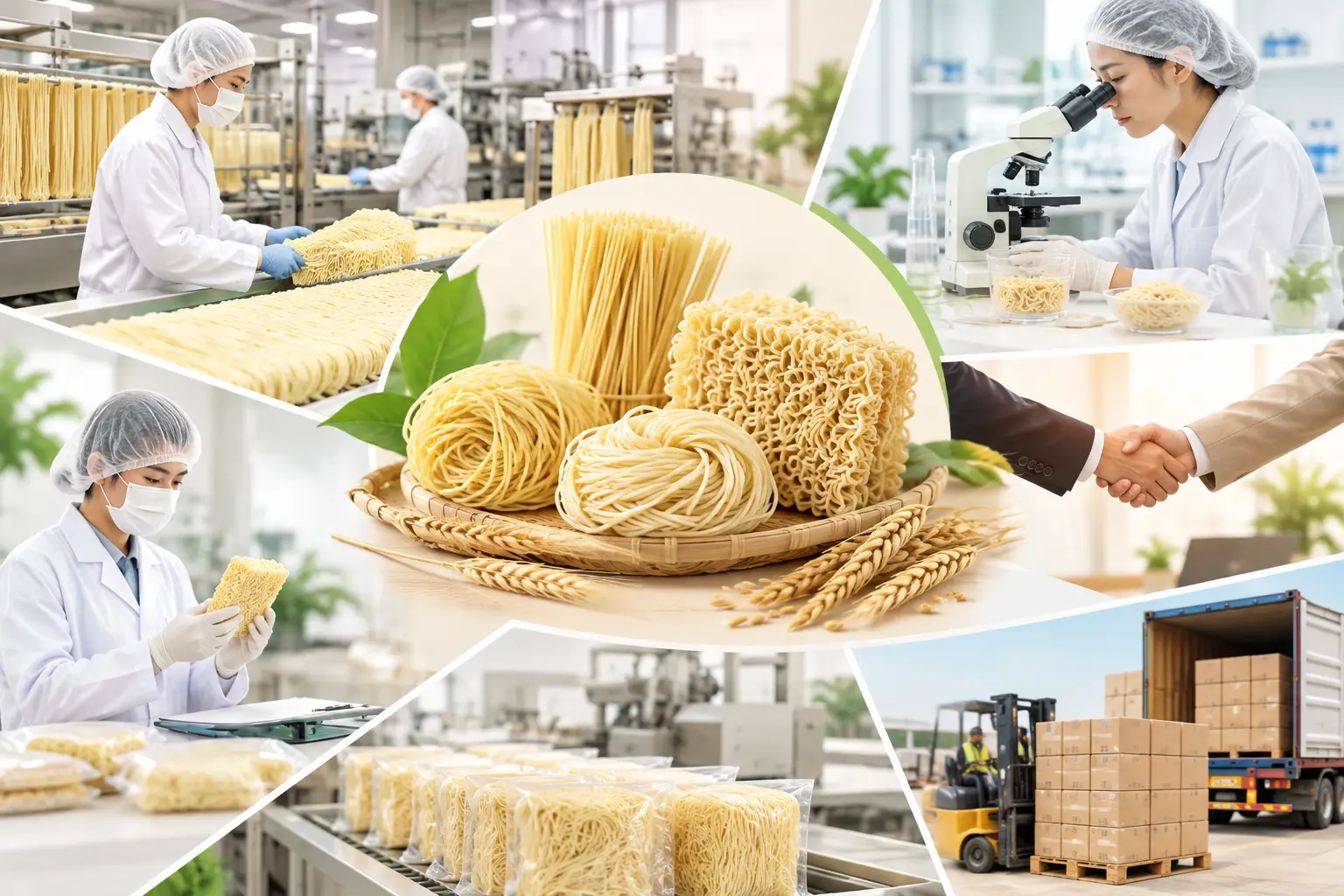
A noodle product can look simple on a product brief, but the commercial details are not. Texture must remain consistent from batch to batch. Packaging must protect the product through distribution. Ingredient choices, portion sizes, labeling requirements, and production capacity all need to support the market you plan to serve. That is why the 7 benefits of working with an OEM noodle supplier for your food business go beyond placing a manufacturing order. The right partner helps turn a product concept into a repeatable, market-ready line.
For brand owners, importers, distributors, foodservice operators, and food companies, OEM manufacturing can reduce operational pressure while creating more room to build a differentiated noodle range. The value depends on choosing a supplier with relevant product knowledge, documented quality systems, and a practical approach to customization.
1. Access to specialized noodle manufacturing knowledge
Noodle production is not a generic food manufacturing process. Flour selection, dough handling, sheeting, cutting, drying, frying, moisture control, and packing all influence the final eating experience and product performance. A manufacturer that specializes in dry Asian noodles understands how these variables work together.
This knowledge is especially useful when a business is developing a new private-label range or adapting an existing concept for a different market. For example, an air-dried noodle product may require a different approach to texture and cooking performance than a fried noodle format. Infant and toddler noodle concepts also call for careful consideration of shape, portioning, ingredients, and product positioning.
Rather than building this expertise internally from the ground up, businesses can work with a manufacturer that already understands the production realities behind the specification. That does not remove the need for a clear brief, but it gives the project a more informed starting point.
2. More consistent product quality at scale
Consistency is one of the most practical benefits of working with an OEM noodle supplier. Customers expect the same noodle texture, appearance, cooking behavior, and pack presentation each time they buy a product. Distributors and foodservice buyers also need confidence that repeat orders will perform as expected.
A capable OEM partner uses defined procedures and quality checks to control the factors that affect consistency. This may include incoming material controls, process monitoring, finished-product checks, traceability practices, and packaging inspections. These systems matter because a promising sample is not enough. The product must remain dependable across routine production runs.
For businesses selling across several channels or markets, this consistency protects brand credibility. It also helps reduce avoidable complications in purchasing, customer service, and inventory planning.
3. Product customization without owning a factory
A branded noodle product should not have to look identical to every other item on the shelf. OEM manufacturing gives businesses a practical route to develop products around their own market position without taking on the cost and complexity of operating a production facility.
Customization can apply to noodle type, thickness, texture, ingredients, portion format, seasoning compatibility, and packaging configuration. A foodservice customer may prioritize a noodle that performs reliably in a specific dish format. A retailer may need portion-controlled packs for a particular category. An importer may require packaging designed for its destination market and distribution model.
The trade-off is that not every idea is equally practical to manufacture. Changes in ingredients, shape, or pack format can affect processing, costs, and production planning. A dependable OEM supplier should be clear about these considerations early, helping customers pursue a concept that is both distinctive and commercially workable.
4. Stronger food safety and quality assurance support
For B2B buyers, food safety is a sourcing requirement, not a marketing extra. When products move through distribution networks, retail programs, or international trade channels, buyers need a manufacturer with systems that support controlled production and reliable documentation.
Working with an OEM noodle supplier that maintains recognized food safety and quality certifications can simplify supplier evaluation. At Tehki Food, manufacturing operations are supported by ISO 22000, HACCP, GMP, MeSTI, and Halal certifications. These frameworks help demonstrate a structured approach to hygiene, process control, and quality management.
Certifications do not replace a buyer's own due diligence, specifications, or market requirements. However, they provide an important foundation when assessing whether a manufacturer can support a professional private-label or contract-manufacturing program. They also give procurement and quality teams a clearer basis for technical discussions.
5. Better use of internal time and resources
Developing an in-house noodle manufacturing operation requires much more than equipment. A business must manage production staff, maintenance, ingredient sourcing, quality control, process development, packaging operations, and capacity planning. For many brands and distributors, these demands can pull attention away from the work that drives their growth.
An OEM arrangement allows internal teams to focus on customer acquisition, brand strategy, category development, sales execution, and distribution relationships. The manufacturer focuses on making the product to the agreed specification and managing the production processes behind it.
This division of responsibility is particularly useful for businesses entering a new category. Instead of committing major resources before demand is established, they can validate the product and build the market with an experienced manufacturing partner. The OEM model is not hands-off, though. The strongest results come when the customer provides clear commercial direction and the manufacturer provides transparent technical guidance.
6. A more practical path to scalable growth
A product launch is only the first stage. If demand grows, the manufacturer must be able to support repeat production while maintaining agreed product standards. This is where an established OEM supplier can provide meaningful commercial value.
A manufacturer with structured production capabilities can help customers plan product ranges that have room to grow. This is relevant for a distributor adding a private-label line, a retailer expanding a successful format, or a food company introducing noodles across multiple markets. The goal is not simply to produce more units. It is to scale without losing the characteristics that made the product successful.
Planning matters here. Forecasting, packaging availability, ingredient specifications, and product change control should be discussed before growth creates pressure. Businesses should also ask whether the manufacturer has experience with the type of noodle format and destination markets involved. Scalability works best when it is considered during product development, not after a product has gained traction.
7. Support for export-ready product development
For importers and internationally focused brands, a noodle product must suit more than its intended consumer. It must also be practical for cross-border sourcing, shipping, documentation, and market-specific packaging requirements. An OEM manufacturer with export experience can help identify these operational considerations earlier in the process.
Export readiness may influence pack language, labeling space, carton configuration, product protection, and the information required by a customer's quality or regulatory team. Requirements vary by market, so businesses should confirm their own obligations rather than assume a single format will work everywhere.
Malaysia-based manufacturers can be well positioned for businesses seeking Asian noodle expertise and export-oriented production. The key is to work with a partner that treats export preparation as part of product planning, rather than an afterthought once the product is already finalized.
Choosing an OEM partner for the right reasons
The benefits of an OEM noodle supplier are strongest when the relationship is built around more than price. A lower-cost quotation may not represent the best long-term value if product quality varies, technical communication is limited, or the supplier cannot support the required level of customization and documentation.
Before moving forward, buyers should assess the supplier's experience with the target noodle format, quality systems, ability to interpret a product brief, packaging capabilities, and approach to production consistency. It is also useful to discuss how product changes, approvals, and ongoing communication will be managed. These details shape the working relationship after the first production run.
A well-chosen OEM noodle supplier becomes part of the product development process, helping translate commercial goals into a product that can be manufactured responsibly and repeated with confidence. For businesses building a new house brand or expanding an established portfolio, that partnership can create a stronger foundation for the next product decision.