
A noodle product can look right in a sample meeting and still fail where it matters most - in repeat production, export documentation, or customer confidence. That is where the advantage of certified noodle manufacturers becomes clear. For B2B buyers, certification is not a badge for marketing. It is a practical signal that a manufacturer has structured systems behind product safety, quality control, and operational consistency.
When you are sourcing dry Asian noodles for private label, foodservice, or distribution, the real question is not just whether a factory can make noodles. It is whether that factory can keep making the same noodles, to the same standard, across batches, markets, and growth stages. Certification helps answer that question with more confidence.
Why certification matters in noodle manufacturing
In food manufacturing, small inconsistencies create large commercial problems. A slight variation in moisture, thickness, cooking performance, ingredients compatibility, or pack presentation may affect retail acceptance, foodservice execution, or import approval. For noodle buyers, that risk grows when production scales up.
Certified manufacturers are usually better positioned to manage this risk because certification requires documented processes, monitoring points, corrective actions, and regular review. In other words, the factory is not relying only on experience or informal checks. It is operating through systems that are designed to reduce avoidable variation.
That does not mean certification guarantees perfection. No manufacturing environment is completely free of challenges. But it does mean there is a stronger framework for prevention, traceability, and response. For a brand owner or importer, that difference matters.
The advantage of certified noodle manufacturers for B2B buyers
The advantage of certified noodle manufacturers is most visible when a buyer moves beyond a trial order and starts thinking about long-term supply. Certification supports business decisions in several ways.
First, it helps with supplier qualification. Procurement teams, category managers, and product developers often need evidence that a manufacturing partner follows recognized food safety and quality practices. Certifications such as ISO 22000, HACCP, GMP, MeSTI, and Halal can help streamline that evaluation because they provide a clearer view of how the manufacturer operates.
Second, certification supports consistency. For private-label noodles, consistency is part of brand value. If a customer expects the same texture, appearance, and cooking behavior each time, the manufacturer needs process discipline, not just technical know-how. Certified systems help create that discipline.
Third, certification can improve commercial readiness. Many distributors, retailers, and international buyers prefer or require suppliers that can demonstrate documented quality management and food safety controls. A certified manufacturer is often better prepared for these conversations, especially when export markets are involved.
Food safety is not a side issue
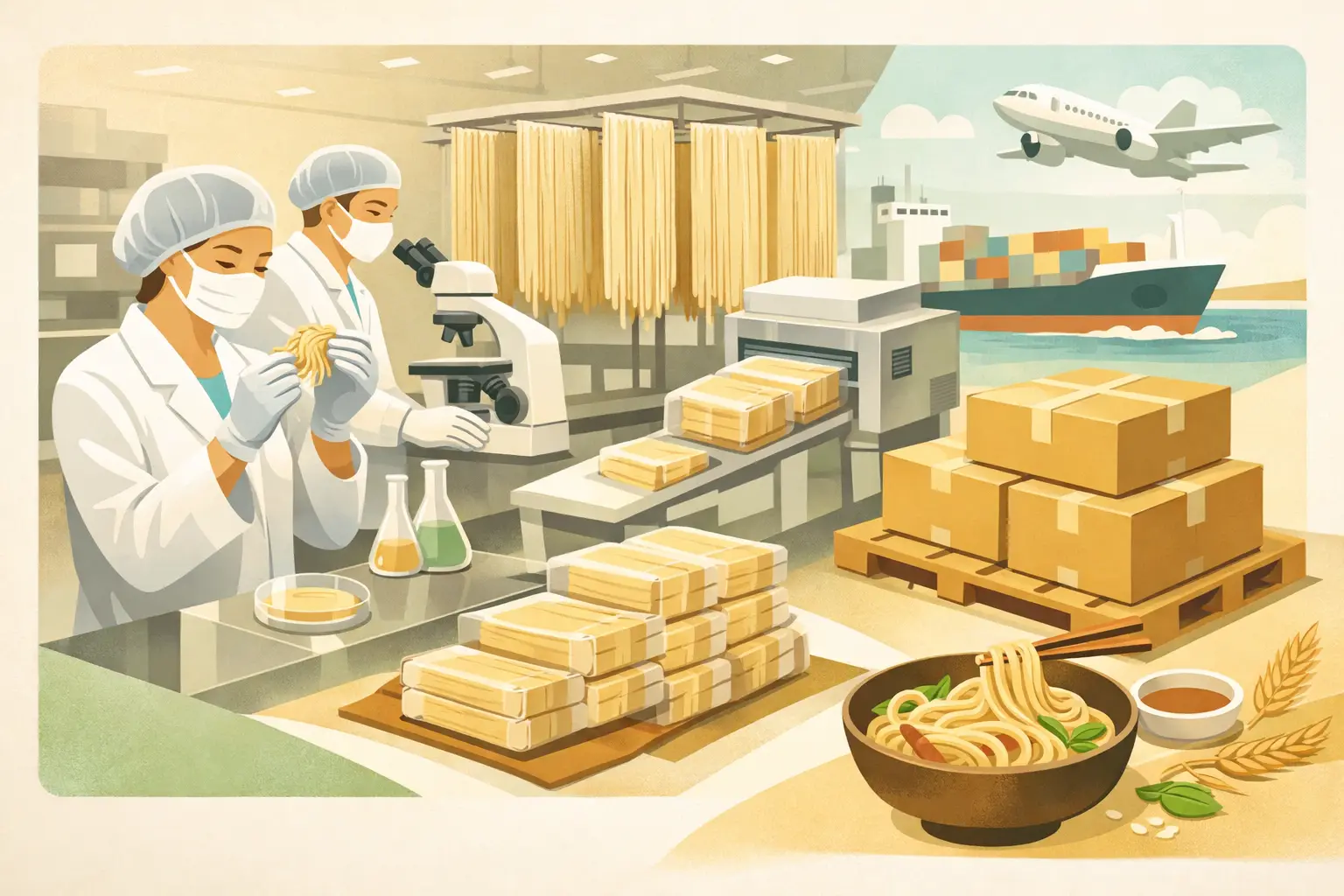
For noodles, food safety starts long before the final product is packed. It involves raw material control, handling practices, sanitation, equipment maintenance, storage conditions, and batch monitoring. In a certified facility, these areas are generally governed by procedures rather than left to individual judgment.
This matters because B2B buyers are not only buying a product. They are buying the risk profile attached to that product. If a manufacturer has weak controls, the buyer may inherit avoidable problems in retail, distribution, or foodservice channels.
A certified manufacturer typically has stronger traceability and clearer documentation. If an issue needs investigation, there is a process for identifying what happened, where it happened, and what corrective action followed. That level of control is especially relevant for importers and brand owners who must protect their own reputation in the market.
Certification and product consistency go together
Noodles are a category where consistency is easy to underestimate. A product may pass a basic visual check and still perform differently in cooking, plating, or shelf presentation. For foodservice operators, that may affect kitchen workflow and menu execution. For retailers, it may affect customer satisfaction and repeat purchase.
Certified manufacturers tend to manage these variables more systematically. They are more likely to define specifications clearly, monitor process points during production, and record deviations. This is particularly useful for OEM and ODM projects where product attributes are customized.
A buyer developing air-dried noodles, child-friendly formats, fried noodle or house-brand dry noodles needs more than a factory that says yes. The buyer needs a production partner that can translate a target specification into a repeatable output. Certification does not replace product development skill, but it supports it.
The export readiness factor
Export business adds another layer of complexity. Buyers may need a manufacturer that can support documentation, maintain stable standards, and align with the expectations of different markets. In that context, the advantage of certified noodle manufacturers is not only operational. It is also commercial.
Certification can make supplier discussions easier because it gives overseas buyers a more familiar reference point. It may also help reduce friction during onboarding, audits, and compliance reviews. This is especially useful for importers or distributors expanding an Asian noodle range and needing dependable supply from a manufacturing partner in Malaysia or elsewhere in the region.
Of course, certification alone is not enough for export success. Product fit, packaging format, market positioning, and logistics still matter. But without credible manufacturing systems, even a strong product concept can become difficult to scale internationally.
Better support for customization
Many noodle buyers are not looking for an off-the-shelf product. They want a format that suits their market, whether that means texture adjustment, ingredient preferences, pack size variation, or a cleaner-label direction. Customization creates opportunity, but it also creates more room for inconsistency if the factory lacks control.
Certified manufacturers often handle customization more effectively because process changes can be evaluated within a structured system. New formulations, revised specifications, or packaging adjustments are less likely to be treated casually. That is important for OEM and ODM projects where commercial success depends on getting details right.
This is one reason experienced manufacturers with recognized certifications are often stronger partners for product development. They can support flexibility without making the production environment unstable. For B2B buyers, that balance is valuable.
Not all certifications mean the same thing
Buyers should still look beyond the certificate itself. Different certifications cover different aspects of manufacturing, and the value depends on how seriously the factory applies those standards in daily operations. A certificate on paper is useful, but it should be supported by real manufacturing discipline.
That is why supplier evaluation should include practical questions. How does the manufacturer manage batch consistency? How are raw materials controlled? What happens when a process deviation occurs? How is allergen management handled, if relevant? How are customer specifications documented and reviewed?
Certification should be seen as part of the picture, not the whole picture. The strongest manufacturing partners combine formal systems with product knowledge, commercial awareness, and the ability to communicate clearly with buyers.
Choosing a certified noodle manufacturer with long-term value
For many buyers, the best supplier is not simply the one with the widest product list. It is the one that can support your business model with fewer surprises. That may mean steady quality for a retail brand, dependable formats for foodservice use, or scalable production for regional distribution.
A certified manufacturer is often better prepared to deliver that kind of long-term value because its systems are built for repeatability and accountability. That matters even more when the noodle category becomes part of your brand strategy rather than a short-term sourcing exercise.
Tehki Food’s approach reflects this manufacturing mindset. For B2B customers developing OEM, ODM, or private-label dry Asian noodles, the combination of certification, customization capability, and practical production control is what turns a factory relationship into a workable supply partnership.
The real benefit of choosing a certified noodle manufacturer is not just that the factory meets a standard today. It is that your business has a stronger foundation for consistent products, safer operations, and more confident growth tomorrow.