

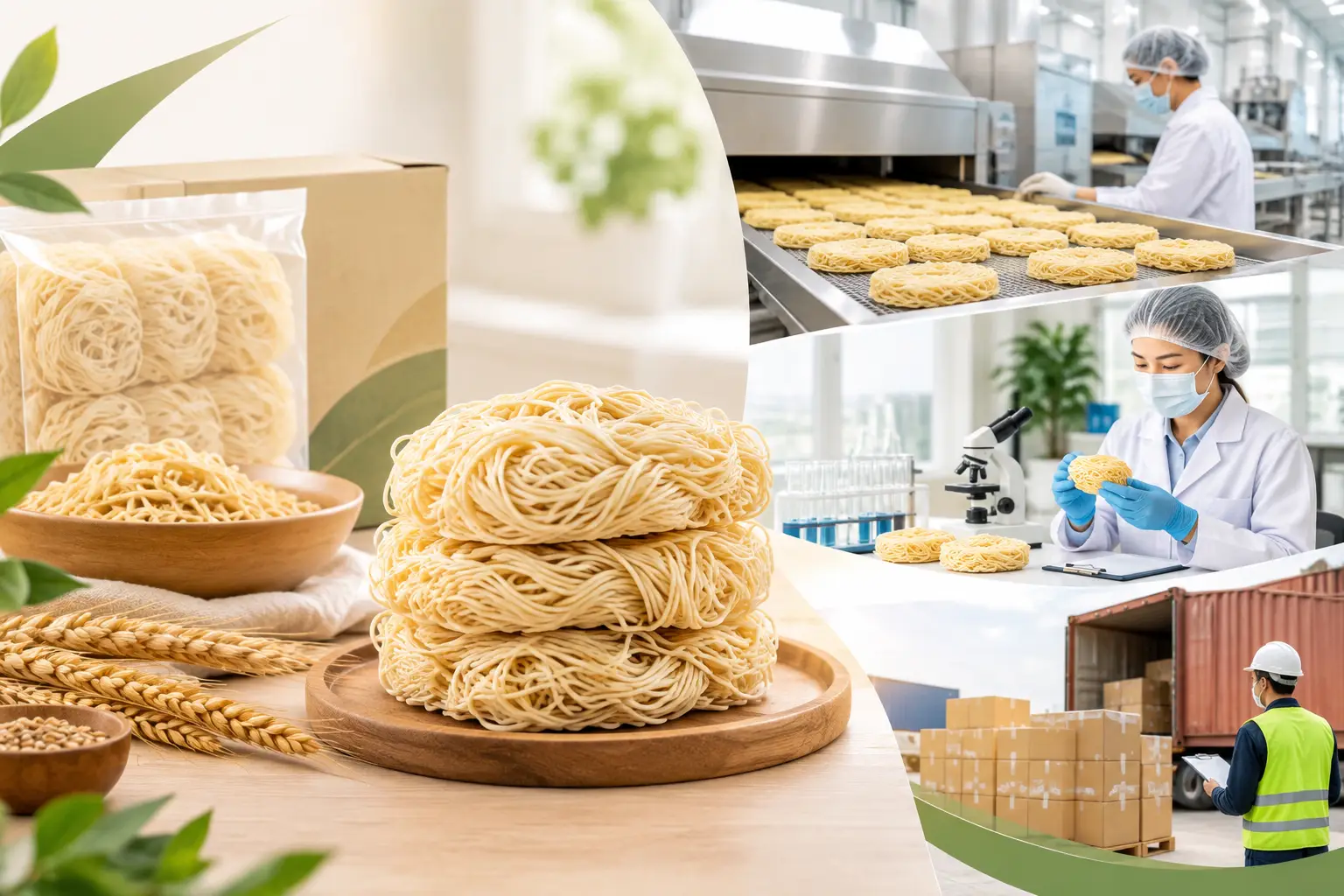
A noodle sample can look promising in a dry bundle yet disappoint once it reaches a customer’s bowl. For brand owners and procurement teams, an air dried noodle evaluation should go beyond appearance, ingredient claims, or a quick tasting session. It should confirm whether the product can deliver consistent eating quality, fit the intended market position, and remain practical to manufacture, pack, distribute, and prepare at scale.
Air-dried noodles are often selected for product ranges that seek a non-fried format, a cleaner ingredient direction, or a more premium noodle experience. However, air drying is a process choice, not a guarantee of quality. The flour blend, dough handling, noodle thickness, drying profile, and packing method all affect the final result. A structured evaluation helps buyers compare options on commercial value as well as sensory appeal.
What an Air Dried Noodle Evaluation Should Measure
The best evaluation starts with the product brief. A noodle intended for an instant cup has different performance requirements from a noodle block for retail packs, meal kits, or foodservice applications. Before reviewing samples, define the target serving format, preparation method, expected cooking time, intended price position, target distribution markets, and preferred ingredient direction.
This gives the evaluation a clear purpose. Without it, teams can overvalue a sample that tastes good in one test but does not suit the final product concept. For example, a noodle with a firmer bite may work well in a soup-based retail product but may be less suitable for younger children or a format designed for quick rehydration.
A practical assessment usually covers five connected areas: dry noodle condition, cooking and rehydration performance, texture and flavor, formulation suitability, and manufacturing reliability. Each area matters because a private-label product is judged by repeatability, not only by the quality of one development sample.
Start With the Dry Noodle Condition
Before cooking, inspect the noodle block or portion as it will be received by the customer. Look for uniform color, consistent strand thickness, clean cutting, and a stable shape. Excessive breakage, loose fragments, uneven nests, or visible surface defects may indicate issues in dough processing, cutting, handling, or drying control.
The product should also be evaluated against its chosen packaging format. A delicate thin noodle may perform well in a controlled kitchen test but create avoidable breakage during distribution if the pack does not provide adequate protection. Conversely, a denser block may require stronger packaging but offer better handling stability for export-oriented channels.
Moisture management is another practical consideration. Air-dried noodles need controlled drying to achieve a stable final product while protecting texture and appearance. Buyers do not need to assess every factory parameter themselves, but they should ask how moisture is monitored, how drying consistency is verified, and how the manufacturer manages variation between production batches.
Test Cooking Performance in Real Conditions
Cooking performance is where many product differences become clear. The evaluation should follow the intended consumer or foodservice preparation instructions, not only the manufacturer’s preferred method. Test the noodle in the format it will actually be sold: soup cup, bowl, packet, restaurant-style serving, or meal component.
Observe how quickly the noodle hydrates and whether the noodle mass separates evenly. Some products need a short rest after hot water is added, while others benefit from boiling. Neither approach is inherently better. The right choice depends on the intended convenience level and the market’s expectations.
During testing, record whether strands remain intact, whether the center hydrates evenly, and whether the noodle creates excessive cloudiness in the cooking water or broth. Evaluate the noodle immediately after preparation and again after several minutes. This holding test matters for retail and foodservice products because customers may not eat the product the moment it is prepared.
A useful internal scorecard can include preparation time, hydration uniformity, strand separation, firmness, elasticity, surface smoothness, broth interaction, and texture after holding. When comparing multiple samples, using the same water quantity, temperature, timing, and serving conditions prevents subjective results from dominating the decision.
Texture Must Match the Product Positioning
Texture is not a single standard. Some Asian noodle formats are expected to be springy and chewy, while others should be soft, smooth, or easy to bite. The key question is whether the texture fits the stated product concept and remains consistent after normal preparation.
For a premium retail range, the target may be a noodle with defined bite and a clean wheat character. For child-friendly noodles, a shorter strand length, gentler texture, and easy preparation may be more relevant. For foodservice, the priority may be resistance to softening during holding or delivery. Product developers should avoid describing one texture as universally superior when the end use calls for something different.
Review Formulation With a Commercial Lens
An air-dried noodle evaluation should examine the ingredient list alongside eating performance. Flour type, starch selection, salt level, egg content where applicable, vegetable ingredients, and processing aids can all influence color, bite, rehydration, and cost structure. A shorter ingredient list may support a clean-label direction, but it must still produce the desired cooking results and be suitable for the intended supply chain.
This is where OEM and ODM capability becomes valuable. A manufacturer should be able to explain which changes are realistic and what trade-offs may follow. Reducing or removing an ingredient can affect dough strength. Altering noodle thickness can change both rehydration time and texture. Adding vegetable powders may affect color consistency and flavor balance. Small formulation decisions often have larger operational effects than expected.
Buyers should also confirm that the noodle format supports the planned seasoning and toppings. A richly flavored soup base may require a noodle that retains structure in hot broth. A dry seasoning format may need a noodle surface that carries sauce or oil evenly. Evaluating noodles separately from the total meal concept can lead to a product that feels unbalanced at launch.
Assess Manufacturing Consistency, Not Just the Sample
A strong sample is only the beginning. For private-label and export programs, the more important question is whether the producer can recreate the agreed noodle specification consistently. Ask how product specifications are documented, how batches are checked, and how deviations are managed before products leave the factory.
Quality systems provide useful assurance when they are supported by disciplined daily operations. Tehki Food operates with ISO 22000, HACCP, GMP, MeSTI, and Halal certifications, reflecting the structured approach B2B buyers should expect from a manufacturing partner. Certifications do not replace product testing, but they help establish confidence that food safety, traceability, hygiene, and process control are built into production planning.
It is also worth reviewing how the manufacturer handles customization. A capable partner should discuss noodle width, shape, portion size, texture target, ingredient preferences, block or nest format, and packaging requirements in relation to production feasibility. The goal is not unlimited choice. It is a product design that can be made reliably and commercially.
Consider Packaging and Distribution Early
Packaging decisions should be tested alongside the noodle, not after formulation approval. The pack must protect the noodle from breakage, fit the chosen portion format, present the brand clearly, and work with the planned distribution channel. For importers and distributors, carton configuration and handling resilience are as relevant as the product inside.
Export-ready planning also requires attention to labeling needs, market-specific pack preferences, and product documentation. These requirements vary by destination and should be discussed early with the manufacturer and the buyer’s compliance team. A well-designed noodle can still face delays if packaging development and market preparation are treated as separate projects.
Build a Clear Approval Process
The most effective evaluation process uses agreed criteria before final approval. Product teams can assign weighted scores to sensory quality, preparation performance, appearance, formulation fit, packaging suitability, and manufacturing confidence. This creates a clear record of why one option was selected and makes later reformulation discussions more efficient.
Where possible, include people who represent the final business use. A buyer may focus on portfolio fit and consistency, a chef may focus on cooking behavior, a quality manager may focus on specifications, and a distributor may identify packaging concerns. Their perspectives should be aligned, but they should not be treated as identical.
The right air-dried noodle is not simply the one with the lowest cost or the strongest first impression. It is the one that performs predictably in its intended format, supports the brand promise, and can be produced with dependable quality controls. A careful evaluation gives a private-label program a more stable foundation and creates better conversations with the manufacturing partner before the product reaches the market.