

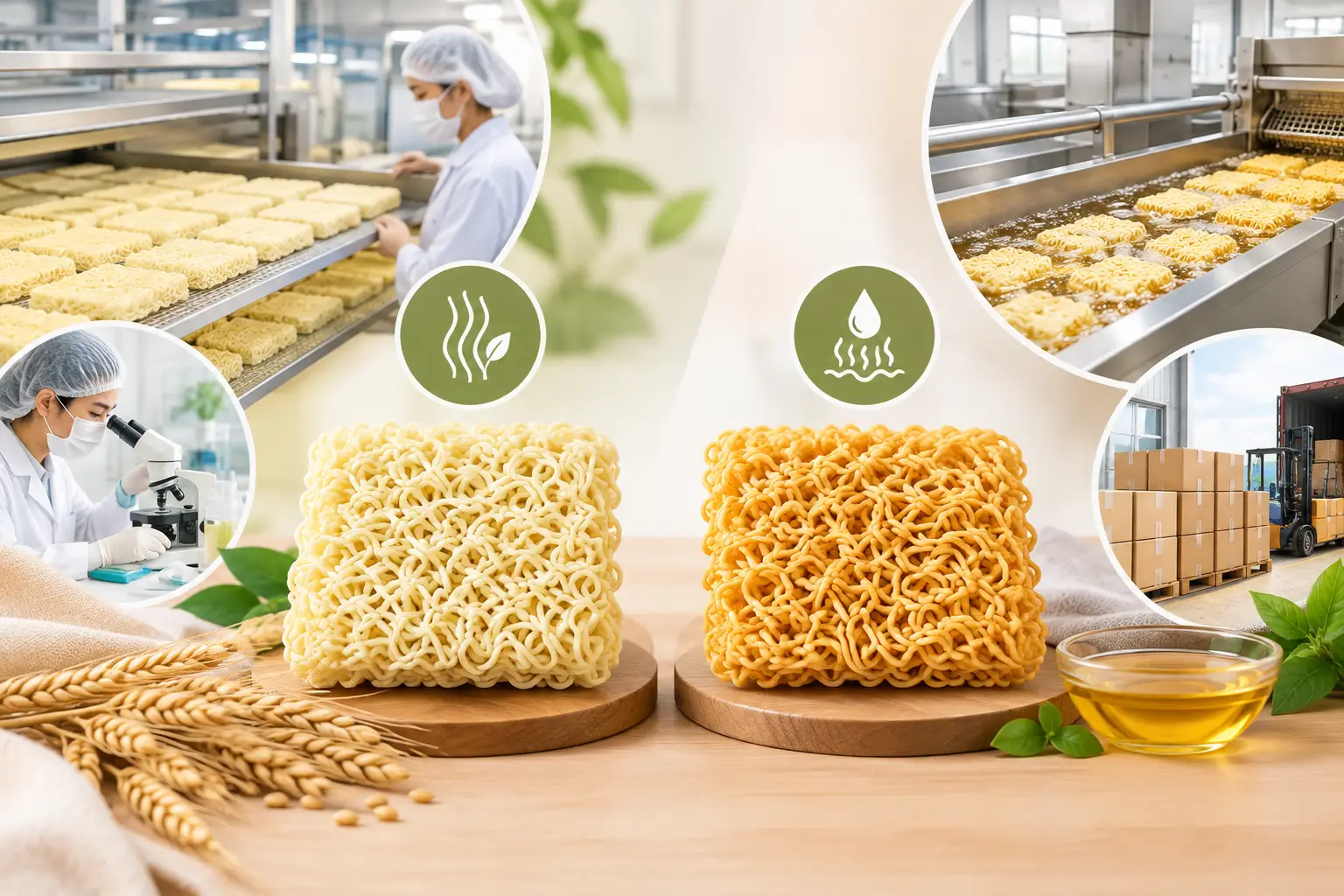
A noodle block can look simple on a retail shelf, yet its drying method affects far more than preparation time. For a brand owner, air-dried instant noodles vs fried instant noodles: what's the difference is a product-development question with implications for ingredient positioning, eating quality, packaging, production planning, and target-market fit. Neither format is automatically the right choice. The stronger decision is the one that aligns with the product brief and the customers it is meant to serve.
Air-Dried Instant Noodles vs Fried Instant Noodles: The Core Difference
The difference begins after the noodles are mixed, sheeted or extruded, cut, and formed into their final shape. Fried instant noodles are typically dehydrated by passing noodle blocks through hot oil. This rapidly removes moisture and creates the porous structure that helps the noodles rehydrate quickly in hot water.
Air-dried noodles use controlled hot-air drying rather than an oil-frying step. The manufacturer manages time, temperature, airflow, and humidity to reduce moisture while protecting the desired noodle structure. Depending on the formulation and noodle style, the process may take longer and requires close control to achieve consistent texture and cooking performance.
Both methods are established ways to make shelf-stable dry noodles. The meaningful distinction is not simply fried versus non-fried. It is how the drying method influences the finished product's appearance, texture, ingredient story, operational requirements, and commercial position.
How Frying Shapes the Finished Noodle
Frying is valued for efficiency and familiar instant-noodle performance. As moisture leaves the noodle during frying, small internal spaces form in the noodle strand. These spaces allow water to enter rapidly during preparation, which can support a short cooking or soaking time.
The process also contributes a distinctive aroma, color, and richer mouthfeel. For many classic instant noodle applications, this is part of the expected eating experience. Consumers in established noodle categories may associate the springy, tender texture and quick rehydration of fried noodles with the products they already know.
For B2B buyers, fried noodles can be a practical choice when speed of preparation, a traditional instant noodle profile, and established category expectations are central to the brief. They can suit retail cup or packet concepts, value-oriented ranges, and foodservice formats where quick preparation matters.
The trade-off is that oil is part of the manufacturing process and becomes part of the finished noodle's product profile. Brands that want to make product claims or communicate nutrition-related information should base all statements on the final approved formulation, verified nutrition analysis, and the requirements of the intended market. Drying method alone should not be treated as a complete nutrition claim.
What Air Drying Changes
Air drying removes moisture without immersing the noodle in frying oil. This makes it relevant to brands developing noodle lines with a non-fried processing story or a more ingredient-conscious market position. It can be especially useful for premium retail concepts, clean-label-oriented product development, and child-focused noodle formats where the overall formulation needs careful attention.
Texture is not identical to fried instant noodles. Air-dried noodles can deliver a firmer, more wheat-forward bite, though the exact result depends on flour selection, starch balance, dough hydration, strand thickness, steaming conditions, and drying controls. A thin noodle designed for a soup cup will behave differently from a thicker noodle intended for a bowl format.
Preparation time may also differ. Because air-dried noodles do not have the same fried porous structure, they may require a longer soak or cook time than a comparable fried block. That is not necessarily a disadvantage. For some products, a slightly longer preparation window supports a more substantial noodle experience. For convenience-led formats, however, the target time needs to be built into development from the beginning.
Air drying requires disciplined process management. If drying is uneven, noodles may show inconsistent texture, breakage, poor rehydration, or variation from batch to batch. A capable manufacturer must manage the relationship between recipe, noodle geometry, drying conditions, and packaging so the product performs consistently through distribution and consumer preparation.
Comparing the Formats for Private-Label Development
When comparing air-dried and fried noodles, buyers should look beyond a single attribute. The following considerations usually determine which format is commercially suitable.
Product positioning and target channel
Fried noodles fit naturally into familiar, highly convenient instant noodle categories. Their recognizable sensory profile can be useful for mainstream retail, promotional packs, and high-volume formats. Air-dried noodles may provide stronger differentiation where a buyer wants to communicate a non-fried process, build a more premium range, or develop a product with a carefully considered ingredient message.
Channel matters as well. A foodservice operator may prioritize speed, holding performance, and broth compatibility. A retail brand may place greater emphasis on front-of-pack positioning, portion format, and product differentiation. Importers and distributors may need a format that meets the expectations of a particular regional noodle category. The best noodle is the one that fits the route to market, not merely the one with the most attractive processing description.
Texture, flavor delivery, and serving format
Noodles need to work with the complete eating experience. Fried noodle blocks often contribute a familiar richness and rapidly absorb hot water. Air-dried noodles can offer a cleaner base for the noodle flavor and may hold up differently in broth, sauce, or stir-fry applications.
Seasoning is equally important. A bold soup powder, oil sachet, or sauce can change how consumers perceive noodle texture and body. Product development should evaluate the finished prepared meal, not the dry noodle in isolation. Testing should include the intended water volume, preparation method, bowl or cup format, and realistic serving conditions.
Formulation flexibility
The drying method should be selected alongside the recipe, not after it. Whole-grain ingredients, vegetable powders, alternative flours, reduced-sodium seasoning concepts, and child-friendly portion sizes can all affect dough handling and final texture. Some formulations may need additional development work to maintain noodle integrity and reliable rehydration.
For OEM and ODM projects, early alignment prevents avoidable revisions. Buyers should clearly define the desired noodle type, strand width, texture target, preparation instructions, flavor system, portion size, packaging format, and destination market. A manufacturer can then assess whether air drying or frying is more appropriate for the product's intended performance.
Manufacturing consistency and quality assurance
Both formats depend on controlled production. Fried noodles require management of frying conditions, oil quality, moisture reduction, and block integrity. Air-dried noodles require precise drying profiles, moisture control, and careful handling to limit cracking or breakage.
The buyer's role is to select a manufacturing partner with documented quality systems and a clear approach to specification control. This includes raw-material management, in-process checks, finished-product evaluation, packaging controls, and traceability practices. For export-oriented programs, consistent documentation and product specifications are just as important as the noodle itself.
Questions to Settle Before Selecting a Format
A productive supplier discussion starts with commercial and technical priorities. Is the product being designed around the fastest possible preparation, a non-fried positioning angle, a traditional fried noodle experience, or a specific texture? Will it be packed in a cup, bowl, bag, or multipack? Is it intended for soup, dry seasoning, stir-fry, or foodservice preparation?
Buyers should also define what cannot be compromised. This may be a desired bite, a portion-weight range, a targeted ingredient approach, or a packaging requirement for a distribution market. When these priorities are clear, a manufacturer can develop samples and validate the right balance between appearance, texture, preparation performance, and production practicality.
Tehki Food supports this type of product evaluation through OEM and ODM dry noodle manufacturing, including air-dried and fried noodle formats. Its food safety and quality systems, including ISO 22000, HACCP, GMP, MeSTI, and Halal certification, help provide the structured manufacturing foundation business buyers need when building private-label and export-ready noodle programs.
The Better Choice Depends on the Product Brief
Air-dried noodles are not a universal replacement for fried noodles, and fried noodles are not inherently a lesser option. Fried formats remain effective where quick preparation, familiar texture, and classic instant noodle appeal are priorities. Air-dried formats can be a strong fit where a non-fried process, differentiated positioning, or a particular texture direction supports the brand strategy.
The most useful next step is to turn the desired market position into a clear product brief. Specify the consumer experience, serving format, ingredient direction, and quality expectations first. From there, the drying method becomes a practical manufacturing decision that supports a noodle product built for its intended market.