
A noodle line that performs well at 5,000 packs can struggle at 500,000. Texture starts to drift, portion weights vary, and minor process differences turn into real commercial issues once products move across distributors, retailers, or export markets. That is why automated noodle production benefits matter to business buyers - not as a factory talking point, but as a practical factor in product quality, supply stability, and brand protection.
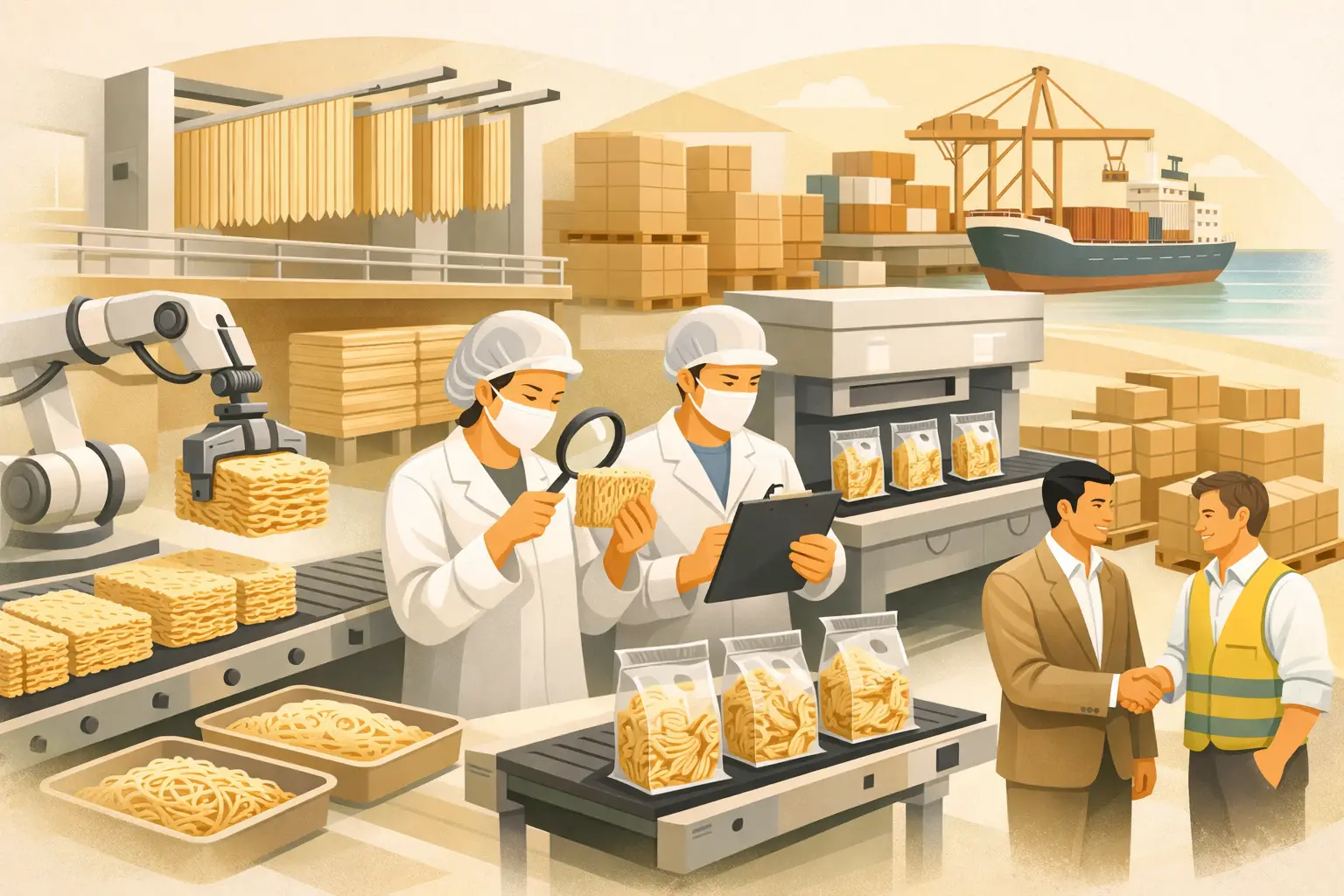
For brand owners, importers, and foodservice buyers, automation is not simply about replacing labor. In noodle manufacturing, it is about controlling critical variables across mixing, sheeting, steaming, cutting, frying or drying, portioning, and packing. The result is a production system that is better suited to repeatable quality at scale, especially for OEM, ODM, and private-label programs where consistency is part of the product promise.
Why automated noodle production benefits matter in B2B supply
In consumer markets, small product differences may go unnoticed once or twice. In B2B supply, repeated inconsistency quickly becomes a procurement problem. If noodle thickness changes, cooking performance can shift. If portion sizes vary, cost control becomes harder for foodservice operators and packers.
Automation helps reduce that variability by standardizing the production process. Equipment settings, line speed, temperature control, drying conditions, and cutting accuracy can be monitored and adjusted with more precision than a heavily manual process. That does not eliminate the need for operator oversight. It does mean the process depends less on individual handling differences and more on defined manufacturing parameters.
For buyers managing multiple SKUs or supplying several markets, that matters. Stable output supports stronger forecasting, fewer quality disputes, and more confidence when expanding a product line.
Better consistency across batches
Consistency is usually the first operational advantage buyers notice. In noodle manufacturing, even small differences in dough development or drying conditions can affect bite, elasticity, breakage rate, appearance, and cooking behavior. Manual intervention has its place, especially for specialty products, but it also introduces more room for variation between shifts and batches.
With automation, key production stages can be controlled more closely. Dough mixing can follow repeatable timing and ratios. Sheeting and cutting can maintain more uniform thickness and width. Drying cycles can be managed within tighter process ranges. Packaging systems can improve portion accuracy and presentation.
This is especially useful for private-label and export-oriented noodles, where repeat purchase depends on customers getting the same product each time. A distributor does not want one shipment with a firm texture and the next with a softer bite. A foodservice buyer does not want noodles that perform differently across outlets. Automation supports the kind of repeatability that commercial accounts expect.
Product consistency also supports brand positioning
If a noodle product is marketed around a specific format, texture profile, ingredient approach, or target segment, the manufacturing process needs to deliver that profile reliably. This is true for air-dried noodles, child-friendly formats, and customized house-brand lines alike. Automation makes it easier to protect the intended specification over time.
Higher production capacity without sacrificing control
Growth creates pressure on manufacturing systems. A product that succeeds in one market may need to scale quickly into new channels, new pack sizes, or new geographies. Without sufficient automation, scaling can increase the risk of inconsistency, production bottlenecks, and waste.
One of the most practical automated noodle production benefits is the ability to increase throughput while maintaining process discipline. Automated lines can handle repetitive, high-volume steps more efficiently, allowing manufacturers to produce larger volumes with a more stable workflow. This supports not just bigger orders, but better planning for ongoing replenishment.
That said, capacity should not be viewed in isolation. More output only creates value if the manufacturer can still maintain specification, packaging quality, and food safety controls. For serious B2B buyers, the right question is not whether a factory is automated. It is whether automation is integrated into a controlled production environment that supports dependable scaling.
Stronger food safety and quality control
Food safety is never only about certificates on paper. It depends on how a facility manages process control, material handling, hygiene, and traceability in day-to-day operations. Automation can contribute meaningfully here by reducing unnecessary manual contact and creating a more controlled production flow.
When ingredients move through standardized process stages and finished products are portioned and packed through calibrated systems, there are fewer opportunities for avoidable variation. Automated packing and handling can also help maintain presentation quality and reduce damage during processing.
This does not mean automation replaces a proper quality system. It works best when combined with documented procedures, equipment maintenance, trained personnel, and certification-based food safety management. For buyers evaluating OEM or ODM partners, that combination is often more important than any single production feature.
Traceability becomes easier to manage
Automated environments often support better production records, process monitoring, and batch documentation. For importers and brand owners, that can simplify internal quality reviews and customer assurance requirements. It is particularly relevant in export supply, where documentation discipline and production consistency tend to carry more weight.
Better cost control over time
Automation is often discussed as a cost-saving tool, but the real commercial value is more specific. It can help control the hidden costs that build up in manufacturing - product giveaway from inaccurate portioning, waste from breakage, rework from off-spec batches, and inefficiency from uneven line performance.
In noodles, margin is shaped not only by raw material cost but also by process stability. If a line produces too much variance, the business pays for it somewhere, whether through waste, complaints, or weaker output planning. Automation helps reduce some of those losses by making production more repeatable.
Of course, automation also requires investment, maintenance, and technical oversight. It is not automatically the lowest-cost option in every scenario. For highly customized, short-run, or experimental products, some manual flexibility may still be useful. But for businesses building repeatable SKUs at meaningful volume, automation often supports better cost discipline over the life of the product.
More reliable customization for OEM and ODM projects
Many buyers assume automation limits flexibility. In practice, it depends on how the production system is set up and how experienced the manufacturer is in product development. A capable noodle manufacturer can use automated processes to support customization while still keeping production controlled.
That matters in OEM and ODM work, where customers may need different noodle widths, textures, ingredients, portion sizes, noodle block formats, or packaging configurations. Customization is commercially attractive, but it only works if the factory can reproduce the agreed specification consistently after approval.
Automation helps bridge that gap. Once the product parameters are validated, the line can run closer to the intended standard across future batches. This is where manufacturing experience is critical. The technology supports consistency, but the manufacturer still needs to understand dough behavior, drying sensitivity, process adjustments, and how formula changes affect output.
For businesses developing private-label dried noodles, a partner that combines automated production with technical noodle knowledge is usually in a stronger position than one offering flexibility without process discipline.
Export readiness improves when systems are stable
For international trade, manufacturing reliability affects more than the product itself. Buyers also look for confidence in documentation, lot control, packaging consistency, and the ability to support repeat orders across markets. Automated production can strengthen export readiness by making output more predictable and reducing avoidable variation.
This is useful for importers balancing freight planning, market launches, and retailer expectations. If every batch behaves differently, downstream planning becomes harder. A stable process supports smoother coordination between manufacturing and commercial teams.
For a Malaysia-based OEM and ODM manufacturer serving regional and international customers, automation can also support the disciplined production environment that export buyers tend to expect, especially when combined with recognized food safety and quality systems.
What buyers should ask before choosing an automated noodle manufacturer
Automation is a positive sign, but it should not be treated as proof of capability on its own. Buyers should look at how automation connects to product development, quality control, and long-term supply performance.
A useful discussion usually covers how the manufacturer manages specification consistency, what level of customization is realistic, how quality is monitored across batches, and whether the production setup suits the intended product category. Air-dried noodles, fried noodles, infant and toddler noodles, and standard retail noodle formats may each require different process attention.
It is also worth asking how the manufacturer handles scale-up from sample approval to commercial production. Some factories develop good samples but struggle to hold the same quality at volume. The operational value of automation is proven at this stage, when a validated product has to be reproduced reliably under real commercial demand.
Tehki Food approaches this with a manufacturing-first mindset: combining noodle process knowledge, certification-backed quality systems, and practical customization support for B2B customers building scalable noodle products.
The best manufacturing partnerships are built on repeatability. When automation is used well, it helps buyers protect product quality, manage growth more confidently, and build noodle lines that are easier to supply across channels and markets.