
When a noodle product scales from trial batches to full commercial production, small inefficiencies stop being small. A few extra minutes in mixing, uneven cutting, inconsistent drying, or manual packing checks can affect output, labor allocation, and product consistency across every production run. That is why automation to increase efficiency in noodle manufacturing has become a practical business priority, especially for brand owners and food companies that need dependable volume, repeatable quality, and export-ready production.
For B2B buyers, efficiency is not only about producing more units per hour. It is about building a process that controls variation, supports food safety, reduces avoidable waste, and gives procurement and product teams more confidence in every batch. In noodle manufacturing, automation works best when it supports process discipline rather than replacing manufacturing expertise.
Where automation creates the most value
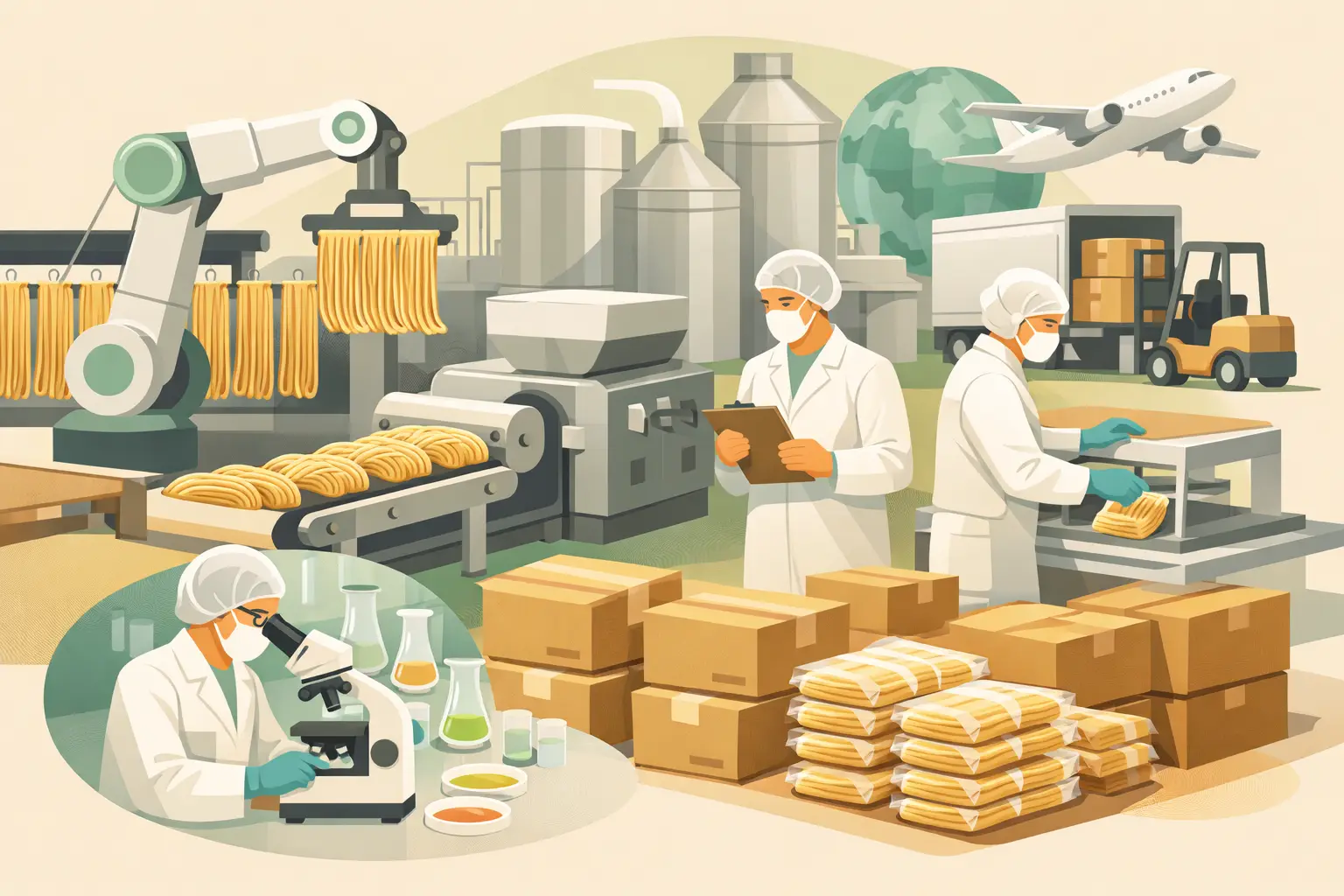
In noodle production, the largest efficiency gains usually come from standardizing repeated tasks and tightening control points between one stage and the next. Mixing, sheeting, cutting, steaming or frying, drying, portioning, and packing all depend on timing and uniformity. When those steps rely too heavily on manual adjustment, batch-to-batch variation becomes harder to manage.
Automation helps by keeping key process settings stable. Dough mixing can be controlled for time, speed, and ingredient dosing. Sheeting and cutting can be calibrated to maintain more consistent thickness and strand definition. Drying systems can be monitored more closely for temperature and airflow. Packaging lines can count, weigh, and seal with less variation than a fully manual setup.
That does not mean every process should be fully automated. In many noodle formats, especially customized OEM or ODM products, some level of operator oversight remains essential. Different flour characteristics, dough behavior, noodle width, texture targets, and packaging requirements still require manufacturing judgement. The real advantage comes from combining machine precision with experienced process control.
Automation to increase efficiency in noodle manufacturing starts with consistency
Many businesses first think about automation as a labor-saving decision. Labor efficiency matters, but in noodle manufacturing, consistency is often the stronger reason to invest. If noodle strands vary in thickness, if drying is uneven, or if portion weights fluctuate, the result is not only internal waste. It can also affect customer acceptance, packing performance, and product specification compliance.
For private-label and export-oriented products, consistency carries commercial value. Buyers want confidence that one shipment matches the last and that scaled production still reflects the agreed product profile. Automated controls help reduce avoidable variation by keeping critical settings within a narrower operating range.
This is especially relevant for manufacturers handling multiple product types, such as air-dried noodles, fried noodles, and child-focused formats with specific portion or texture requirements. The more diverse the product range, the more important repeatable line settings and process monitoring become. Automation supports that repeatability, but only when the line is designed around the product, not the other way around.
Better line efficiency does not mean chasing maximum speed
One common mistake is to treat automation as a way to run every line faster. In practice, faster is not always more efficient. If line speed increases but causes more breakage, poor drying balance, sealing defects, or higher rework, the apparent gain disappears.
A better approach is to evaluate total line efficiency. That means looking at throughput together with yield, downtime, changeover time, labor deployment, and quality hold rates. In some cases, a slightly slower but more stable process delivers better commercial results than pushing maximum output.
For noodle manufacturing, this matters because product behavior changes across formats. A line configured for standard dry noodles may not respond the same way when running thinner strands, smaller portions, or formulations with different functional ingredients. Automation should support process stability across these variations, not force every product through a single operating pattern.
Key areas where automation supports practical manufacturing goals
Ingredient handling and dosing
Accurate dosing is one of the simplest ways to improve process reliability. Automated ingredient handling reduces manual weighing variation and helps maintain tighter formulation control. That matters for texture consistency, dough handling, and traceability.
In a B2B environment, where customers may request customized formulations or specific ingredient positioning, dosing accuracy also supports product development discipline. It becomes easier to reproduce approved samples at commercial scale when ingredient addition is controlled more precisely.
Dough mixing and sheet formation
Dough development affects nearly every downstream stage. If hydration and mixing are uneven, manufacturers may see issues later in sheeting, strand formation, drying, or cooking performance. Automated control of mixing cycles and line parameters helps create a more repeatable dough structure.
This is important not only for standard output but also for reducing operator-to-operator variation across shifts. Skilled operators remain essential, yet automated settings provide a stronger baseline for consistency.
Drying and thermal processing
In dry noodle manufacturing, drying is one of the most sensitive stages. Uneven moisture removal can affect texture, appearance, breakage rates, and packing performance. Automated drying controls allow closer management of time, temperature, and airflow across the production cycle.
The benefit is not simply technical. Better control can reduce wasted product, improve line planning, and support more dependable finished-goods quality. For manufacturers serving international customers, tighter process control also strengthens confidence in shipment consistency.
Portioning, weighing, and packaging
Packaging automation often has immediate operational impact because it affects line speed, labor use, presentation consistency, and final inspection. Automated weighing reduce variation in pack weights. Sealing systems and inspection steps can also help reduce packaging errors before goods move into cartons.
For private-label buyers, packaging consistency matters almost as much as product consistency. A well-made noodle product can still create problems if pack appearance, coding, or count accuracy is unreliable.
Automation and food safety work together
In food manufacturing, efficiency cannot be separated from control. A line that runs quickly but creates gaps in monitoring, traceability, or hygiene management is not truly efficient. Automation can support stronger control by recording process data, reducing unnecessary manual contact points, and making deviations more visible.
That is one reason manufacturers with structured quality systems often gain more from automation than those treating it only as a machinery upgrade. When process controls, SOPs, verification routines, and staff training are already in place, automated systems become more useful and more reliable.
For buyers assessing an OEM or ODM noodle partner, this is worth paying attention to. The question is not only whether a factory has automated equipment. It is whether automation is integrated into a disciplined manufacturing system that supports quality and compliance expectations.
The trade-offs buyers should understand
Automation brings clear benefits, but it is not a universal fix. High automation can improve output consistency, yet it may reduce flexibility if equipment is not suitable for varied noodle formats or smaller customized runs. Changeovers can also become more complex if the line was designed around narrow product specifications.
There is also a practical investment issue. Not every stage needs the same level of automation, and not every operation will deliver equal return. In some factories, upgrading drying control or packaging automation may create stronger gains than automating every upstream task. The best decisions usually come from identifying where variation, downtime, or labor intensity is creating the biggest bottleneck.
For customers, this means the most capable manufacturing partner is not necessarily the one with the most machinery. It is the one that understands where automation improves quality, where manual expertise still matters, and how to balance both for commercial production.
Automation to increase efficiency in noodle manufacturing for OEM and ODM projects
OEM and ODM manufacturing adds another layer to the discussion because efficiency must coexist with customization. A manufacturer may need to produce different noodle widths, textures, pack sizes, ingredient profiles, or market-specific formats while still maintaining reliable output.
That is where thoughtful automation matters most. A well-managed production environment can standardize repeatable processes while leaving room to adjust specifications for different customer briefs. For businesses developing house-brand noodles or export-ready products, this balance is valuable. It supports scale without treating every product as identical.
Tehki Food operates in this space, where manufacturing efficiency has to work alongside practical customization, food safety control, and product consistency. For B2B buyers, that combination is often more useful than speed alone.
The strongest manufacturing partnerships are built on predictability. Buyers need to know that a supplier can translate product requirements into stable production, maintain quality across repeat orders, and support growth without unnecessary disruption. Automation plays a central role in that process, but only when it is applied with discipline, process knowledge, and a clear understanding of the product being made.
For any company sourcing dry Asian noodles, the better question is not whether a factory uses automation. It is whether that automation helps deliver the consistency, control, and manufacturing reliability your brand will need as volume grows.