
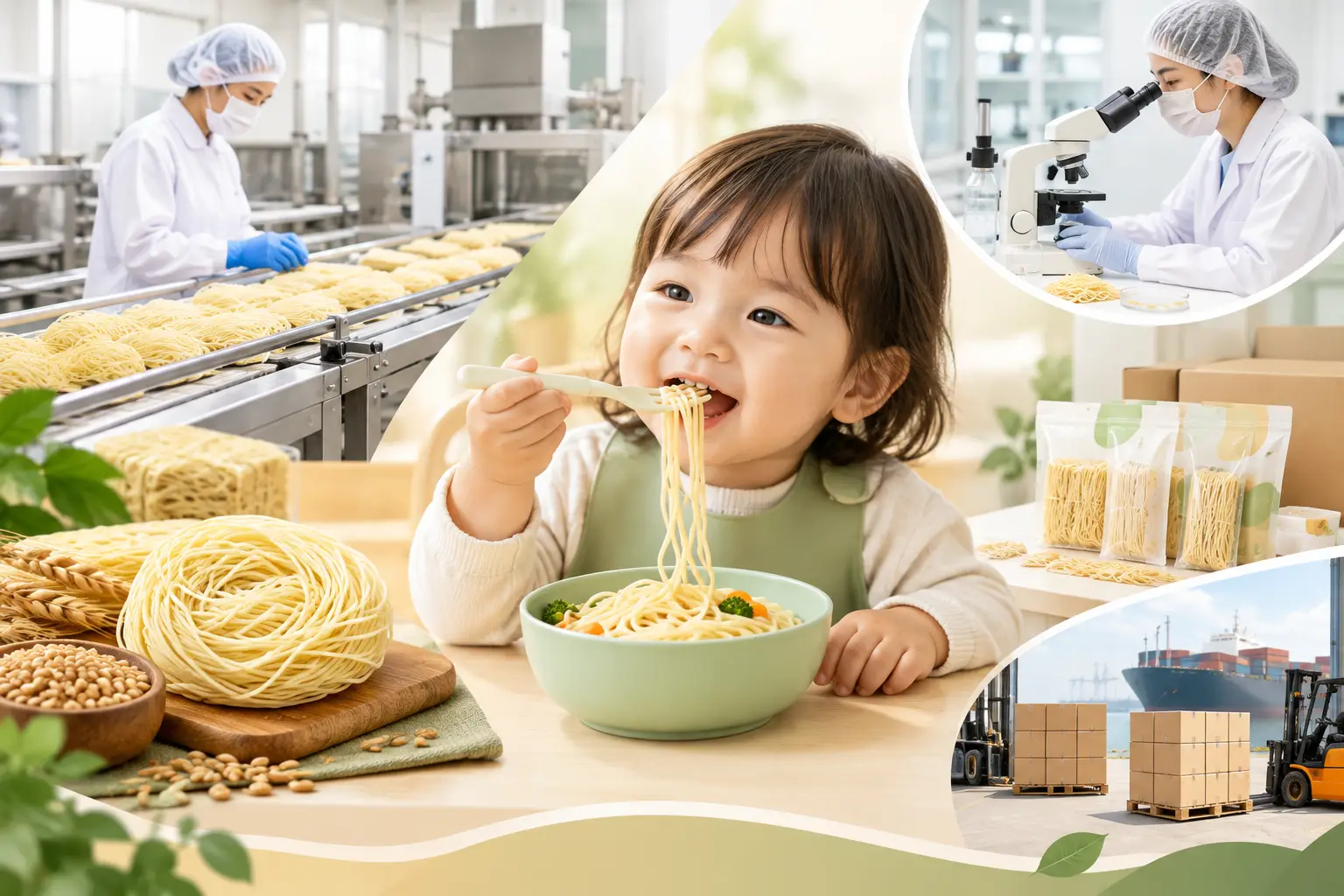
A baby udon product can look simple on a shelf, but baby udon in Malaysia: how to develop noodles for babies and toddlers is a more detailed product-development question than it first appears. For brand owners, the challenge is to create a noodle that cooks reliably, suits age-appropriate eating needs, communicates its proposition clearly, and can be produced consistently at commercial scale.
Unlike standard dry noodles, infant and toddler noodle lines require decisions that affect one another. Noodle thickness influences cooking time and bite. Ingredient choices affect dough handling and breakage. Portion format changes packaging requirements and cost structure. The strongest product concepts begin with a clear brief rather than a generic request for "kids' noodles."
Start With the Intended Age and Use Occasion
Babies and toddlers are not one uniform consumer group. A noodle intended for early self-feeding may need a noticeably different shape and cooking profile than one designed for older toddlers eating family-style meals. Before selecting flour, cut length, or packaging, define who the product is for and how caregivers are expected to prepare it.
A practical development brief should clarify the intended age range, whether the noodles will be served in soup, stir-fried after boiling, or mixed into prepared meals, and whether the format is for home retail, foodservice, or meal-kit applications. These choices guide the manufacturing specification from the beginning.
For example, a short-cut udon format may be more suitable where easy handling is a central product objective. A longer noodle can still work for older toddlers, but it creates a different preparation experience and may require clearer serving guidance from the brand. There is no universally correct length. The commercial goal is consistency between the target user, product claim, cooking method, and pack message.
Baby Udon in Malaysia: Build Texture Into the Specification
Texture is often the defining feature of udon, yet conventional udon chewiness may not be appropriate for every baby or toddler noodle concept. A child-focused format generally needs to soften predictably after cooking while retaining enough structure to avoid turning into paste during preparation or holding.
That balance depends on more than noodle width. Flour selection, water level, dough mixing, sheeting, cutting, drying conditions, and final noodle thickness all influence the cooked result. A thicker strand may deliver a familiar udon appearance, but it can require a longer cook time and greater control to achieve even softening. A thinner or narrower strand may cook faster, though it can be more susceptible to breakage in production and transport.
The right specification should be tested under realistic conditions, not only in a development kitchen. This includes evaluating cooking performance at the recommended time, after a few extra minutes in hot broth, and after holding in a prepared dish. Foodservice operators may prioritize noodles that remain stable in soup, while retail brands may favor a format that is straightforward for caregivers to prepare at home.
Length, Shape, and Portion Behavior
Short-cut noodles are a practical option for baby and toddler ranges because they reduce the need for extensive cutting after cooking. However, short pieces can change the visual perception of the product and may behave differently during packing. A manufacturer should confirm that the selected length can move efficiently through cutting, drying, weighing, and packing processes without unnecessary variation.
Alternative shapes may also be considered, but novelty should not outweigh function. A familiar udon-style noodle with a carefully selected length and thickness often provides a clearer route to market than a complex shape that complicates production, cooking instructions, or cost control.
Formulate for a Clear, Responsible Positioning
Parents and buyers increasingly look for simple ingredient declarations in child-oriented food categories. For a private-label baby udon project, this can mean exploring a clean-label direction, selected grain options, or formulas without unnecessary additives, depending on the intended market and brand position.
At the same time, an ingredient list should not be developed as a marketing exercise alone. Every formulation adjustment affects processing behavior. Whole-grain or vegetable-based ingredients, for instance, can influence dough elasticity, color, drying performance, and the final bite. A formula that sounds attractive in a concept document still needs to be manufacturable at stable quality.
Salt level is another key development consideration. Standard noodle recipes may not align with the goals of a child-focused range, so the formulation should be reviewed specifically for the product brief and destination market. Care should be taken not to make broad nutrition claims unless the finished product and supporting documentation substantiate them.
Where allergen management matters to a brand, it should be raised early in the discussion. It can affect ingredient sourcing, production planning, labeling review, and the feasibility of particular product claims. Clear communication at this stage helps avoid expensive revisions later.
Choose a Drying Method That Supports Product Performance
For export-ready baby and toddler noodles, dry format offers practical advantages in handling, distribution, and storage. The drying method, however, also influences the noodle's appearance, strength, and rehydration behavior.
Air-dried noodles are often considered by brands seeking a lighter product positioning and a clean, natural-looking noodle format. The process can support good cooking performance when the recipe and drying parameters are developed together. Fried noodle formats may suit other product concepts where speed of preparation or a specific finished texture is required. The better choice depends on the target channel, price architecture, preparation method, and brand story.
Drying must be controlled to reduce issues such as excessive breakage, uneven cooking, or inconsistent color. This is especially relevant for small noodle portions, where a high level of breakage can affect pack presentation and perceived quality. Development samples should therefore be assessed not only as cooked noodles, but also after packing, transport simulation, and routine handling.
Design Packaging Around the Buyer and the Caregiver
Packaging for infant and toddler noodles has two audiences. The buyer needs confidence in the product's quality, safety controls, and brand proposition. The caregiver needs clear preparation instructions, understandable portion information, and a pack that is easy to use.
Single-serve nests, small bundled portions, and family packs each serve different commercial purposes. Individual portions can help a brand communicate convenience and reduce guesswork in preparation. Larger packs may provide better value positioning and suit households with more than one child. The choice should reflect the intended sales channel rather than copying an existing adult-noodle format.
On-pack instructions deserve particular attention. Cooking time, water guidance, serving suggestions, and storage instructions should be tested against the actual product. If the noodle is designed to soften further in soup or sauce, the preparation method should account for that. Clear, accurate instructions reduce the risk that a well-developed noodle is judged on an avoidable preparation error.
Validate Safety and Manufacturing Consistency Early
Child-oriented foods raise the stakes for quality management. Brand owners should look beyond a visually appealing sample and ask how the product will be controlled across repeat production runs. This includes raw-material specifications, allergen considerations, foreign-material controls, moisture management, finished-product checks, traceability, and packaging integrity.
A qualified manufacturing partner should be able to discuss these controls in practical terms and align development with its food safety system. Tehki Food operates with ISO 22000, HACCP, GMP, MeSTI, and Halal certifications, providing a structured foundation for customers developing private-label dry noodle products for local and international markets.
Consistency also means protecting the sensory profile that the brand approved. The cooked texture, cut length, color, noodle integrity, and pack weight should be set as measurable expectations wherever possible. A product brief that relies only on descriptions such as "soft" or "premium" leaves too much room for interpretation.
Move From Concept to a Scalable Product Brief
The most productive OEM or ODM projects translate brand ambition into clear technical decisions. Instead of asking for a baby udon noodle in broad terms, provide the target market, intended age group, desired noodle dimensions, preparation style, preferred ingredient direction, pack format, and expected channel. A manufacturer can then identify trade-offs before the project reaches costly packaging or launch stages.
Sampling should be used to refine the specification, not simply to approve appearance. Evaluate each version for dry-noodle strength, cooking time, softness, flavor neutrality, portion practicality, and fit with the planned packaging. If the product is intended for export, review the specification with destination-market labeling and documentation needs in mind from the outset.
A well-developed baby udon line is built through disciplined choices: a realistic use occasion, an appropriate cooked texture, a manufacturable formula, and packaging that supports the promise on the front of the pack. That level of clarity gives a brand more than a child-friendly noodle concept. It gives the product a stronger basis for repeatable production and confident market entry.