
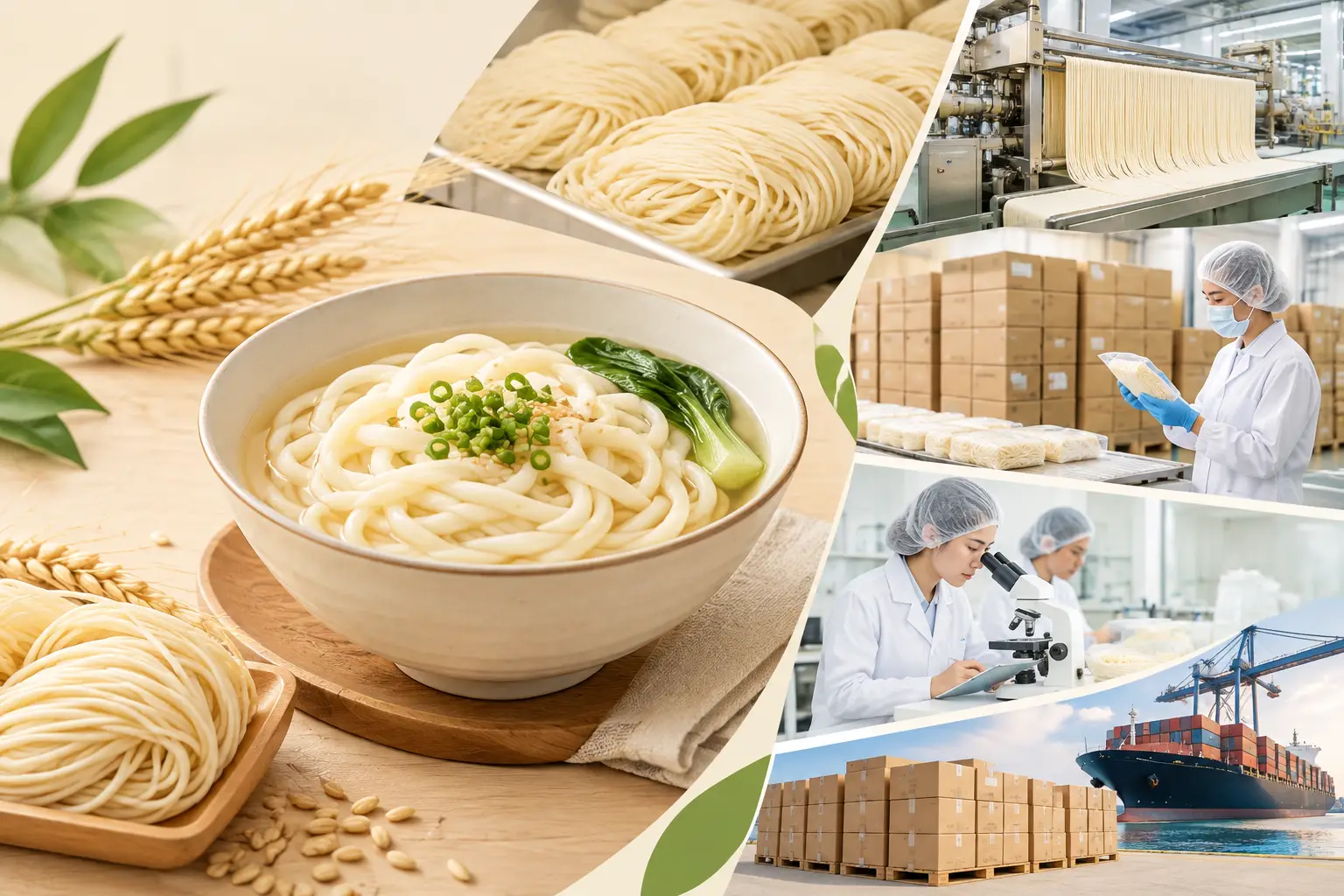
A young-child noodle product can look simple on the shelf, but its commercial success depends on decisions made well before packaging artwork is approved. For buyers assessing baby udon noodles: texture, ingredients and product considerations for young children, the priority is to translate caregiver expectations into a dry noodle specification that can be produced consistently, prepared easily, and positioned clearly in the intended market.
Udon is a useful starting point because its familiar wheat-based profile and fuller strand shape can create a soft, satisfying eating experience. However, standard udon specifications are not automatically appropriate for a baby or toddler range. Strand dimensions, cooking behavior, portion format, ingredient declaration, and quality controls all need deliberate review.
Why texture is the first product decision
Texture is more than a sensory detail. In a young-child noodle product, it affects preparation instructions, serving convenience, perceived suitability, and repeat purchase potential. A noodle that remains too firm after the recommended cooking time may be difficult for a young child to manage. One that softens too quickly can break down in broth or sauce, creating an inconsistent bowl experience.
For dry baby udon noodles, the development target is usually a tender cooked bite with enough structural integrity to hold its shape. This balance depends on flour selection, dough hydration, mixing, sheeting or extrusion conditions, strand thickness, drying profile, and final moisture control. Small changes in any of these variables can alter how the noodle hydrates and softens.
Traditional udon is often valued for its thick, chewy character. For a younger audience, a manufacturer may adjust the format rather than simply make a conventional udon softer. Shorter lengths can reduce the need for cutting at the point of use. A narrower or flatter strand may cook more evenly and become tender more readily. The right format depends on whether the product is intended for early self-feeding, older toddlers, family meal use, or foodservice preparation.
Cooked texture must be tested in real serving conditions
Laboratory checks are necessary, but they do not replace practical preparation testing. Product teams should assess noodles at the stated cooking time, after holding in warm liquid, and after mixing with common sauces or purees. The noodle should be reviewed for softness, strand separation, breakage, stickiness, and tolerance to holding.
This matters particularly for distributors and foodservice buyers. A noodle may perform well when served immediately but become overly soft during a short holding period. Conversely, a firm noodle could be acceptable in a factory sample yet require a preparation method that is impractical for busy kitchens or caregivers.
Ingredient choices should support a clear market position
A straightforward wheat flour and water formulation can be a practical foundation for baby udon noodles. Simplicity may support a clean, understandable product concept, but every ingredient choice still has technical implications. Flour protein level influences dough strength and cooked bite. Water management affects processing stability. Salt can contribute to dough handling and texture, so its use should be considered against the desired finished-product profile and market expectations.
Egg, dairy, vegetable powders, and other inclusions can broaden a product range or create flavor and color variation. They also add formulation complexity, possible allergen-management requirements, sourcing considerations, and label implications. A vegetable-based concept, for example, should be evaluated not only for appearance but also for its effect on dough consistency, drying behavior, and cooked texture.
Seasoning deserves separate attention. Many young-child noodle concepts work best as plain noodles, allowing the caregiver or foodservice operator to control what is added at serving. Others are sold with a soup base or sauce component. A combined format can be convenient, but it introduces additional questions around flavor intensity, ingredient transparency, portioning, and packing configuration.
For private-label development, the commercial objective should guide the formulation. Is the product intended to be a minimal-ingredient pantry staple, a value-oriented family format, a premium air-dried range, or a differentiated vegetable noodle concept? A focused answer helps prevent feature overload and keeps the specification aligned with the brand's category strategy.
Product considerations for young children go beyond the noodle
The best baby udon noodle specification accounts for the complete product system. That includes the noodle itself, the pack size, cooking directions, handling guidance, visual communication, and the way the product will be sold and used.
Portioning is one of the most practical decisions. Individual nests or smaller bundled portions can help users prepare an appropriate amount with less waste. Larger multi-serve packs may suit families and foodservice channels, but they require clear preparation guidance and a resealable or otherwise practical pack format where relevant. There is no universal answer: the preferred format depends on retail positioning, price architecture, and expected consumption occasions.
Packaging also has to protect a relatively delicate dry noodle. Thick udon-style strands can be more vulnerable to breakage if pack design and handling are not considered during development. Product teams should review transit performance, case packing, merchandising conditions, and the appearance of the noodles after distribution. A product that arrives with excessive broken strands can undermine a carefully developed premium or child-friendly position.
Clear cooking instructions are equally valuable. They should specify the water method, cooking duration, and any recommended cutting or serving preparation where appropriate. Instructions should be validated against the actual noodle, not copied from another format. The goal is repeatable results for users with different kitchen equipment and experience levels.
Building a specification that manufacturers can scale
A strong brief avoids vague requests such as “soft noodles for babies.” It gives the manufacturer usable targets while leaving room for technical problem-solving. For an OEM or ODM program, buyers should be ready to define at least the following:
- Intended age range and primary usage occasion
- Preferred noodle shape, strand width, and cut length
- Target cooked texture and expected cooking method
- Required or excluded ingredients and allergen considerations
- Portion format, packaging type, and target sales channel
- Label, export-market, and quality-documentation needs
These details allow the development team to identify feasible production routes early. They also make sample evaluation more meaningful because stakeholders are testing against a shared commercial objective rather than personal preference alone.
Scalability should be reviewed from the first prototype. A small development sample may have the desired color and softness, yet become difficult to reproduce if the formulation is sensitive to normal ingredient variation or processing changes. An experienced manufacturer will consider dough handling, drying consistency, strand integrity, packing efficiency, and finished-product uniformity alongside sensory performance.
Air-dried versus fried noodle formats
The manufacturing method is a central product decision, particularly where a brand is building a health-conscious or clean-label-oriented range. Air-dried noodles can provide a practical route for brands seeking a dry noodle format without a fried processing step. They also require careful process control to achieve stable quality and the intended rehydration behavior.
Fried noodles offer their own functional characteristics, including fast preparation and a familiar instant-noodle format. Whether they fit a young-child proposition depends on the broader product concept, ingredient approach, target channel, and brand positioning. The choice should not be made on marketing language alone. It should be tested against texture goals, cost expectations, packaging requirements, and the experience the brand wants to deliver.
Quality assurance and export readiness
Young-child products deserve a disciplined quality mindset, even when the commercial format is straightforward. Buyers should look for a manufacturing partner with documented food safety systems, traceable raw-material controls, established allergen-management practices, and repeatable batch processes. These are operational fundamentals that help protect product consistency as distribution expands.
For international programs, documentation and packaging requirements may differ by destination. Ingredient terminology, nutrition-panel formats, language needs, claims review, and import requirements should be verified for each market before final artwork and production planning. A flexible manufacturing partner can support this process by aligning the product specification, pack configuration, and quality documentation with the buyer's route to market.
Tehki Food develops dry noodle solutions with this full product view in mind, combining practical customization with manufacturing controls supported by ISO 22000, HACCP, GMP, MeSTI, and Halal certifications. For brand owners, the value is not simply receiving a soft udon noodle. It is developing a product format that can remain consistent from approval sample to commercial distribution.
A well-designed baby udon range begins with a precise brief, then earns its place through dependable cooking performance, clear ingredients, thoughtful portions, and a specification built for the realities of production and distribution.