
A short ingredient statement can influence whether a noodle product gets approved for a retail range, foodservice menu, or private-label launch. For buyers evaluating the best clean ingredient noodle options, the question is not simply which noodle has fewer ingredients. It is which format can deliver a clear formulation, consistent cooking performance, suitable positioning, and dependable scale.
For brand owners and sourcing teams, clean ingredient development is a product-design decision. The right choice depends on the target customer, intended market, price architecture, preparation method, packaging format, and the ingredients that your brand wants to feature or avoid. A well-built clean-label noodle should be practical to manufacture and easy for customers to understand, without compromising the texture expected from Asian noodles.
What Clean Ingredients Mean in Noodle Development
Clean ingredient is not a fixed legal definition. In commercial product development, it usually describes an ingredient approach that is recognizable, purposeful, and aligned with a brand's positioning. This may involve a shorter ingredient declaration, straightforward staple ingredients, or the removal of selected additives based on a product brief.
That distinction matters. A shorter ingredient list is not automatically better if the noodle breaks during packing, turns soft too quickly in soup, or performs inconsistently after distribution. Conversely, a formulation with carefully selected functional ingredients may be appropriate when it has a clear role in texture, stability, or preparation performance. The objective is transparency and fit for purpose, not ingredient reduction at any cost.
A manufacturer should help clarify the brief early. Is the priority an air-dried noodle with a lighter processing story? A simple wheat noodle for a value-focused retail line? A rice-based format for a particular cuisine? Or a mild, small-portion noodle designed for child-focused product concepts? Each direction calls for different technical decisions.
Best Clean Ingredient Noodle Options for Private Labels
The strongest options begin with a familiar noodle base and build outward only where the market requires it. The following formats give brands practical starting points for clean ingredient product development.
Air-dried wheat noodles
Air-dried noodles are often a natural choice for brands seeking a cleaner positioning because they can avoid the frying stage used in some instant noodle formats. A typical base may include wheat flour, water, salt, and, depending on the product specification, alkaline agents or other processing aids needed to achieve the intended noodle character.
This format is relevant for retail and foodservice lines that want a dry noodle with convenient preparation and a more deliberate processing story. However, air-drying requires close control of dough handling, drying conditions, moisture targets, and breakage resistance. The product must retain its structure through packing, shipping, and cooking. A clean formulation is commercially useful only when every production batch delivers the same result.
Traditional wheat noodle formats
Wheat-based Asian noodles remain a flexible foundation for private-label programs. Brands can develop fine or broad strands, straight or wavy noodles, and different bite profiles depending on the intended meal application. The ingredient deck can remain relatively direct while the noodle itself is customized through flour selection, dough development, sheeting, cutting, and drying.
For distributors and wholesalers, this flexibility supports portfolio building. One brand may need a versatile soup noodle, while another may require a firmer format for stir-fry or sauced applications. The key is to specify cooking time, texture after holding, portion weight, and pack format before finalizing the recipe. These details affect customer satisfaction as much as the ingredient list.
Rice-based noodle options
Rice noodles can fit clean ingredient programs where the brand seeks a rice-forward product identity or a noodle suited to regional Asian cuisine. Rice flour, water, and starches may form the core of the formula, although the precise composition depends on the desired strand strength, appearance, and rehydration behavior.
Rice-based formats are not interchangeable with wheat noodles. They respond differently to soaking, boiling, seasoning, and extended holding. For a foodservice customer, a rice noodle that performs well in quick service may not be the best choice for delivery or buffet use. Product trials should reflect the actual serving conditions rather than a basic kitchen test alone.
Child-friendly and smaller-portion noodles
Child-focused noodle concepts require a disciplined approach to ingredients, size, and user experience. The product may call for shorter noodle lengths, mild formulation direction, small portion formats, or selected ingredients that align with a parent's expectations. These products should also be designed around practical preparation and an age-appropriate eating experience.
Ingredient simplicity is valuable here, but it must be supported by reliable manufacturing controls. Product developers need to consider strand dimensions, cooking behavior, packing consistency, and clear product specifications. A child-friendly positioning should be built thoughtfully, not treated as a smaller version of an adult noodle product.
Vegetable and grain-forward concepts
Some brands want to introduce vegetable powders, grain ingredients, or other recognizable components to create a differentiated noodle range. These additions can support a clear product story, but they also create technical trade-offs. Powders and whole-grain materials can affect color, dough elasticity, noodle strength, drying behavior, and finished texture.
The best approach is to start with the customer promise. If the product must visibly reflect a vegetable ingredient, color retention and flavor balance may matter most. If the goal is a grain-forward texture, the formulation must be tested for handling and cooking performance. A development partner should be candid about what is achievable at scale and what may require adjustment.
How to Assess a Clean-Ingredient Noodle Supplier
A clean ingredient claim on a concept sheet is only the beginning. Buyers should assess whether the manufacturer has the systems and development discipline to produce the noodle consistently across commercial runs.
First, review ingredient traceability and specification control. A supplier should be able to work from an agreed formulation and manage raw material standards consistently. This is particularly relevant when a product contains selected flours, vegetable ingredients, or other components that can vary in color, moisture, or performance.
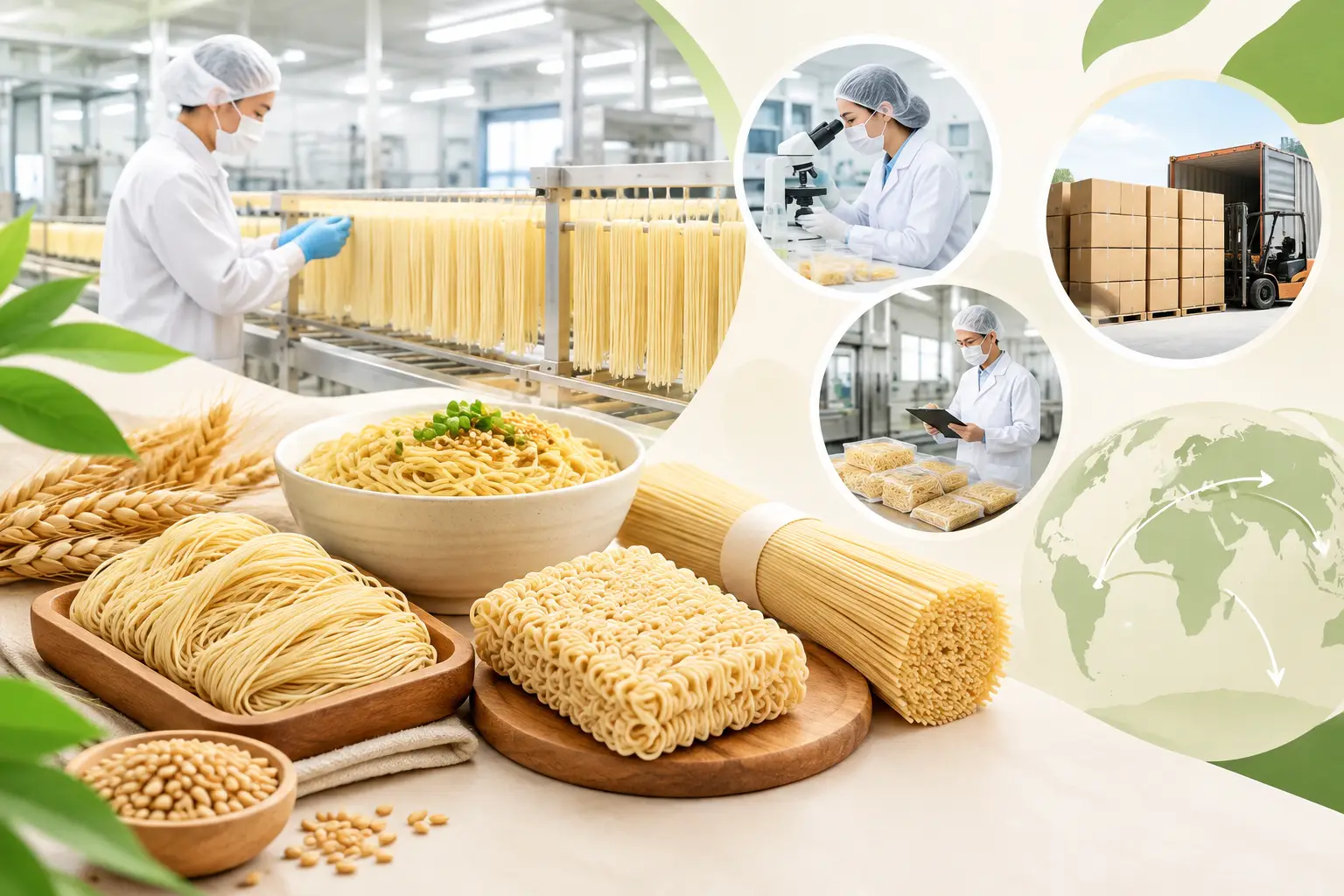
Second, examine the manufacturer's quality and food safety framework. Recognized systems such as ISO 22000, HACCP, GMP, and MeSTI provide useful assurance that production is managed through documented controls. Certifications do not replace product testing, but they indicate that the manufacturer has structured processes for quality management, hygiene, and traceability.
Third, test for the actual route to market. A retail noodle should be assessed for pack integrity and consumer cooking instructions. A foodservice noodle should be evaluated for batch preparation, holding time, and compatibility with broth or sauce. Export-oriented products may need additional attention to packaging durability, labeling requirements, and the conditions encountered across distribution channels.
Finally, consider customization beyond the ingredient declaration. Portion size, noodle length, thickness, strand shape, seasoning compatibility, and packaging all shape the final commercial proposition. A capable OEM or ODM partner can help bring these elements together instead of treating them as separate decisions.
Build the Product Brief Before Choosing the Formula
The most efficient clean ingredient projects start with a specific brief. Define the noodle format, target channel, intended preparation method, desired texture, ingredient priorities, and packaging needs. It is also useful to identify which attributes are essential and which are preferences. For example, an air-dried format may be non-negotiable, while the exact noodle width can remain open during development.
Avoid making claims before the final formulation and market requirements have been reviewed. Terms such as natural, free-from, simple, or clean can carry different expectations across markets and customers. Brand owners should ensure that packaging language is substantiated, appropriate for the destination market, and aligned with the finished product specification.
For businesses seeking to develop private-label dry noodles, Malaysia-based manufacturer Tehki Food can support OEM and ODM projects across air-dried, fried, child-friendly, and customized Asian noodle formats. The value of an experienced manufacturing partner is not merely producing noodles to a recipe. It is helping convert a commercial idea into a repeatable product with the quality controls needed for real distribution.
The best clean ingredient noodle option is the one that makes sense from ingredient deck to final bowl: clear in purpose, consistent in performance, and designed for the market it is meant to serve.