
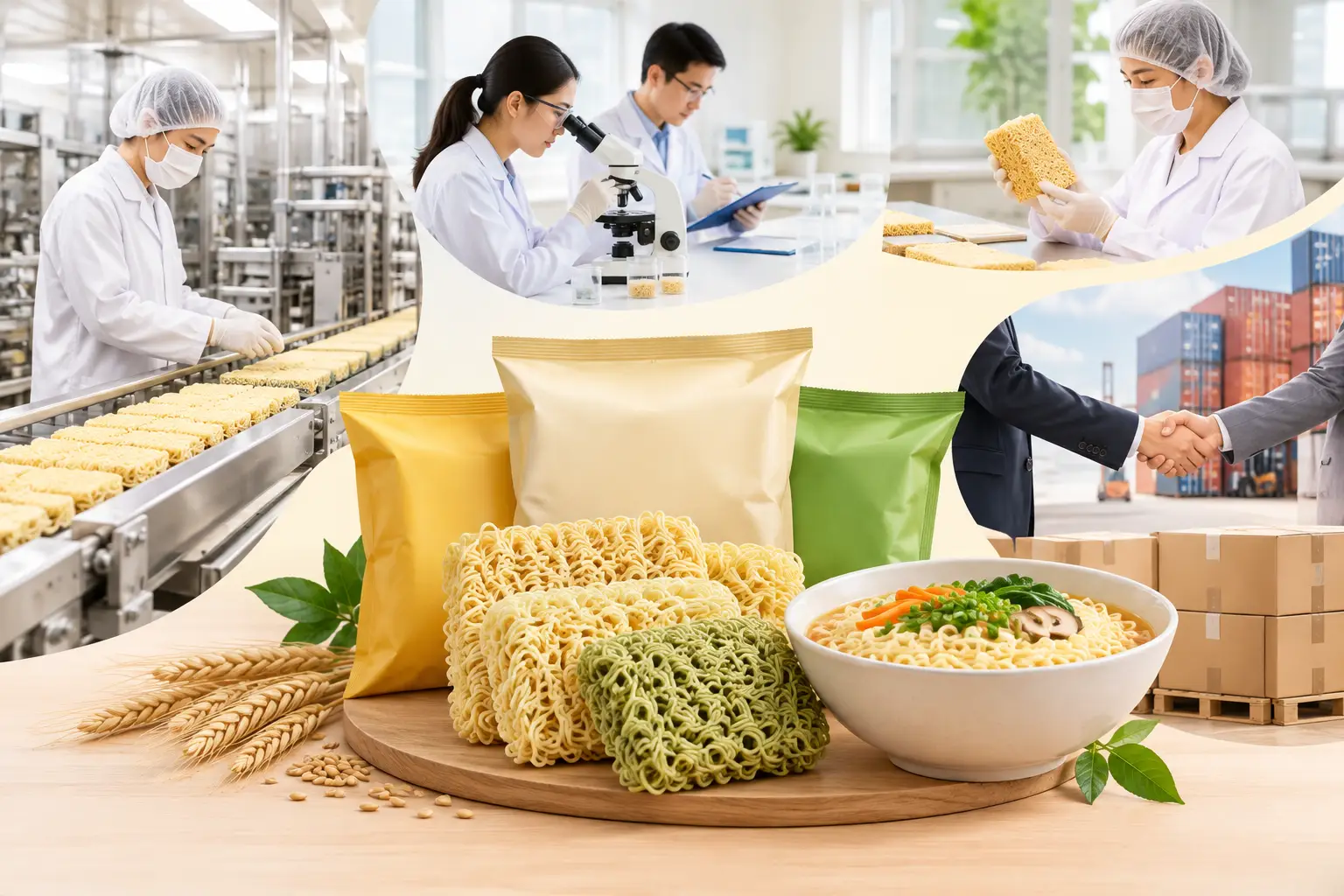
A noodle sample can look promising in a tasting session and still create costly problems once it reaches production, shipping, or a customer’s kitchen. The question behind bulk instant noodles: what food businesses should know before choosing a supplier is therefore larger than flavor and unit cost. It is about whether a manufacturer can produce the same product consistently, support the intended market, and adapt the format to the commercial reality of your brand or operation.
For importers, private-label brand owners, distributors, and foodservice buyers, instant noodles are not one uniform category. Noodle block structure, drying method, seasoning integration, packaging requirements, preparation time, and product positioning can all change the right sourcing decision. A useful supplier evaluation starts with the product brief, then tests whether the manufacturer has the systems and experience to deliver it at scale.
Start with the Product You Actually Need
“Instant noodles” can describe a wide range of products. A fried noodle block may suit a familiar, indulgent retail format, while an air-dried noodle may better fit a lighter-positioned range or a customer seeking a different eating texture. Dry noodles intended for foodservice may need to perform well in stir-fries, soup applications, or prepared meal kits rather than in a single-serving cup.
Before requesting quotations or samples, define the practical role of the product. Is it a branded retail SKU, a private-label line, a bulk ingredient for restaurants, or a component in another food product? Who prepares it, and how? These questions shape choices around noodle thickness, strand length, cooking behavior, portion size, and pack configuration.
A clear brief should address the noodle style, desired texture, preparation method, ingredient preferences, target packaging format, intended sales channels, and destination market. It does not need to prescribe every manufacturing detail. In fact, leaving room for a capable manufacturer to recommend workable options can improve both product performance and production efficiency.
Bulk Instant Noodles: Supplier Fit Matters More Than a Sample
A sample is an essential starting point, but it is not proof of long-term supplier fit. The key question is whether the supplier can maintain the approved product specification from batch to batch. This depends on controlled raw materials, documented processes, trained production teams, equipment capability, and quality checks that are built into daily operations.
Ask how the supplier manages critical characteristics such as noodle moisture, weight, appearance, texture after preparation, and pack integrity. The answer should be specific and process-focused. A dependable manufacturing partner can explain how specifications are agreed, monitored, and handled when adjustments are required.
It is also worth asking whether the sample represents a standard product or a development-stage concept. A standard noodle may move through development more simply, while a highly customized format can create stronger differentiation. Neither route is automatically better. The appropriate choice depends on your market position, expected volumes, speed-to-market needs, and willingness to invest in product development.
Evaluate Manufacturing Capability, Not Just Product Range
A broad product catalog can be useful, but it should not be the main reason to select a supplier. The more relevant issue is whether the manufacturer has hands-on capability in the format you need. Fried noodles, air-dried noodles, children’s noodle concepts, and traditional dry Asian noodles each require different considerations in formulation, processing, and quality control.
For a private-label project, customization capability deserves close attention. Can the supplier adjust noodle type, thickness, ingredients, portion size, and packaging around your brief? Can it guide you toward options that are realistic for commercial production rather than simply agreeing to every request?
Good OEM and ODM support is practical. It balances brand objectives with manufacturing feasibility. A supplier should help identify where customization adds genuine value and where it may introduce unnecessary complexity, cost pressure, or inconsistency.
Food Safety Systems Should Be Visible in the Conversation
Food safety credentials do not replace due diligence, but they provide an important indication of how a manufacturer operates. Buyers should look for recognized quality and food safety systems that are relevant to their supply chain requirements, such as ISO 22000, HACCP, GMP, MeSTI, and Halal certification where applicable to the product and market.
More importantly, discuss how these systems work in practice. Ask about traceability, incoming ingredient controls, sanitation procedures, allergen management, foreign-material controls, and finished-product release processes. If the product will be exported, documentation discipline becomes particularly important because buyers may need clear product specifications, ingredient information, packing details, and supporting quality records.
A supplier that treats certification as part of its operating culture is generally easier to work with than one that presents certificates only at the procurement stage. This matters when a distributor requests clarification, a retailer reviews a product file, or a brand needs to investigate a quality concern quickly.
Check How the Noodles Travel, Store, and Serve
Instant noodles are shelf-stable dry products, but their performance still depends on suitable packaging, handling, and distribution planning. A noodle block that arrives damaged, absorbs moisture, or loses its intended structure creates problems for both the buyer and the end user.
Discuss the full route from factory to final market. This includes inner packaging, outer carton strength, pallet configuration, container loading, and the conditions likely to be encountered during transport and storage. Export buyers should also consider whether packaging artwork, labeling space, and carton markings can accommodate their market requirements.
Foodservice customers have another layer to assess: operational usability. Kitchen teams may value consistent portions, predictable preparation, and noodle formats that hold up well in broth or sauce. Retail buyers may prioritize shelf presentation and consumer convenience. The supplier should understand which performance measure matters most for your channel.
Price Needs Context
Comparing supplier prices without comparing specifications can lead to the wrong decision. Two noodle products that appear similar may differ in drying method, noodle weight, ingredients, packaging materials, quality controls, customization level, or export packing requirements. The lower number is not always the lower total cost once product performance and supply reliability are considered.
A better commercial discussion looks at value across the full program. Consider the risk of inconsistent quality, the cost of damaged packs, the effort needed to manage product changes, and the manufacturer’s ability to support future line extensions. For some buyers, a straightforward standardized product is the most efficient choice. For others, a differentiated air-dried or custom-formulated noodle can justify a more involved development process.
Transparency matters here. A supplier should be able to explain what is included in the proposed specification and flag where a requested change may affect materials, production, or packaging.
Assess Communication Before You Commit
The early stages of a sourcing project often reveal how the long-term relationship will work. Are questions answered clearly? Are technical limitations explained directly? Does the supplier request enough information to understand your product, market, and packaging needs?
Reliable communication is especially valuable when working across borders. Product approvals, artwork revisions, specification updates, and shipment documentation require coordination between procurement, quality, marketing, logistics, and manufacturing teams. A supplier that communicates in a structured, timely way can reduce avoidable delays and misunderstandings.
For businesses developing their first house-brand noodle line, the right partner should provide guidance without taking control away from the brand. For experienced buyers, the supplier should be able to work efficiently within established specifications and quality procedures. The level of support may differ, but the need for accountability does not.
Build Supplier Selection Into Product Development
Choosing a bulk instant noodle supplier should not be treated as a final procurement task after the product has already been designed. Manufacturing input is most useful early, when there is still room to improve the noodle format, simplify packaging, refine the preparation experience, or align the concept with export and distribution needs.
Malaysia-based OEM and ODM manufacturers such as Tehki Food can be particularly relevant for buyers seeking dry Asian noodle expertise combined with export-oriented quality systems and practical customization. The strongest projects are usually those where the buyer brings a clear market objective and the manufacturer brings process knowledge, product discipline, and realistic development advice.
A supplier relationship is tested long after the first approved sample. Choose the manufacturer that can explain how your noodles will be made, controlled, packed, and supported as your business grows. That foundation gives a new product far more room to perform well in the market.