
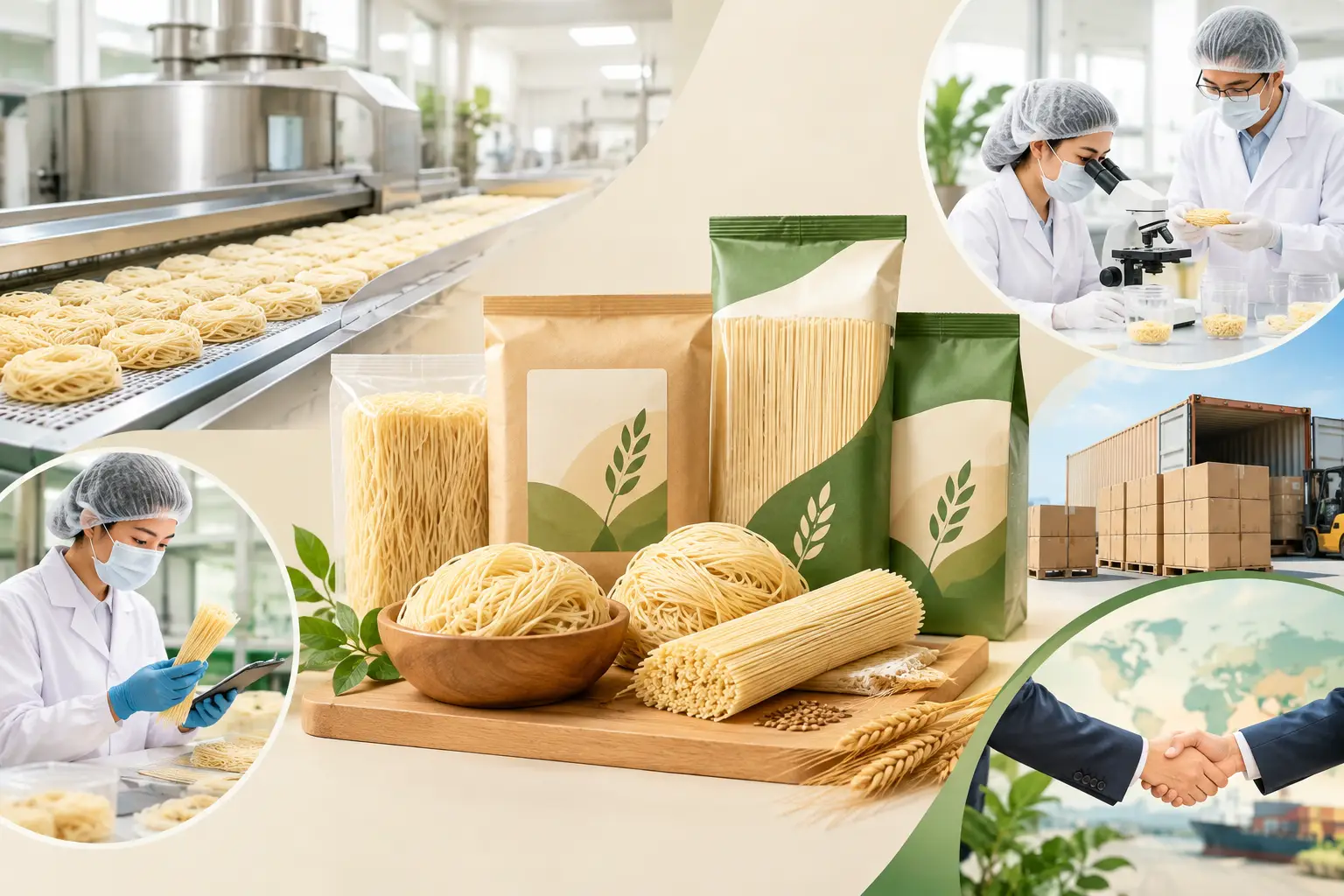
A noodle product can look simple on the shelf, yet its commercial success often depends on decisions made long before production begins. Can dry noodles be customized to meet a brand’s positioning, customer expectations, and operational needs? Yes, but meaningful customization is more than changing a pack design or selecting a noodle shape. It requires aligning formulation, processing, portioning, packaging, and quality controls into a product that can be produced consistently at scale.
For brand owners, importers, distributors, and foodservice operators, the best approach is to define what the noodle must achieve in the market first. A premium retail line, a value-focused family pack, a child-friendly product, and a foodservice noodle format may all start with similar ingredients, but they need different product specifications.
Can Dry Noodles Be Customized Beyond Packaging?
Packaging is the most visible part of private-label development, but it is only one part of the product. Dry noodle customization can begin with the noodle itself: its type, thickness, width, length, bite, color, cooking behavior, and finished appearance. These details affect how customers use the product and how they perceive its quality.
For example, a brand developing an Asian noodle range may choose a fine noodle for soups, a broader cut for stir-fry applications, or a curly format associated with convenient meal solutions. Air-dried and fried noodle formats also create different product characteristics. The right choice depends on the intended market, serving method, price position, and desired eating experience.
A capable OEM or ODM manufacturer helps turn broad product ideas into workable specifications. This matters because a noodle that performs well in a test kitchen must still be practical to manufacture repeatedly, pack efficiently, and transport reliably through the distribution chain.
The Main Areas of Dry Noodle Customization
Noodle format and texture
Noodle format is usually the first development decision. Businesses can explore traditional Asian noodle styles, straight or wavy shapes, varying widths, and different portion configurations. Texture can also be adjusted through formulation and processing choices to target a softer bite, firmer chew, or a balance suited to the intended preparation method.
Texture should not be considered in isolation. A noodle designed for a quick soup application needs to hydrate and cook differently from one intended for stir-fry or longer holding in foodservice service. Product developers should specify the likely preparation conditions early, including cooking time expectations, broth or sauce use, and whether the noodle may be held before serving.
Ingredients and product positioning
Ingredient selection gives brands room to differentiate, especially where buyers are seeking simpler ingredient approaches, vegetable-based colors, or product concepts designed around particular customer groups. Wheat-based formulations remain central to many dry noodle products, while other ingredients can influence appearance, flavor, handling, and texture.
The practical question is not simply whether an ingredient can be added. It is whether it will deliver the desired result consistently after drying, cooking, packing, and storage. Some ingredients can alter dough handling, breakage risk, color stability, or cooking performance. This is why formulation work should be evaluated alongside factory capability rather than treated as a standalone marketing exercise.
For infant and toddler noodle concepts, product design also requires extra care around size, texture, and preparation suitability. These products should be developed with clear product requirements and appropriate quality processes, not positioned through broad or unsupported nutrition claims.
Portion size and pack configuration
Portioning is a commercial decision as much as a manufacturing one. Single portions may suit convenience-focused products, while multi-serve formats can better fit household retail, wholesale, or foodservice channels. Noodle block weight, bundle size, and the number of portions per pack affect price architecture, product presentation, case packing, and customer use.
A distributor may need case formats that work efficiently across several retail accounts. A restaurant group may prioritize portion consistency to help kitchen teams manage serving sizes. A brand launching in export markets may need pack configurations that suit local buying habits and retailer requirements. The noodle and the pack must be planned together.
Packaging and private-label presentation
Custom packaging gives a house-brand noodle product its identity, but the chosen material and format must also protect the product and support efficient handling. Options may include individual packs, multipacks, pillow packs, bundle formats, or larger foodservice-oriented packs, subject to the product specification and market needs.
Artwork should be developed with practical manufacturing requirements in mind. Required product information, print layout, barcode placement, language needs, and case markings should be organized before final production planning. For export programs, early alignment between the brand owner, importer, and manufacturer can reduce avoidable artwork revisions and documentation delays.
Customization Has Limits - and That Is Useful
Nearly every product idea involves trade-offs. A highly distinctive noodle shape may affect production efficiency. A complex formulation may require additional development work. Smaller portion sizes can increase packing complexity. Premium packaging can support shelf presence but may change the overall cost structure.
These are not reasons to avoid customization. They are reasons to prioritize it. The most successful private-label products usually focus on the attributes that matter most to the target buyer instead of trying to make every element different at once.
A clear product brief helps the manufacturer assess feasibility from the start. It should cover the sales channel, intended market, noodle format, preferred preparation method, target pack size, desired ingredient direction, packaging concept, and any required quality or certification considerations. The more specific the brief, the faster a development discussion can move from a general idea to a practical specification.
How to Build a Custom Dry Noodle Program
Start with the commercial role of the product. Is it intended to extend an existing Asian food range, fill a gap in a distributor portfolio, support a foodservice menu, or establish a new private-label line? This determines which features deserve investment and which should remain standardized for efficiency.
Next, define the non-negotiables. These may include noodle type, cooking performance, pack format, ingredient preferences, or market-specific labeling needs. Then identify where flexibility is acceptable. Being clear about priorities allows a manufacturer to recommend options that balance product appeal with production consistency.
Sampling and review are the point where decisions become tangible. Evaluate samples not only for appearance and taste, but also for cooking behavior, texture after preparation, breakage, pack usability, and fit with the intended serving method. When several stakeholders are involved, agree on evaluation criteria before reviewing samples so feedback remains focused.
Finally, treat quality planning as part of product development, not an afterthought. Consistent raw material management, controlled processing, hygienic production, and documented quality systems all support a repeatable finished product. For businesses selling across borders, this manufacturing discipline is particularly valuable because product consistency protects both the brand and the buyer relationship.
What to Look for in a Custom Noodle Manufacturer
The right manufacturing partner should be able to discuss customization in operational terms, not only in marketing language. Ask how the proposed noodle format will be produced, what variables may affect consistency, how samples are evaluated, and how packaging requirements will be managed.
It is also useful to assess whether the manufacturer has experience with the product category and the intended route to market. An export-oriented private-label program has different demands from a local foodservice supply arrangement. Quality certifications and structured food safety systems provide additional confidence that the manufacturer has established controls behind the product development conversation.
As a Malaysian OEM and ODM dry noodle manufacturer, Tehki Food works with B2B customers on custom Asian noodle formats that account for product identity, manufacturing practicality, and export-oriented requirements. The aim is not to force every customer into a fixed catalog, but to develop specifications that can support a reliable long-term program.
A Custom Noodle Should Solve a Market Need
The strongest customized noodle products are not customized merely for novelty. They give a brand a clearer place in its category, make life easier for a foodservice operator, or provide a distributor with a relevant product for a defined customer base. Start with that market need, then build the noodle specification around it. That is where customization becomes a practical business advantage rather than just a different-looking pack.