
A short ingredient statement can be compelling on a noodle pack, but it creates a much bigger manufacturing question behind the scenes: can noodles use natural ingredients while still delivering stable processing, familiar texture, efficient packing, and consistent performance across markets? The answer is yes, but natural ingredient development needs to be approached as a formulation and supply-chain project, not simply an ingredient swap.
For brand owners, importers, and foodservice buyers, the opportunity is clear. Natural ingredient concepts can support cleaner product positioning, regional flavor preferences, and differentiated private-label ranges. The practical challenge is ensuring that each ingredient works reliably within a dry noodle system and can be supplied consistently as production grows.
What “natural ingredients” means in noodle development
The term “natural” can mean different things to different customers. One buyer may be focused on recognizable pantry-style ingredients. Another may want noodles colored with vegetable powders rather than artificial colors. A third may prioritize a shorter ingredient declaration, no added preservatives, or a formulation built around grains, vegetables, herbs, and spices.
For an OEM or ODM project, the first step is to turn that broad preference into a workable product brief. That brief should define which ingredients are preferred, which ingredients are excluded, the desired noodle format, intended cooking method, target customer, and commercial market. It should also set clear expectations around appearance, flavor, texture, and the finished product’s handling requirements.
This matters because a noodle’s ingredient list is only one part of its quality. Consumers and foodservice operators still expect the noodle to hydrate evenly, hold its shape, provide a pleasant bite, and perform consistently in soup, stir-fry, or other applications. A natural formulation that looks good on paper but breaks during cooking will not support repeat purchase or a dependable menu.
Can noodles use natural ingredients without compromising quality?
They can, provided the ingredient choices are tested against the full manufacturing process. Wheat flour, rice flour, buckwheat, vegetable powders, legume ingredients, whole grains, herbs, and spices can all play a role in noodle development. Their suitability depends on the desired noodle type and the production method used.
Air-dried noodles, for example, may be well suited to concepts where the product team wants to emphasize a lighter processing approach or a more carefully selected ingredient profile. Fried noodle formats have different functional needs, particularly around dough behavior and finished texture. Infant and toddler noodle projects require especially careful attention to ingredient simplicity, size, softness after cooking, and appropriate product specifications.
Natural colors illustrate the trade-off clearly. Spinach, carrot, pumpkin, beet, turmeric, or other plant-based ingredients can contribute visual differentiation. Yet they may also affect dough moisture, color consistency, flavor, and response to drying. The same principle applies to whole-grain or high-fiber ingredients. They can support a distinctive product concept, but they may alter gluten development, bite, and cooking tolerance.
The right question is not whether a natural ingredient can be added. It is whether it can be added at a meaningful level while preserving the noodle characteristics that matter to the intended market.
Texture starts with the dough system
A dry noodle’s texture is shaped by more than the base flour. Water absorption, mixing time, sheeting conditions, cutting dimensions, steaming where applicable, drying profile, and final moisture control all influence the finished result. When a conventional ingredient is replaced or reduced, these variables may need adjustment.
For example, vegetable powders can raise the amount of water needed in a dough, while grain-based ingredients may produce a firmer or more fragile noodle structure. A manufacturer needs to assess dough handling during production as well as the consumer experience after cooking. This is why pilot trials are valuable before a brand commits to packaging artwork, a market launch, or a larger production program.
A capable development process compares options rather than assuming one recipe will fit every format. A formulation that performs well in a thin noodle for quick-service applications may not be the best choice for a thicker noodle designed for retail soup kits.
Flavor should support the intended use
Natural ingredients can create a more distinctive flavor profile, but subtlety is often important. Strong vegetable, grain, or herb notes may work well in a premium retail concept, yet be less suitable for a versatile foodservice noodle that needs to complement multiple sauces and broths.
Product developers should consider the entire eating system. Will the noodle be sold plain, paired with a seasoning sachet, served in a rich broth, or used in a restaurant recipe? A noodle with mild natural coloring and a neutral flavor may offer more menu flexibility. A more pronounced formulation may be appropriate when the noodle itself is positioned as the main point of difference.
Ingredient sourcing is part of product consistency
Natural does not automatically mean consistent. Agricultural ingredients can vary by season, origin, harvest conditions, milling specifications, and processing method. For a growing brand, that variation can affect color, particle size, flavor intensity, water absorption, and ultimately noodle performance.
A manufacturer should therefore qualify ingredients against practical standards, not just purchase them based on a general description. This includes confirming specifications, evaluating incoming material, maintaining traceability records, and monitoring how each ingredient behaves in production. Reliable supplier relationships also help reduce the risk of unexpected reformulation when a preferred ingredient becomes difficult to source.
For export-oriented products, ingredient sourcing needs additional attention. The formulation must be practical to produce repeatedly, and documentation must support the buyer’s quality review process. Claims, declarations, and packaging language should be reviewed carefully for the markets where the product will be sold. Product positioning should always match what the formulation and supporting records can substantiate.
Processing choices affect the final natural ingredient story
Ingredient selection and process selection should be developed together. An air-dried noodle may support a different product narrative and eating texture than a fried noodle, even when both begin with a similar dough. Neither is automatically better. The appropriate choice depends on the brand’s positioning, target price architecture, cooking requirements, and desired finished characteristics.
Portion size and packaging format also matter. A natural-ingredient noodle designed for retail may require a different block weight, nest format, or pack configuration than one intended for foodservice kitchens. Smaller formats can be relevant for child-oriented concepts, while larger or bulk formats may better suit operators seeking preparation efficiency.
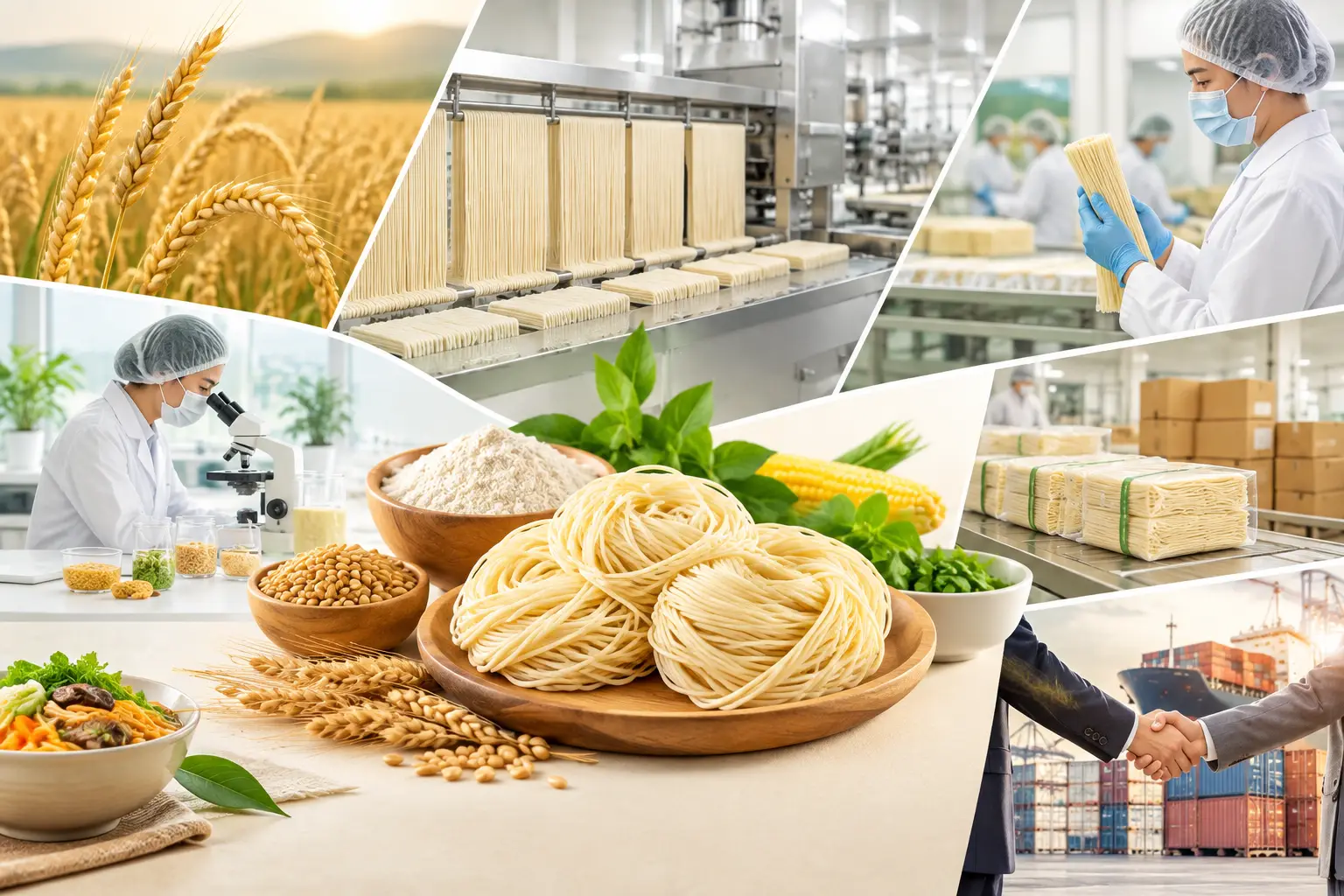
These decisions should be made early because they influence production planning and quality controls. A dependable manufacturer will assess the product as a complete system: ingredients, noodle format, processing route, portioning, packaging, and handling through distribution.
Building a commercially workable natural noodle range
The most successful projects balance a clear consumer-facing idea with disciplined manufacturing requirements. Rather than trying to include every possible natural ingredient, brands are often better served by choosing one or two meaningful formulation priorities and executing them consistently.
A spinach-colored wheat noodle, a pumpkin noodle for a child-friendly range, or a whole-grain-inspired Asian noodle concept can each be commercially relevant when the target user and eating occasion are clearly defined. The formulation should then be tested for process stability, cooked texture, flavor compatibility, visual consistency, and packaging suitability.
Quality systems are equally important. Established controls for food safety, sanitation, raw-material management, and production consistency provide the foundation for customized projects. Certifications such as ISO 22000, HACCP, GMP, MeSTI, and Halal can give business buyers additional confidence when evaluating a manufacturer’s systems, though each customer should still review requirements for its own product and destination market.
For private-label buyers, working with an experienced noodle manufacturing partner can shorten the distance between an attractive concept and a repeatable product. Tehki Food supports this work by aligning noodle type, ingredient direction, texture, portion size, and packaging with practical production needs.
Natural ingredient noodles are most effective when they are developed with equal attention to the label, the production line, and the bowl. Start with a focused product brief, validate the trade-offs through trials, and build a formulation that your supply chain can support long after launch.