
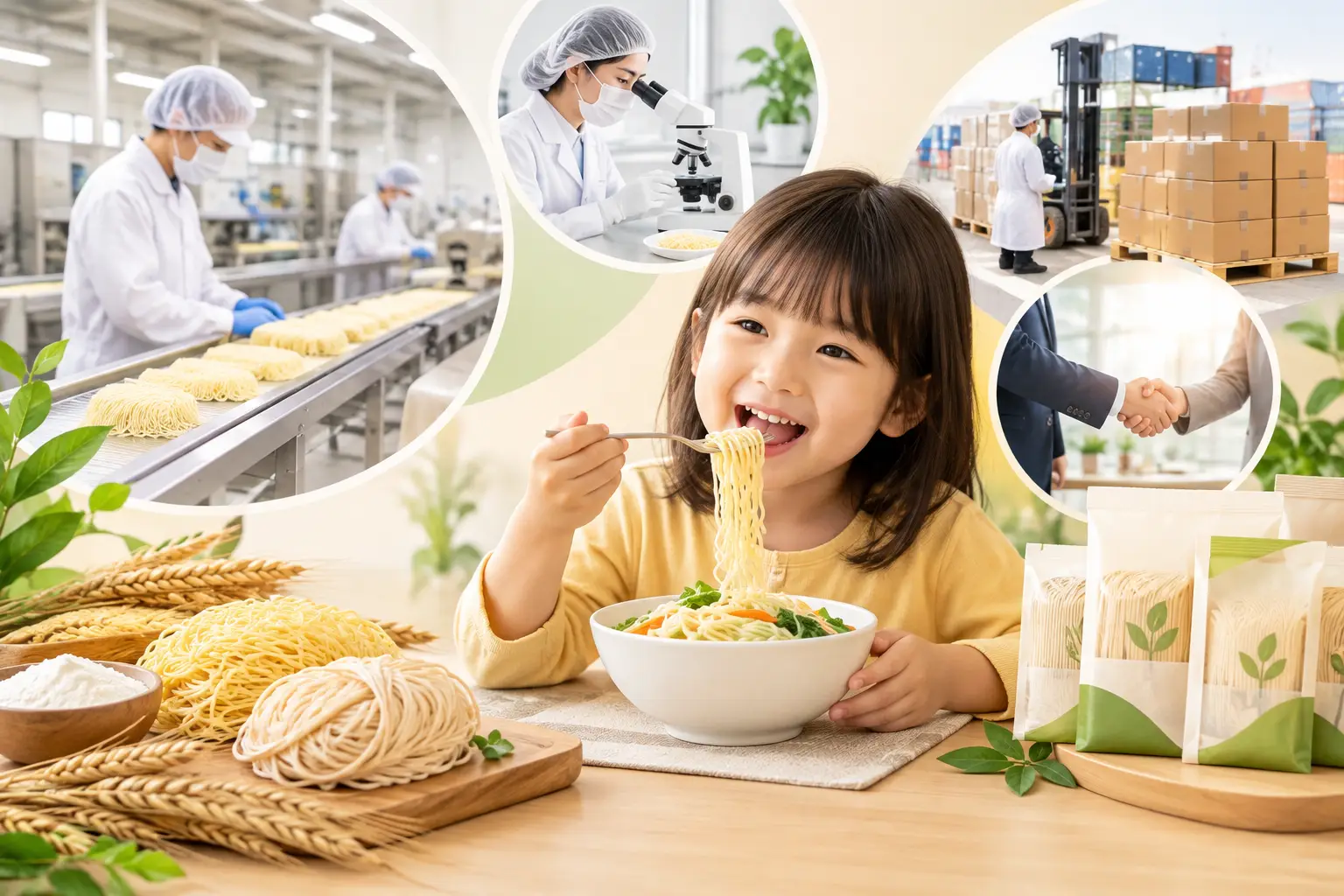
Children’s noodle products are not simply smaller versions of adult noodle ranges. A strong child friendly noodle concept example considers how the noodle cooks, how easily it is eaten, what parents and caregivers expect from the label, and whether the product can be manufactured consistently at commercial scale. For brand owners, the concept must also work across packaging, positioning, sourcing, quality control, and export planning.
The best starting point is not a cartoon character or a bright pack design. It is a clear product brief that connects the intended age group, eating occasion, noodle format, ingredient direction, and target market. When those decisions are aligned early, development becomes more efficient and the finished product is easier to position with retailers, distributors, and foodservice buyers.
What Makes a Noodle Concept Child Friendly?
A child-friendly concept should be designed around practical eating experience. Young children may struggle with long strands, firm textures, heavily seasoned meals, or portions intended for adults. The noodle itself should therefore be considered alongside preparation instructions, serving size, and the wider meal solution.
For a retail brand, this may mean a dry noodle product with shorter strands or a format that can be cut easily after cooking. For a foodservice operator, it may mean a noodle portion that performs reliably in soups, stir-fries, or meal bowls without becoming overly soft during holding. The right answer depends on the customer’s age range, menu use, and market expectations.
A child-friendly range should also avoid treating “better for children” as a vague marketing claim. Product developers should define what the concept delivers in practical terms: a manageable texture, a clear ingredient approach, convenient preparation, or portion options appropriate to the intended use. Clear decisions create a more credible product story than broad promises.
A Child Friendly Noodle Concept Example for Private Label
Consider a private-label air-dried Asian noodle range developed for families with young children. The core product could be a plain, short-cut wheat noodle packed in individual portions, with a mild flavor profile and simple cooking instructions. The brand may position it as a versatile pantry product for soups, broth-based meals, vegetable dishes, or family meal preparation.
This concept has several commercial advantages. Air-dried noodles can support a lighter product positioning than fried noodle formats, while the plain noodle base gives customers flexibility in how they prepare and season the meal. Individual portions help the brand communicate convenience and support more controlled meal planning. Shorter noodle lengths can improve the eating experience for younger users without changing the familiar character of Asian-style noodles.
The concept can be expanded with carefully selected variations. A brand may introduce vegetable-based color cues, such as spinach or pumpkin ingredients, where formulation and label requirements support the intended positioning. Another option is a shaped noodle format, such as short curls or small pieces, designed for easy spoon or fork use. These choices should be evaluated for their effect on texture, cooking behavior, ingredient cost, pack appearance, and manufacturing consistency.
The important point is that every feature should have a function. Added ingredients, shape changes, or pack formats should improve usability, brand differentiation, or market fit rather than create unnecessary complexity.
Start With the Intended User and Eating Occasion
“Children” is too broad to be a useful product-development brief. A noodle designed for toddlers will have different texture and portion considerations than a product intended for school-age children. Brands should identify the primary user group before selecting noodle thickness, strand length, cooking time, and pack size.
The eating occasion matters just as much. A quick breakfast noodle, lunchbox-friendly dry noodle, family soup noodle, and foodservice side dish each require different performance. For example, a noodle intended for soup needs to retain an acceptable bite in hot liquid, while a noodle used in a ready-to-prepare meal kit may need faster cooking and a compact portion format.
This early clarity helps prevent a common development problem: creating a product that appears child-friendly on pack but does not perform well in the kitchen. A successful concept should be convenient for the adult preparing it and comfortable for the child eating it.
Choose the Noodle Format Before Finalizing the Story
Noodle format influences nearly every part of the concept. Air-dried noodles, fried noodles, and other dry noodle formats can each serve different commercial needs. The choice should be based on the desired eating experience, product positioning, production requirements, and target channel.
Air-dried noodles are often a practical option for brands seeking a cleaner, health-conscious direction without making unsupported nutrition claims. They can be developed in different thicknesses and shapes and may suit products that need a straightforward ingredient narrative. Fried noodles can offer familiar texture and preparation characteristics in certain product categories, but they should be evaluated against the brand’s positioning and customer expectations.
Texture is especially important. A noodle that is too firm may be difficult for young eaters, while one that softens too quickly can create a poor meal experience. Manufacturers should test cooking performance across realistic preparation conditions, including variations in water volume, cooking time, holding time, and serving style. This is where an experienced OEM or ODM partner adds value: the concept is assessed not only as a sample, but as a repeatable production product.
Build Ingredient Choices Around Clarity and Consistency
Ingredient selection should support a focused product brief. Some brands may prefer a familiar wheat noodle base. Others may explore egg-free options, vegetable-containing formulations, or ingredient profiles designed to fit a clean-label direction. Each path involves trade-offs in color, dough handling, texture, flavor, and cost structure.
A simple formula can be commercially effective when it is supported by good noodle quality and clear pack communication. Adding multiple ingredients may help a brand create differentiation, but it can also increase formulation complexity and create variability if the raw materials behave differently from batch to batch.
For products aimed at younger consumers, consistency matters more than novelty. The noodle should have predictable appearance, cooking behavior, and texture. A product development team should also consider how ingredient choices affect the final label, allergen management requirements, and suitability for the intended export market.
Packaging Should Solve a Real Preparation Problem
Packaging is part of the product experience, not an afterthought. Individual nests or portioned bundles can help users prepare the right amount without weighing noodles. Larger family packs may be more suitable for value-oriented retail formats. Foodservice packs, by contrast, may prioritize operational efficiency and easy portion control in a professional kitchen.
The front of pack should communicate the concept clearly without overstating benefits. Practical messages such as short-cut noodles, easy-cook format, or portioned noodle bundles are easier to support than broad claims. Visual design can be warm and approachable, but brand owners should ensure the product still appears credible to the adult buyer making the purchase decision.
Export-ready packaging also requires attention to language, labeling space, carton configuration, and transport durability. These considerations are most effective when discussed during concept development rather than after the recipe and pack size have already been fixed.
Quality Systems Matter From Sample to Scale
A child-focused product can attract closer scrutiny from buyers, retailers, and import partners. Reliable food safety systems, documented production controls, raw material management, and consistent quality checks are therefore central to the concept’s commercial viability.
When selecting a manufacturing partner, brand owners should look beyond the first product sample. Ask how the manufacturer manages product specifications, batch consistency, traceability, packaging controls, and change management. Certifications such as ISO 22000, HACCP, GMP, and MeSTI indicate that a manufacturer has established quality and food safety frameworks, but the practical development process also matters.
Tehki Food works with B2B customers to align noodle format, texture, ingredients, portions, and packaging with the realities of scalable dry noodle production. That approach helps move a concept from an initial idea toward a product that can be produced consistently for private-label and export-oriented markets.
Keep the Range Focused at Launch
It can be tempting to launch several shapes, flavors, and pack formats at once. For many brands, a more focused first range is easier to manage and gives buyers a clearer reason to list the product. One core noodle format, one or two relevant pack sizes, and a well-defined user group can provide a stronger foundation than a broad assortment with unclear differentiation.
Additional variants can be introduced once the brand understands which features matter most in the target market. Some markets may respond to portion control and simple preparation; others may prioritize a familiar Asian noodle style, a particular texture, or family-oriented packaging. The concept should remain adaptable without losing its central purpose.
A child-friendly noodle product succeeds when it is easy to understand, dependable to prepare, and practical to manufacture. Start with the child’s eating experience, validate it against the adult buyer’s needs, and build the product around manufacturing discipline from the first brief onward.