
When a noodle product moves under your brand name, food safety stops being a background requirement and becomes a commercial decision. Choosing a haccp certified noodle manufacturer is not only about checking a certification box. It is about reducing preventable risk, protecting product consistency, and building a supply chain that can support growth without creating avoidable quality issues.
For importers, brand owners, distributors, and foodservice buyers, that distinction matters. A certificate on paper has value, but what matters more is whether the manufacturer runs HACCP as a working system across sourcing, production, packaging, and batch control. The gap between those two things can affect customer confidence, complaint rates, and long-term brand performance.
Why a HACCP certified noodle manufacturer matters in B2B sourcing
Noodles may look like a straightforward category, but manufacturing control is rarely simple. Product quality depends on flour characteristics, mixing accuracy, dough handling, drying or frying conditions, moisture control, hygiene practices, and packaging discipline. If those variables are not managed well, consistency suffers.
HACCP helps manufacturers identify where food safety hazards can occur and how those points should be monitored and controlled. In practical B2B terms, that creates a more disciplined production environment. It supports clearer documentation, defined control measures, and more reliable handling of deviations when they happen.
That does not mean HACCP alone guarantees a perfect product. It does mean the manufacturer should have a more structured way to prevent problems rather than reacting after the fact. For buyers managing private label, OEM, or export programs, that difference is significant.
What HACCP should look like inside a noodle factory
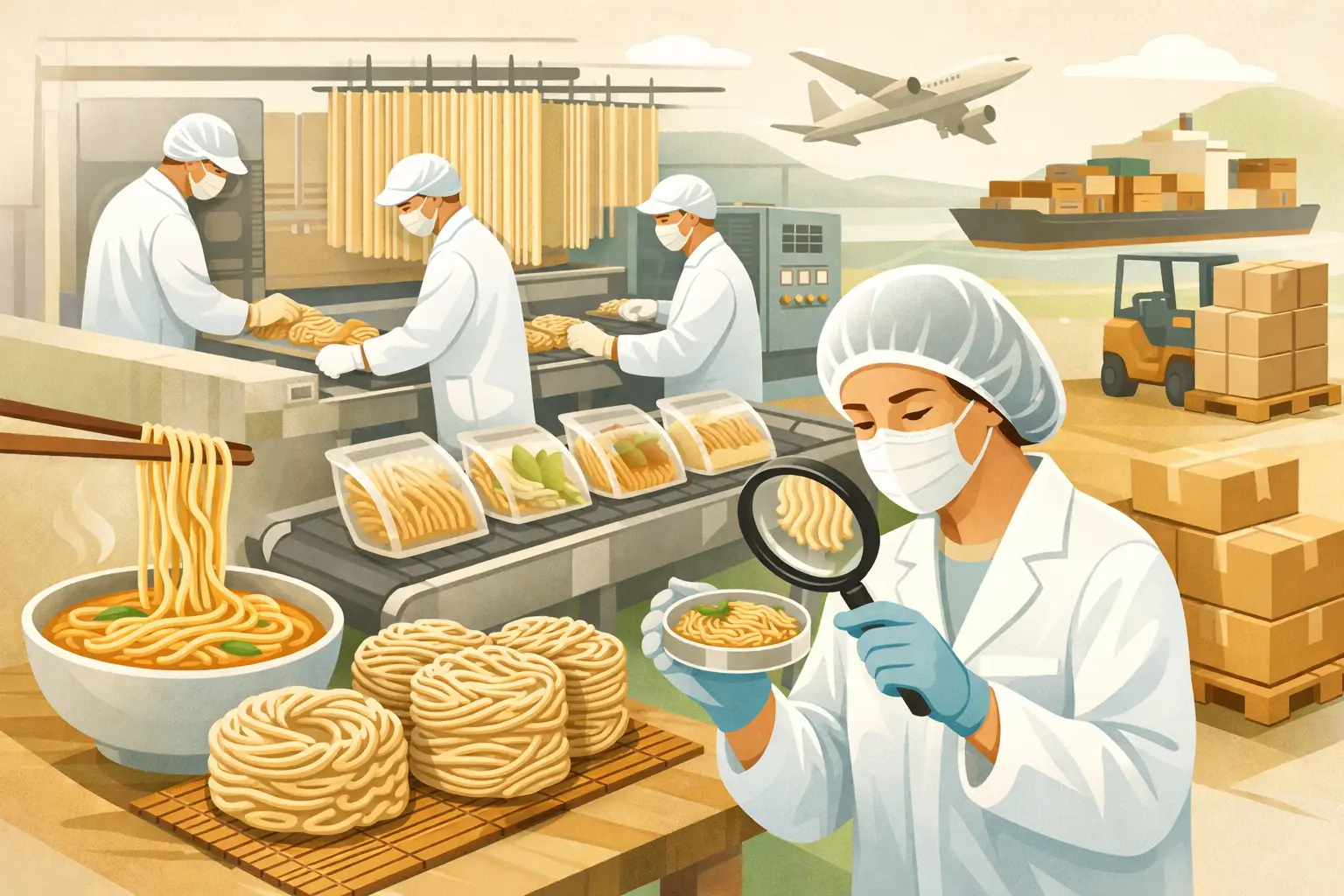
A credible HACCP system should be visible in how the factory operates, not only in how it presents itself during sales discussions. You should expect to see control thinking reflected in raw material handling, personnel hygiene, equipment sanitation, process checks, and traceability records.
In noodle production, critical points may vary depending on whether the product is air-dried, fried, or developed for specific customer requirements such as child-friendly formats or cleaner-label positioning. A competent manufacturer understands that product format affects risk management. The process for a standard dry noodle line is not automatically the same as one developed for a more sensitive formulation or specialized packaging format.
This is where experienced manufacturing partners stand out. They do not treat HACCP as isolated from product development. They integrate food safety planning into formulation decisions, line setup, packaging selection, and production controls from the beginning.
Certification is the starting point, not the whole standard
Buyers sometimes place too much weight on the certificate itself and too little on operational discipline. A manufacturer may be HACCP certified and still be a poor fit if communication is weak, records are inconsistent, or process control is not backed by experienced production management.
A stronger approach is to treat certification as a baseline and then evaluate how the business supports it. Ask how batch records are maintained. Ask how changes in raw materials are managed. Ask what happens when specifications drift. A dependable manufacturer should be able to explain its process clearly and practically, without relying on vague reassurances.
How HACCP connects to consistency, not just compliance
For B2B noodle buyers, product consistency is often as important as food safety itself. Your customers expect the noodle texture, cooking performance, appearance, and pack presentation to remain stable across repeat orders. If those fundamentals shift too much, your brand absorbs the consequences.
A good HACCP-based production environment supports consistency because it encourages tighter process control. When water ratios, drying conditions, oil handling, packaging integrity, or sanitation routines are managed with discipline, the result is usually a more repeatable product. That is especially important for businesses scaling from trial runs into broader distribution.
There is also a commercial benefit here. Better process control can reduce unnecessary variation, rework, and complaint handling. That does not eliminate every production challenge, but it improves the manufacturer’s ability to respond with documentation and corrective action when issues arise.
Questions to ask a HACCP certified noodle manufacturer
A serious supplier conversation should go beyond asking whether HACCP exists. You want to know how the system supports your product and your market requirements.
Start with the basics. Ask which noodle categories the factory currently produces and whether it has experience with air-dried noodles, fried noodles, custom portioning, or private-label formats. Then move into process questions. How are incoming ingredients checked? How are in-process controls recorded? How is packaging verified before release?
It is also worth asking about broader quality systems. HACCP is stronger when supported by certifications and practices such as ISO 22000, GMP, MeSTI, and Halal where relevant to the target market. These do not all serve the same purpose, but together they can signal a more mature manufacturing framework.
Just as important is development capability. If you need an OEM or ODM partner, the manufacturer should be able to discuss how it handles formulation adjustments, texture targets, packaging needs, and market positioning without disrupting control standards.
Why customization increases the need for manufacturing discipline
Many B2B noodle programs are not off-the-shelf purchases. Buyers may want a house-brand dry noodle, a healthier air-dried format, a child-focused concept, or a product adapted to regional taste and cooking preferences. Customization creates opportunity, but it also introduces complexity.
Every change in ingredient profile, noodle thickness, seasoning compatibility, pack size, or processing method can affect how the product behaves in production. That is why a HACCP certified noodle manufacturer with OEM and ODM experience is often a better fit than a factory that only handles standard products.
The right partner can balance flexibility with control. That means understanding when a product idea is commercially workable, when it may create production challenges, and how to adjust specifications without compromising manufacturing stability. Buyers benefit from that honesty. Sometimes the best development support is not saying yes to everything, but helping refine a concept into something scalable and reliable.
Export readiness and documentation matter too
For international buyers, food safety systems are closely linked to export readiness. The product may be excellent, but if documentation, labeling coordination, or production records are disorganized, the sourcing process becomes harder than it needs to be.
A manufacturer serving export markets should understand that overseas customers often require more than product samples and a specification sheet. They need confidence that records are maintained, standards are followed consistently, and communication is structured. This is especially relevant for importers managing multiple SKUs or building a private-label range across markets.
Malaysia-based manufacturers can be well positioned here when they combine Asian noodle expertise with formal quality systems and practical export support. For buyers seeking dry Asian noodle production, that combination can offer both product familiarity and manufacturing discipline.
The manufacturer relationship is as important as the certificate
A HACCP certified noodle manufacturer should make sourcing feel more controlled, not more uncertain. That comes down to communication as much as certification. If your supplier cannot explain specifications clearly, respond directly to technical questions, or manage development in a structured way, the relationship may become difficult once production scales.
A better manufacturing partner acts with commercial awareness. It understands that your product has to perform in distribution, retail, or foodservice, not only on the factory floor. It also understands that quality, cost practicality, and product positioning need to be managed together.
This is why many B2B buyers look for a partner rather than a simple vendor. A dependable noodle manufacturer should be able to support long-term planning, not just one-off production. That includes helping customers think through format choices, packaging suitability, quality expectations, and the practical demands of repeat manufacturing.
Tehki Food operates in that space with a focus on dry Asian noodle manufacturing for OEM, ODM, and private-label customers who need scalable production supported by recognized quality systems.
Choosing well means looking beyond the label
The best sourcing decisions usually come from asking a simple question: can this manufacturer support our brand safely, consistently, and realistically as we grow? HACCP certification is an important part of that answer, but it should be backed by process discipline, product understanding, and the ability to develop noodles that work in the real market.
A reliable manufacturing partner gives you more than production capacity. It gives you clearer control over risk, a stronger foundation for product consistency, and a better chance of building a noodle line that customers will trust order after order.
If you are evaluating suppliers, look for the manufacturer that can explain its systems with confidence, adapt products with discipline, and treat your brand standards as a production priority from day one.