
When a noodle product fails, the issue is rarely just the noodle. It can be inconsistent texture between batches, unclear process control, weak documentation, or a factory system that does not scale well under commercial demand. That is why working with an ISO 22000 noodle supplier matters for brand owners, importers, distributors, and foodservice buyers who need more than a basic manufacturing source.
ISO 22000 is not a marketing label. In practical B2B terms, it signals that a manufacturer has built a structured food safety management system that connects hazard control, traceability, operational discipline, and continuous improvement. For buyers developing private-label or OEM noodle products, that structure can reduce risk and improve confidence across sourcing, product development, and distribution.
Why an ISO 22000 noodle supplier matters
For business buyers, food safety certification is only useful if it supports day-to-day manufacturing reliability. ISO 22000 helps create that reliability by formalizing how a factory identifies hazards, manages critical control points, documents procedures, trains staff, and reviews performance. In other words, it is not just about passing an audit. It is about running a more controlled operation.
This becomes especially relevant in noodle manufacturing, where small process changes can affect product quality. Flour behavior, dough consistency, drying conditions, frying parameters, seasoning integration, packaging control, and handling standards all influence the final product. A supplier with an organized food safety system is generally better positioned to manage these variables consistently.
That does not mean certification alone guarantees the right fit. A factory can be certified and still be unsuitable for your product category, market requirements, or customization needs. The better question is not simply whether a supplier has ISO 22000, but how that system supports your commercial objectives.
What buyers should evaluate beyond certification
An ISO 22000 noodle supplier should be able to explain how its systems translate into practical manufacturing outcomes. For a procurement team, that may mean cleaner documentation, clearer batch traceability, and stronger supplier control. For a brand owner, it may mean more confidence when building a house-brand noodle line. For a foodservice operator, it may mean dependable product consistency across repeat orders.
Process control and batch consistency
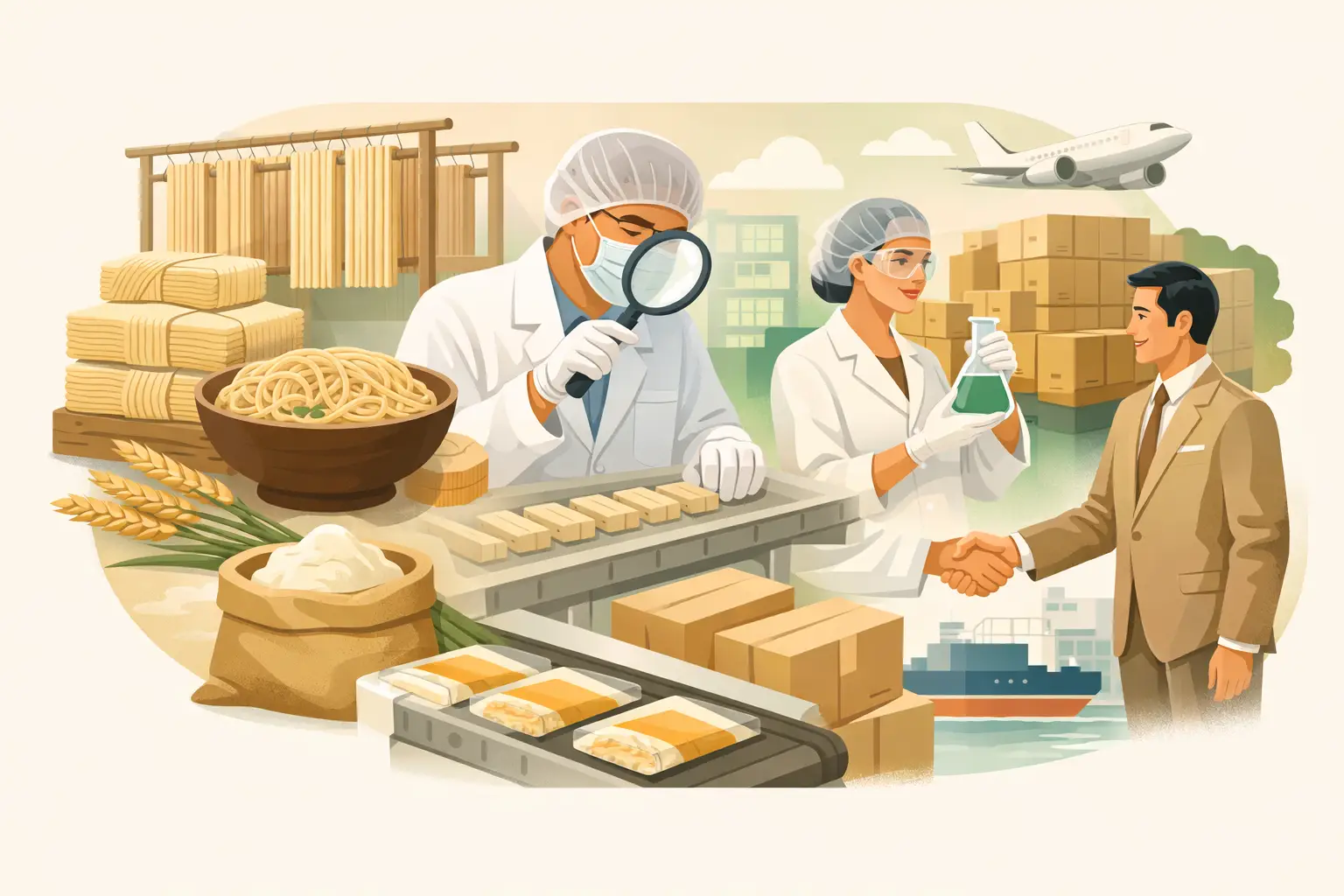
Noodles are highly sensitive to process variation. A slight difference in moisture management or drying conditions can change texture, cooking performance, breakage rate, and visual appearance. A capable manufacturer should have clear controls around raw materials, mixing, forming, drying or frying, packing, and final inspection.
This is where ISO 22000 becomes commercially useful. It supports disciplined monitoring and corrective action, which helps manufacturers maintain more stable outcomes over time. If your business depends on repeatable eating quality and presentation, this matters as much as the certificate itself.
Documentation and traceability
For importers and distributors, traceability is often a practical concern rather than a technical one. If a question arises about a batch, ingredient source, or production date, the response needs to be fast and clear. Strong documentation helps reduce confusion, supports internal compliance reviews, and makes it easier to manage customer expectations.
A supplier that treats traceability seriously is often easier to work with during product onboarding and ongoing account management. This becomes even more important for export programs, where documentation standards tend to be stricter and buyer scrutiny is higher.
Product development capability
Many buyers are not sourcing generic noodles. They are building a product line that must fit a target market, price architecture, preparation method, and brand position. That may involve air-dried noodles, fried noodles, child-focused formats, customized texture profiles, or packaging tailored to retail or foodservice channels.
An ISO 22000 noodle supplier with OEM or ODM capability adds more value when its technical and production teams can align product development with manufacturing reality. Some concepts look attractive on paper but are difficult to produce consistently at scale. The right partner helps narrow the gap between concept and factory-ready product.
The role of certification in private-label noodles
Private-label programs place extra pressure on the manufacturer because the finished product carries the buyer's brand reputation. If product quality drifts or documentation falls short, the brand owner absorbs the commercial impact. That is why many private-label buyers prefer suppliers with established food safety and quality systems.
In this context, ISO 22000 supports more than compliance confidence. It can also support smoother communication between buyer and factory. Specifications, process checks, non-conformance handling, and recordkeeping are easier to manage when the manufacturer already operates with system discipline.
Still, private-label success depends on balance. A highly structured supplier may be reliable but inflexible. Another may be creative with development but weaker on process control. The better manufacturing partner combines both - system strength and practical customization.
How an ISO 22000 noodle supplier supports export readiness
Export-oriented noodle programs require more than a factory that can produce volume. They require consistency, documentation, packaging discipline, and a quality culture that holds up under external review. This is one reason ISO 22000 is often relevant to international buyers.
A supplier serving multiple B2B markets usually understands that export readiness is tied to repeatability. Product specifications need to be stable. Packaging needs to be controlled. Production records need to be organized. If a market requires additional certifications or buyer-specific checks, the factory must be able to respond without losing control of the process.
For buyers sourcing from Malaysia or wider Asia, this matters because the supplier is not only manufacturing product. It is also representing your sourcing standards to your own downstream customers, distributors, and retail partners.
Questions worth asking before you commit
A serious buyer should look at how the factory operates, not just how it presents itself. Ask how hazards are identified and controlled in noodle production. Ask how batch records are maintained. Ask how product specifications are verified during scaling. Ask what happens when a process deviation occurs.
It is also worth discussing the supplier's experience with your type of product and channel. A factory that handles dry noodles for export retail may not approach foodservice packs the same way. A manufacturer that supports infant or toddler noodle concepts may need tighter development controls than one making standard commodity formats. The point is not to look for a perfect universal supplier. It is to find one whose systems match your commercial use case.
What a dependable manufacturing partner looks like
The strongest suppliers tend to be straightforward. They do not rely on certification alone to build trust. They can explain their process, show how quality is managed, and discuss product development in practical terms. They understand that buyers care about consistency, food safety, customization, and long-term supply confidence.
This is where an experienced manufacturer such as Tehki Food can be relevant to B2B buyers seeking OEM or ODM dry Asian noodle production. The value is not only in having ISO 22000 alongside other established quality systems, but in applying those systems to real manufacturing needs - from private-label development to export-oriented production and customized noodle formats.
Choosing the right ISO 22000 noodle supplier for growth
The best sourcing decisions are usually made before a problem occurs. If your noodle range is expected to scale across retail, distribution, or foodservice channels, your supplier should be equipped for that growth from the start. Food safety systems, process consistency, and documentation discipline become more important as volumes increase and product lines expand.
An ISO 22000 noodle supplier is often a stronger option when your business needs dependable control, not just available capacity. But certification should be treated as a starting point, not the full decision. The right partner is one that can support your product goals, maintain manufacturing consistency, and adapt to market requirements without compromising process discipline.
For B2B buyers, that kind of supplier relationship is rarely about finding the cheapest factory or the fastest quote. It is about choosing a manufacturing partner that can protect product quality while helping your noodle business move forward with fewer operational surprises.