
If you're developing a noodle line for retail, export, or foodservice, the phrase clean label vs organic: what's the difference? is more than a marketing question. It affects ingredient sourcing, claim strategy, certification requirements, cost structure, and how clearly your product is positioned in the market. Many buyers use the two terms interchangeably at first, but in manufacturing, they lead to different product development decisions.
For brand owners and procurement teams, the distinction matters because each claim signals something different to the market. One is largely about ingredient simplicity and consumer perception. The other is tied to a defined production and certification framework. A product may fit one, both, or neither depending on the formulation and supply chain.
Clean label vs organic: what's the difference in practical terms?
At the simplest level, clean label usually refers to products made with ingredients that are easier for consumers to recognize and understand. There is no single universal legal definition of clean label across all markets. In practice, it often means shorter ingredient lists, fewer artificial additives, and formulations designed to feel more straightforward and less processed from a labeling perspective.
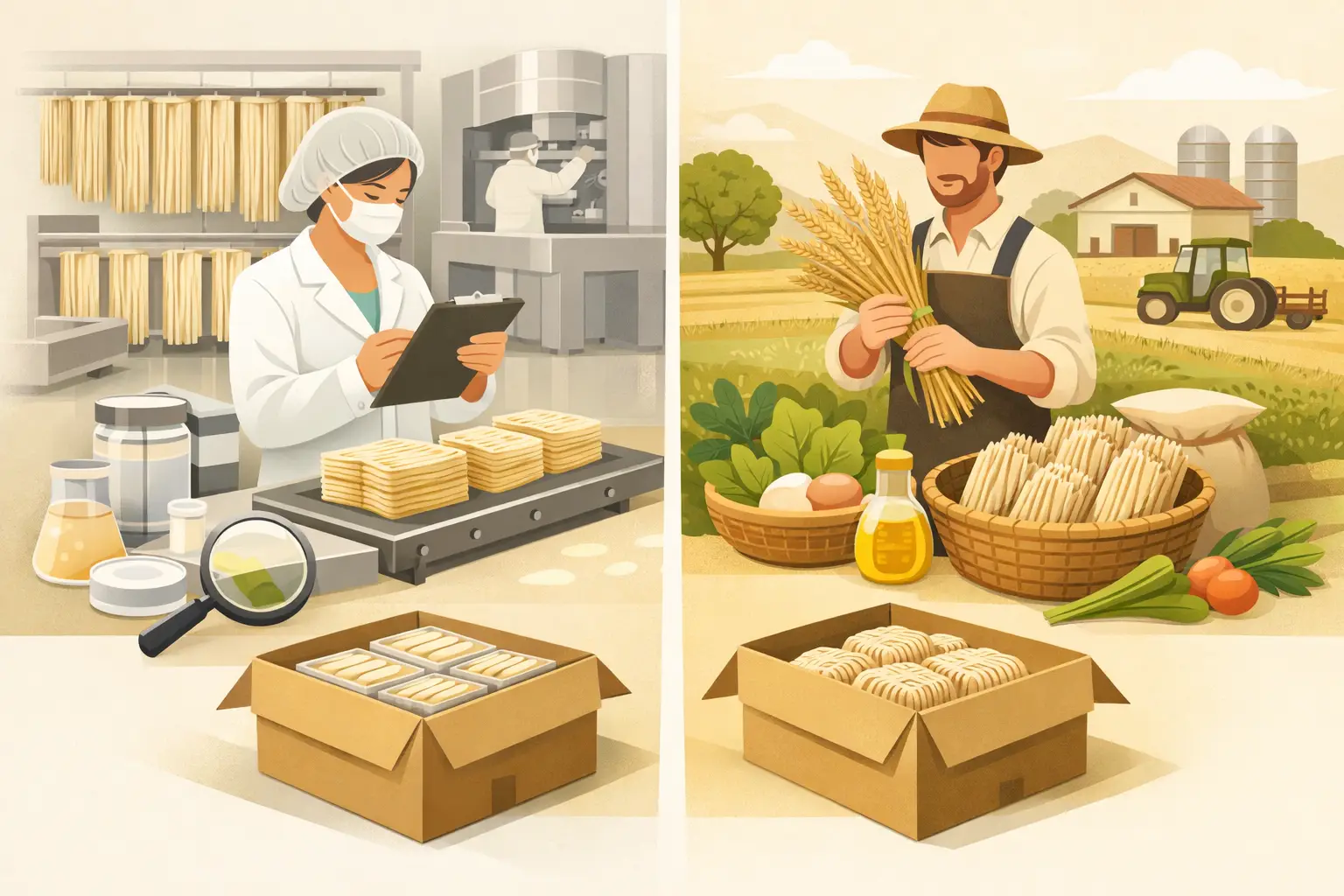
Organic is different. Organic claims are typically linked to established standards covering how agricultural ingredients are grown, handled, and processed. That means the claim is not only about what appears on the label. It also depends on how raw materials are sourced and whether the product meets the requirements of the relevant certification system in the target market.
This is why the two concepts should not be treated as substitutes. Clean label is often perception-led and formulation-led. Organic is standards-led and certification-led.
Why the distinction matters for noodle product development
In noodles, these choices shape the product from the start. If your goal is a clean-label noodle, you may focus on reducing unnecessary additives, simplifying seasoning components, or choosing ingredients that support a more familiar declaration on pack. If your goal is an organic noodle, your development path starts earlier - with eligible organic raw materials, segregation controls, documentation, and certification alignment.
For B2B buyers, this affects more than brand messaging. It influences supplier selection, manufacturing controls, packaging claims, audit readiness, and export planning. A clean-label concept may be relatively flexible depending on your internal standards and market expectations. An organic concept usually requires a more structured chain of compliance.
What clean label usually means in food manufacturing
Clean label is not a fixed checklist. Different brands define it differently based on category, customer expectations, and target market. In one market, clean label may mean no artificial colors, flavors, or preservatives. In another, it may also include non-fried formats, familiar pantry-style ingredients, or exclusion of certain texturizers and stabilizers.
For noodle manufacturers, clean label often becomes a formulation exercise. The product team looks at which ingredients are functionally necessary, which can be simplified, and which may create concerns for customers seeking a more natural or minimally complicated profile. This is especially relevant for dry noodles, where format, texture, cooking performance, and ingredient declaration all need to stay commercially viable.
That trade-off is important. A shorter ingredient list can support market appeal, but it also needs to work in production. Texture, machinability, breakage control, and finished product consistency still matter. Clean label is not just about removing ingredients. It is about reformulating responsibly so the product remains stable, scalable, and fit for its intended market.
What organic means in a commercial supply chain
Organic claims are more technical. They depend on approved agricultural practices and verified handling throughout the supply chain. If wheat flour, vegetable powders, or seasonings are part of the product, those inputs must meet the applicable organic requirements for the intended claim.
For buyers, this usually means higher attention to traceability and documentation. Organic product development is not simply a packaging decision made at the end. It begins with ingredient sourcing and continues through storage, handling, production controls, and certification processes. If one key ingredient cannot be sourced in compliant form, the claim strategy may need to change.
This creates both value and complexity. Organic can be a strong positioning tool in the right category, but it is less flexible than a general clean-label approach. The supply chain has to support it consistently, not just occasionally.
Can a product be both clean label and organic?
Yes, but not automatically.
A noodle product can be organic and still have a relatively complex ingredient list if the permitted ingredients meet organic requirements. On the other hand, a noodle can have a very simple, recognizable formula and still not qualify as organic because its agricultural ingredients were not sourced under organic standards.
The strongest overlap happens when a product is designed with both goals from the beginning. That means choosing compliant raw materials while also keeping the formulation simple and commercially practical. For some brands, this combination makes sense in premium retail or child-focused product concepts. For others, the added sourcing complexity may not match the target price point or volume strategy.
So the answer is not whether one is better than the other. It depends on the product brief, the target market, and what the claim is expected to achieve.
Which claim is easier to execute?
In most cases, clean label is easier to execute than organic.
That is because clean label gives brands more room to define the standard they want to follow. A manufacturer can work with the customer to simplify ingredients, remove selected additives, or create a more straightforward formula without necessarily entering a full certification pathway. There are still technical and commercial limits, but the route is generally more adaptable.
Organic usually requires a more committed supply chain structure. Ingredient availability can be narrower, documentation requirements are stricter, and claim management must be handled carefully. This does not make organic impractical. It simply means the operational demands are higher, especially for brands managing multiple SKUs or export destinations.
For many B2B buyers, clean label becomes the first step because it aligns with current market demand while remaining more manageable in cost and sourcing. Organic may follow later when the business case is clear and the supply chain is ready.
How to choose between clean label and organic
The right choice starts with your commercial objective, not the claim itself.
If your goal is broader market accessibility, simpler communication, or a healthier-positioned noodle concept without unnecessary formulation complexity, clean label may be the more practical direction. This is often relevant for private-label dry noodles, air-dried formats, and family-oriented product lines where ingredient clarity supports the brand story.
If your goal is to enter a category where organic certification is expected or strongly valued, then organic may be worth the additional sourcing and compliance effort. This is more likely when the target customer has a defined certification requirement or when the retail environment already segments organic as a distinct range.
It is also worth asking whether the claim supports the product itself. A claim should strengthen the overall concept, not distract from it. Texture, cooking performance, taste profile, packaging format, and consistency still drive repeat orders. Claims can support commercial success, but they do not replace product quality.
What B2B buyers should ask a manufacturing partner
When evaluating a noodle manufacturer for either route, buyers should look beyond label language. The more useful questions are operational.
Can the manufacturer support ingredient customization in a stable production environment? Is there experience with simplified formulations, air-dried formats, or child-friendly noodle concepts where label expectations may be stricter? Are quality systems and food safety controls strong enough to support consistent execution across runs and markets?
For organic projects, the questions become even more specific. Can the manufacturer align with required sourcing and handling protocols? Is the documentation discipline strong enough for export-oriented business? Does the development team understand how claim strategy affects formulation, production planning, and finished product positioning?
This is where manufacturing experience matters. A reliable partner does not just say yes to a claim request. They help assess whether the concept can be produced consistently and presented credibly in the intended market.
Clean label vs organic: the better question for brands
Often, the better question is not clean label vs organic: what's the difference? It is which claim fits your product strategy, market expectation, and supply chain reality.
A smart product brief balances market appeal with manufacturing practicality. Clean label may offer flexibility and faster route-to-market. Organic may offer stronger category differentiation where certification is commercially meaningful. In some cases, a hybrid direction works. In others, keeping the product simple, well-made, and clearly positioned is the stronger business move.
For brands developing dry noodle products, the goal should be clarity from the start. Define what the claim needs to mean for your customer, then build the formulation and sourcing model around that decision. That usually leads to a better product and a more dependable launch.
If you are planning a new noodle range, the most useful starting point is not the trend term on the pack. It is whether the product can deliver the right balance of ingredient strategy, production consistency, and market fit over time.