
A noodle brief that simply asks for a "better texture" is rarely enough to produce a market-ready product. A successful custom noodle formulation process converts a commercial idea into specifications that can be manufactured consistently, packed correctly, and delivered under a brand's required quality standards. For private-label brands, importers, and foodservice operators, this work determines far more than the noodle's appearance. It affects cooking performance, ingredient positioning, production efficiency, and suitability for the intended market.
The strongest projects begin with a clear understanding of the product's job. Is the noodle designed for a retail meal kit, a restaurant kitchen, a distributor's value range, or a child-focused product line? Each use case creates different priorities. A noodle that must remain springy after stir-frying has different requirements from one intended to soften quickly in soup. Formulation is therefore a structured development process, not a matter of choosing a flavor or changing one ingredient.
Start With a Commercial Product Brief
Before flour is selected or a production trial is scheduled, the manufacturer and buyer should define what the finished noodle needs to achieve. This includes the noodle style, cooking method, target texture, portion format, ingredient preferences, packaging concept, and expected market channel.
For example, a brand may need a dry Asian noodle that cooks reliably in a short service window for foodservice customers. Another may be building a clean-label retail concept and require a shorter, more recognizable ingredient statement. A third may need smaller portions and an easy-to-handle format for a child-friendly range. These are not minor variations. They influence formulation choices from the outset.
Commercial expectations also need to be realistic. Increasing protein-rich or fiber-containing ingredients, reducing certain additives, or using alternative raw materials can change dough handling, color, bite, and cooking tolerance. The goal is not to pursue a single feature in isolation. It is to reach a practical balance between product positioning, sensory performance, cost structure, and scalable manufacturing.
The Custom Noodle Formulation Process in Practice
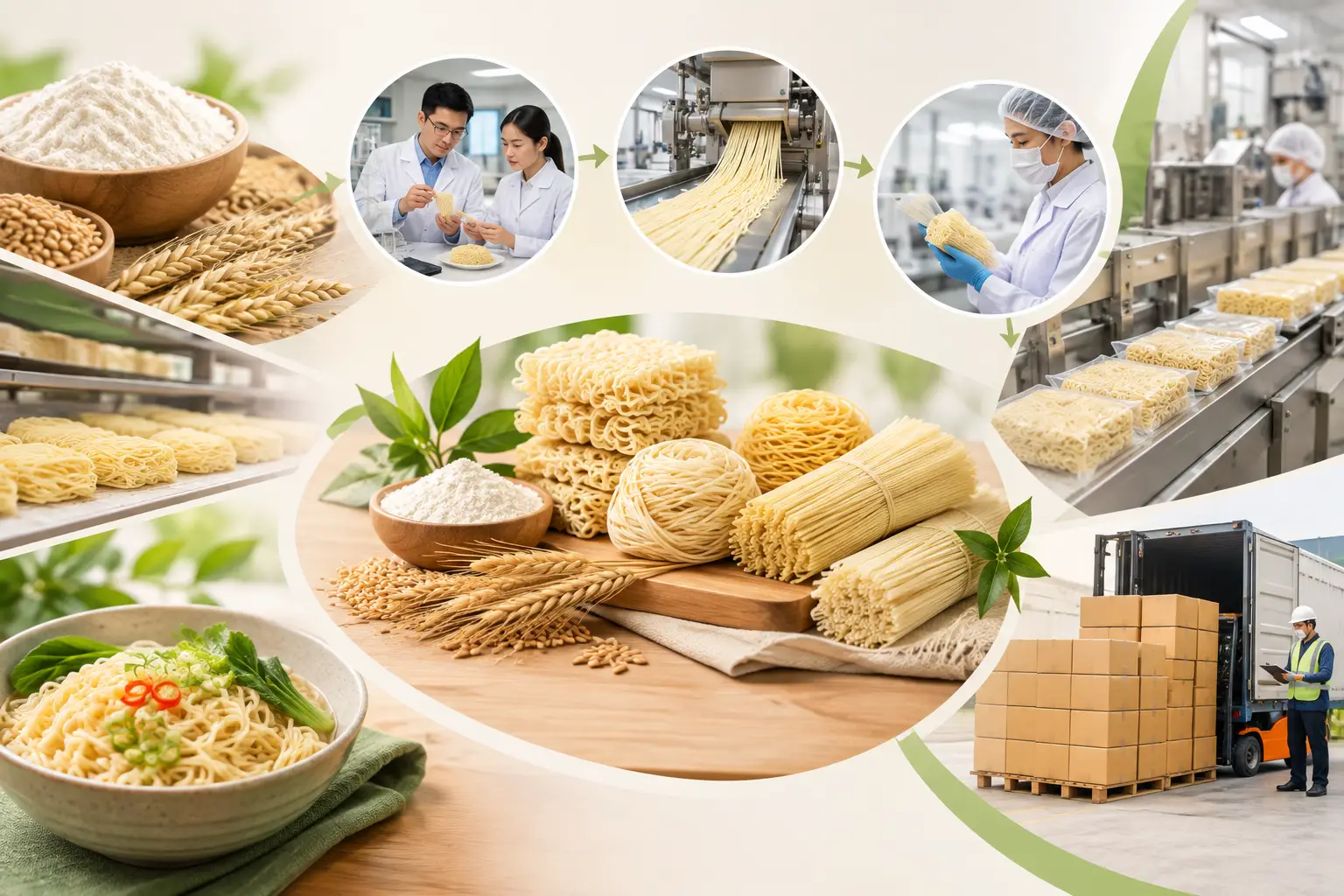
A disciplined custom noodle formulation process usually moves from concept definition to bench evaluation, production trials, validation, and final specification. While the steps may overlap, each stage answers a different business question: Can the noodle meet the desired product concept? Can it be made consistently at production scale? Can it retain its intended quality through packing, shipping, and use?
Select the Base Ingredients and Noodle Style
The base flour or starch system is central to noodle character. It influences dough strength, color, elasticity, surface smoothness, and the final bite. Depending on the requested noodle format, the development team may evaluate different wheat flour characteristics, starch components, or other approved ingredients that support the desired texture and processing behavior.
Water level and dough development are equally important. Dough that is too dry may not sheet or cut consistently. Dough that is too soft can become difficult to process and may affect the noodle's final structure. Salt, alkaline agents where appropriate for the noodle style, and other functional ingredients are assessed for their contribution to handling and eating quality.
At this stage, traditional noodle knowledge matters. The formulation should respect what makes a given Asian noodle style recognizable while allowing room for brand-specific differentiation. A premium retail product may prioritize a firm, resilient bite. A convenient family format may prioritize easy cooking and broad consumer familiarity. Neither approach is automatically better. The right choice depends on the product's market role.
Define Texture Through Cooking Performance
Texture cannot be judged only when the dry noodle leaves the production line. It must be tested after cooking in the way the customer expects it to be used. Development teams assess factors such as hydration, firmness, elasticity, surface feel, breakage, and the noodle's ability to hold its structure after standing in broth or sauce.
This is especially relevant for foodservice and export-oriented products. A noodle may perform well immediately after cooking but soften too quickly during holding, delivery, or final preparation. In other cases, a product formulated for a firm bite may require a cooking time that does not suit the intended kitchen operation. Testing should reflect real handling conditions as closely as possible.
Air-dried and fried noodle formats also require different considerations. Air-dried noodles can support certain product-positioning goals and may offer a distinct eating profile, while fried noodles follow a different processing route and can deliver different preparation characteristics. The most suitable format depends on the brand's concept, target channel, and desired consumer experience.
Build Ingredient Positioning Without Compromising Manufacturability
Many B2B buyers are developing products around clean-label preferences, simpler ingredient approaches, or tailored nutritional positioning. These requests can be commercially valuable, but they should be evaluated with manufacturing discipline rather than treated as label-only changes.
An ingredient adjustment can affect the entire system. It may alter water absorption, dough tolerance, sheeting behavior, drying response, flavor, or color. A formulation that looks attractive on paper may need further work before it can run reliably at scale. This is why product development should include both ingredient review and practical line trials.
For infant, toddler, and child-oriented noodle concepts, formulation decisions require additional care around noodle size, bite, cooking behavior, and ingredient suitability for the product brief. The development focus should remain on producing a consistent, age-appropriate format aligned with the buyer's specifications and applicable market requirements.
Scale-Up Is Where the Formula Is Proven
A promising sample is not yet a finished commercial product. The move from development work to full production introduces variables that must be controlled: mixing, resting, rolling or sheeting, cutting, steaming or frying where relevant, drying, cooling, and packing.
Each stage can influence consistency. Small changes in dough moisture, sheet thickness, cutting precision, or drying conditions may affect noodle appearance and cooking quality. An experienced OEM or ODM manufacturer evaluates the formulation alongside the process settings needed to reproduce it batch after batch.
Scale-up also identifies trade-offs early. A highly customized formula may require tighter process control or may create more production complexity than a standard format. That does not mean customization is unsuitable. It means the commercial team should make decisions with a clear view of the operational implications. Often, a carefully adjusted formulation can preserve the brand's point of difference while improving repeatability and production efficiency.
Packaging Must Protect the Intended Product Experience
Packaging is part of formulation success because it supports the quality of the noodle after it leaves the factory. The appropriate pack format depends on noodle fragility, portion requirements, retail display needs, foodservice handling, and export logistics.
For dry noodles, breakage control is a practical concern. Noodle length, bundle structure, pack dimensions, and secondary packaging all affect how the product travels through distribution. Portion-controlled formats may add convenience for foodservice or retail meal applications, while multi-pack formats may suit family-oriented or wholesale channels.
The packaging specification should also match the information required by the destination market and the buyer's brand standards. Early alignment between product development, quality teams, and packaging stakeholders prevents late changes that can delay a launch or create unnecessary rework.
Quality Systems Should Be Built Into Development
For B2B buyers, a good noodle is not only one that tastes or performs as expected. It is one produced within dependable food safety and quality systems. Ingredient approval, process controls, traceability, hygiene practices, inspection points, and documented specifications all support confidence in the finished product.
Tehki Food operates with ISO 22000, HACCP, GMP, MeSTI, and Halal certifications, providing a structured foundation for OEM and ODM noodle development. For buyers serving multiple markets, this type of quality framework helps support supplier assessment and more organized product onboarding.
Quality discussions should begin before final approval, not after the first production order. Clear specifications for noodle dimensions, color range, moisture-related controls, cooking expectations, pack configuration, and labeling responsibilities reduce ambiguity between buyer and manufacturer. Where export markets are involved, the buyer and manufacturer should also confirm destination-specific requirements during the project planning stage.
A Better Brief Produces a Better Noodle
The most efficient development projects are collaborative. Buyers bring market knowledge, brand direction, and channel requirements. Manufacturers bring formulation experience, process understanding, and quality control discipline. When both sides define priorities clearly, the result is more likely to be distinctive enough for the market and practical enough for long-term supply.
A useful starting brief should describe the intended noodle type, use occasion, target texture, preferred ingredients, portion size, packaging direction, and destination market. It should also state which requirements are essential and which can be adjusted after trials. That distinction helps the development team solve the right problems first.
For a new private-label noodle launch or an existing range that needs refinement, the best next step is a detailed product discussion. A well-managed formulation process gives your brand a noodle built not just for a promising sample, but for consistent production and confident market delivery.