
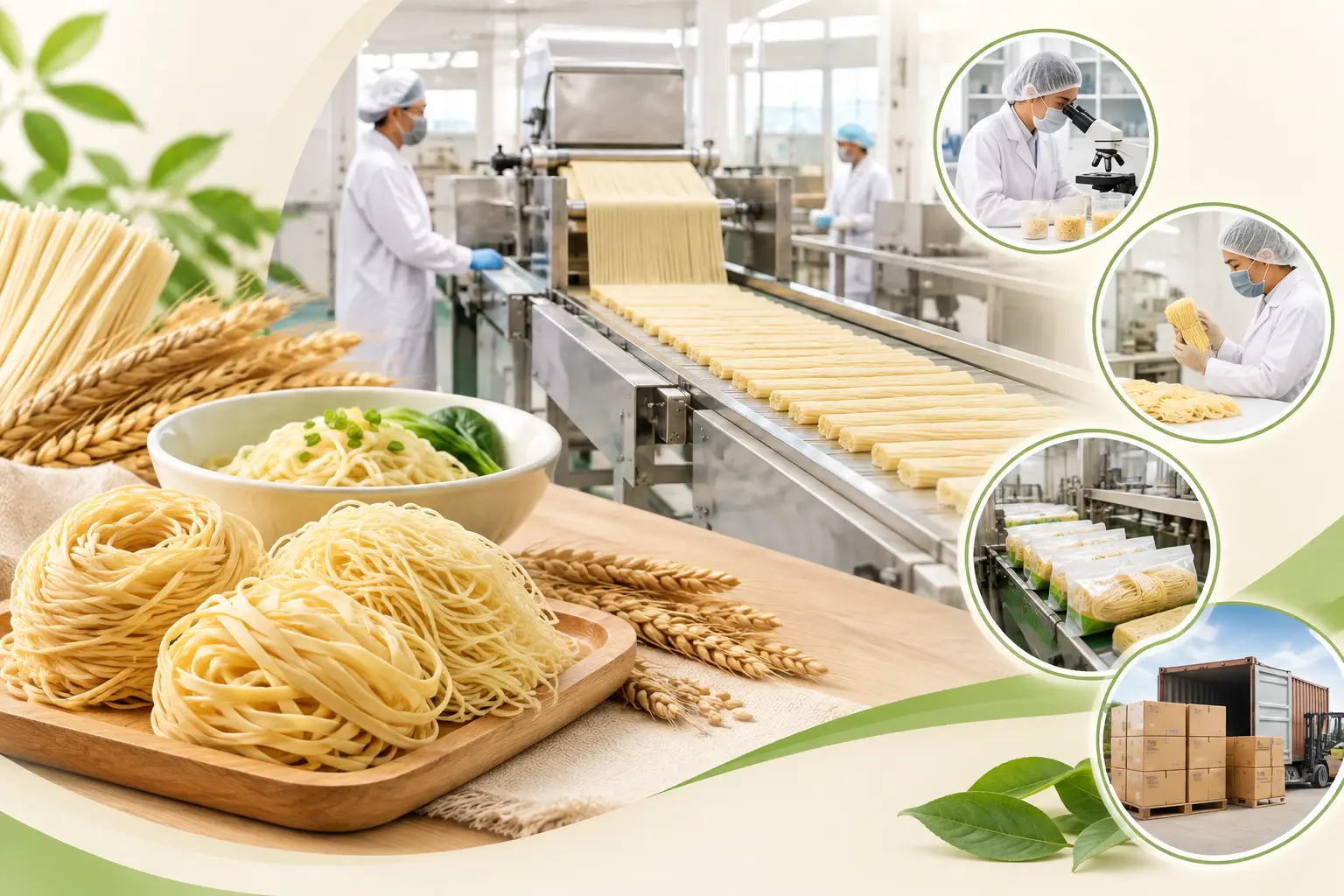
A noodle brand does not begin when a package reaches the shelf. It begins with decisions that affect eating quality, production efficiency, labeling, distribution, and repeat orders. What is custom noodle manufacturing? A guide to developing your own noodle brand starts with understanding how an experienced manufacturer turns a commercial idea into a consistent, market-ready dry noodle product.
For brand owners, importers, distributors, and foodservice buyers, custom manufacturing offers a practical way to enter or expand the noodle category without building and operating a factory. The value is not simply placing a logo on an existing item. It is working through the product choices that make the noodle appropriate for a specific market, channel, price position, and customer need.
What Is Custom Noodle Manufacturing?
Custom noodle manufacturing is the development and production of noodles to a buyer’s agreed specifications. Depending on the project, those specifications may cover noodle style, ingredients, thickness, texture, cooking performance, portion format, packaging, and outer-carton requirements.
The process can take two main forms. OEM manufacturing generally means producing an established or buyer-defined product under the buyer’s brand. ODM manufacturing involves more manufacturer-led development, where the buyer selects and adapts a product concept or platform with technical guidance from the factory. The right route depends on how clearly defined the product is, how much customization is needed, and how quickly the brand needs to move from concept to launch.
For example, a distributor may require a proven air-dried noodle format in retail-ready packaging. A food company may need a more tailored formulation, a specific noodle bite, or small portions designed for a child-friendly range. Both are custom manufacturing projects, but they require different levels of product development.
Why Brand Owners Use a Noodle Manufacturing Partner
Building internal noodle production requires specialized equipment, ingredient sourcing systems, quality controls, trained operators, packaging capability, and ongoing maintenance. For most companies entering a new category, this is a major operational commitment before demand is proven.
A capable manufacturing partner allows the brand to focus on market positioning, distribution, sales, and customer relationships while production is handled within an established food manufacturing system. This can reduce complexity, but it does not remove the need for careful planning. The buyer still needs to define what the product must achieve commercially and operationally.
The strongest partnerships are built around more than product supply. They involve practical conversations about manufacturing feasibility, ingredient behavior, packaging fit, expected handling conditions, and the level of consistency needed as sales grow. A noodle that performs well in a development sample must also be produced reliably at commercial scale.
The Decisions That Shape Your Noodle Brand
Choose the noodle format before finalizing the concept
The first decision is usually the noodle format. Dry Asian noodles can be produced in different styles and processing methods, each with its own market fit. Air-dried noodles may support a lighter product positioning and can appeal to buyers seeking alternatives to fried noodle formats. Fried noodles offer their own familiar preparation characteristics and may suit particular instant noodle concepts.
Noodle type also affects cooking time, texture, sauce absorption, breakage resistance, and how the product is perceived by the end user. Thin noodles, broad flat noodles, wavy formats, and other regional Asian styles should not be selected only for visual appeal. The choice must work with the intended meal occasion and preparation method.
A foodservice operator may prioritize speed and consistency in a busy kitchen. A retail brand may need portions that are easy to understand and prepare at home. An importer may be focused on whether the format can travel and fit the expectations of a target market. A clear use case makes later development decisions more efficient.
Define texture and cooking performance
Texture is one of the main reasons consumers return to a noodle product. It is also one of the most difficult features to describe without structured sampling. Terms such as firm, smooth, springy, chewy, or tender are useful starting points, but they need to be translated into specifications that can be repeated in manufacturing.
Flour selection, starches, water absorption, dough handling, sheeting, cutting, drying, and frying or air-drying conditions all influence the final result. Small adjustments can change the noodle’s behavior in hot water, broth, stir-fry applications, or holding conditions.
This is where samples are essential. Buyers should evaluate noodles under realistic preparation conditions, not only by tasting them immediately after cooking. Consider how the noodle performs with the planned sauce or soup base, whether it retains its intended texture, and whether it remains suitable for the expected serving process.
Consider ingredient and positioning requirements early
Many private-label noodle projects begin with a positioning goal, such as a simpler ingredient approach, vegetable-inclusive formulation, a child-friendly concept, or a product suitable for a particular dietary preference. These goals should be discussed early because ingredient changes can influence dough processing, appearance, taste, and texture.
A clean-label direction, for example, is not only a label decision. The manufacturer needs to assess whether the selected ingredients can deliver the desired product quality consistently. Likewise, products developed for infants and toddlers need careful consideration of noodle size, texture, preparation expectations, and appropriate product design.
The most practical approach is to prioritize the requirements that matter most to the target buyer. Trying to solve every possible consumer preference in a single product can create unnecessary complexity and weaken the core proposition.
Build packaging around the channel
Packaging is part of the product system, not an afterthought. It protects the noodles, communicates the brand, supports handling, and influences how easily the product moves through retail, wholesale, or foodservice channels.
Retail packs may need clear portion communication, preparation instructions, and strong shelf presentation. Foodservice packs may place more emphasis on operational convenience and bulk handling. For export projects, the outer carton configuration, product protection, and documentation requirements should be considered alongside the primary pack.
Packaging design must also match manufacturing realities. The selected pack format, dimensions, and material need to work with the factory’s packing process and the noodle’s physical characteristics. A well-designed package that causes excessive noodle breakage or inefficient packing is not a practical commercial solution.
From Brief to Commercial Production
A productive custom noodle project starts with a complete brief. The brief does not need to be overly technical, but it should answer the questions that guide development: Who is the target customer? Where will the product be sold? What noodle style is required? How will it be prepared? What package format is preferred? Are there ingredient, labeling, or market-entry requirements to consider?
After the brief, the manufacturer typically reviews feasibility and recommends an appropriate development path. This may involve selecting an existing format, modifying a current product, or creating a more tailored specification. Samples and feedback then narrow the gap between the initial idea and the product standard.
Once specifications are agreed, the project moves toward packaging confirmation, production planning, quality requirements, and commercial production. At this stage, consistency matters as much as product appeal. Brands should expect alignment on approved samples, product specifications, pack details, and quality checkpoints rather than relying on informal descriptions.
Quality Systems Matter in Private-Label Noodles
When your name is on the package, manufacturing discipline becomes part of your brand reputation. Buyers should look beyond product appearance and ask how quality is managed from ingredient receipt through processing, packing, and finished-product release.
Relevant food safety systems, documented procedures, traceability practices, hygiene controls, and trained production teams provide a stronger foundation for reliable supply. Certifications such as ISO 22000, HACCP, GMP, MeSTI, and Halal can be meaningful indicators of an established quality framework when they are relevant to the buyer’s market and product requirements.
However, certificates alone do not guarantee that every project will run smoothly. Good communication remains essential. The manufacturer should understand the agreed product standard, while the buyer should provide timely approvals and clear feedback. Quality is most dependable when both parties treat specifications as working documents, not paperwork completed only at launch.
Selecting a Manufacturing Partner
The best manufacturer is not necessarily the one offering the widest catalog. It is the one whose capabilities match the product and business model you are building. Evaluate whether the factory has experience with your required noodle format, whether it can support the desired degree of customization, and whether its quality systems align with your sourcing expectations.
It is also useful to assess how the manufacturer communicates during development. Direct questions about formulation feasibility, packaging limitations, product handling, and export preparation should receive practical answers. A dependable partner will identify trade-offs early instead of approving every request without examining how it affects quality or scalability.
For businesses sourcing dry Asian noodles from Malaysia for local or international markets, Tehki Food supports OEM and ODM development across air-dried, fried, and customized noodle formats. The goal should be a product specification that can be produced consistently, presented credibly, and adapted to the needs of the intended channel.
Start With a Clear Commercial Brief
A successful noodle brand is rarely defined by one feature alone. It is the result of compatible choices: the right format for the market, a texture that meets expectations, ingredients that support the positioning, packaging that fits the channel, and a manufacturer equipped to repeat the result.
Before requesting a sample, write down the commercial job your noodle must do. That clarity gives a manufacturing partner the information needed to recommend realistic options and helps turn a promising concept into a product your business can confidently build around.