
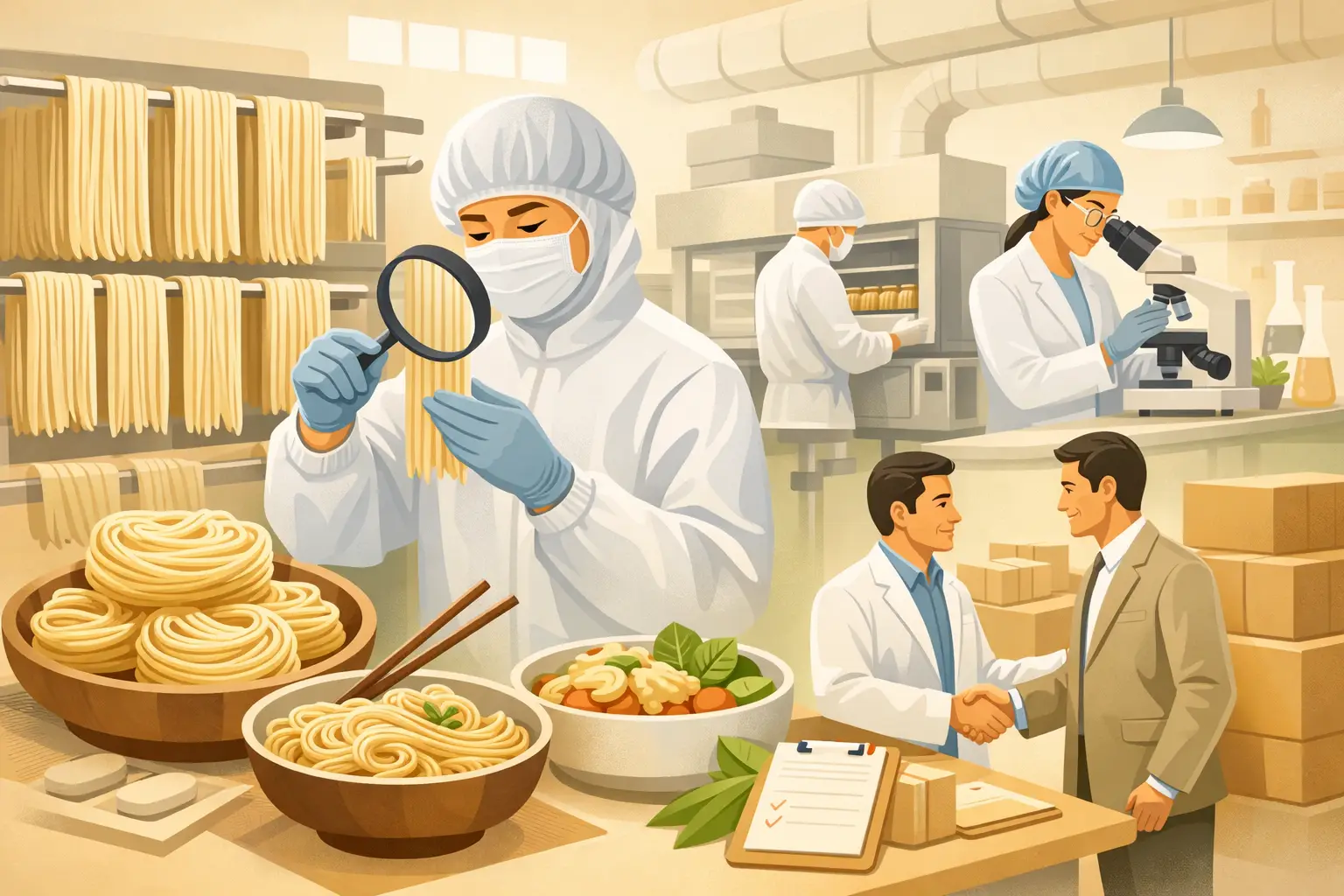
A noodle product can look consistent on the outside and still create costly problems if food safety controls are weak. For brand owners, importers, and foodservice buyers, food safety in noodle manufacturing is not a box to tick after product development. It is part of how a noodle line earns trust, supports repeat orders, and stays commercially viable across different markets.
In dry noodle production, small process gaps can have outsized consequences. A change in raw material quality, poor moisture control, weak allergen handling, or inconsistent sanitation can affect product integrity long before issues appear in the market. That is why experienced manufacturers treat food safety as an operating discipline tied directly to quality, consistency, and customer confidence.
Why food safety matters beyond compliance
For B2B buyers, food safety is closely tied to risk management. A manufacturer may offer attractive product formats or customization options, but if its control systems are weak, every shipment carries unnecessary exposure. Product withdrawals, rejected consignments, customer complaints, and damaged brand reputation are far more expensive than preventive controls built into production.
This matters even more for private-label and export-oriented noodles. When a buyer places its own brand on the pack, the manufacturing partner becomes an extension of that brand. The buyer is not only purchasing noodles. It is purchasing process discipline, documentation standards, and consistency from batch to batch.
Food safety also affects commercial flexibility. A manufacturer with structured systems is generally better positioned to manage product variations, support OEM and ODM development, and maintain control when specifications change. That becomes important when developing air-dried noodles, fried noodles, child-oriented formats, or customized formulations with specific ingredient and packaging requirements.
Food safety in noodle manufacturing starts with raw materials
The process does not begin at mixing. It starts with supplier approval, raw material specifications, and incoming inspection. Wheat flour, starches, oils, additives, and packaging materials all need clear acceptance criteria. If the incoming material is inconsistent or poorly controlled, downstream corrective action becomes harder and more expensive.
A reliable noodle manufacturer evaluates suppliers against documented quality and safety expectations. That may include ingredient traceability, certificate review, physical inspection, and testing protocols based on risk. Not every ingredient carries the same level of concern, so controls should match the product type and intended market.
For example, infant or toddler noodle concepts often demand closer scrutiny over ingredient suitability and production handling than a standard commodity line. The principle is simple: the more sensitive the application, the more disciplined the material control needs to be.
Process control is where safety and consistency meet
In noodle manufacturing, food safety and product consistency are closely connected. Mixing parameters affect dough performance. Sheeting and cutting influence structure and uniformity. Steaming, frying, or drying conditions affect moisture behavior and stability. Cooling and packing determine whether the product remains protected after processing.
Critical control points (CCP) and operational controls should be defined clearly, then monitored consistently. In dry noodle production, moisture management is one of the most practical examples. Excess moisture can compromise product stability, while uncontrolled variation can affect texture, appearance, and storage performance. The target is not only a safe product, but a repeatable one.
Sanitation is another area where discipline matters. Equipment design, cleaning frequency, line clearance, and environmental hygiene all contribute to overall control. A strong factory does not rely on end-product testing alone. It prevents problems by controlling the production environment and reducing opportunities for contamination before the product reaches final packaging.
Certifications matter, but daily execution matters more
Business buyers often look for certifications such as ISO 22000, HACCP, GMP, MeSTI, and Halal because they provide confidence that a manufacturer operates within recognized systems. That confidence is justified. These frameworks help standardize hazard analysis, process controls, documentation, and continuous improvement.
Still, a certificate on its own is not enough. Buyers should care about how those systems are practiced on the factory floor. Are deviations recorded and investigated? Are staff trained by function? Are cleaning and maintenance routines documented and verified? Is traceability usable in real operational conditions, not just during an audit?
The difference between a basic supplier and a dependable manufacturing partner often shows up here. Strong food safety culture is visible in routine behavior, not only in audit preparation. That is especially relevant for businesses planning long-term private-label programs or export growth, where consistency over time matters more than one successful inspection.
Allergen control and product changeovers need careful planning
Noodle production plants that handle multiple formulations face a practical challenge: flexibility can increase complexity. A facility that supports different noodle types, ingredients, seasoning profiles, or packaging formats must manage changeovers carefully to reduce cross-contact risk and maintain specification accuracy.
This is where scheduling, line clearance, labeling control, and verified cleaning become commercially important. A manufacturer may be technically capable of broad customization, but if changeovers are poorly controlled, that flexibility can create avoidable food safety and quality issues.
For B2B customers, this has direct implications for product portfolio planning. It may influence how SKUs are grouped, how ingredients are selected, and how launch schedules are structured. The right manufacturing partner will discuss these trade-offs early rather than treating every custom request as identical in risk or operational complexity.
Traceability supports faster decisions when problems arise
No food manufacturer can promise a zero-issue environment forever. What matters is whether systems are strong enough to detect, isolate, and respond quickly when something goes wrong. Traceability is central to that capability.
A good traceability system connects raw materials, production batches, packaging materials, and shipment records in a way that allows fast retrieval of accurate information. For buyers, this reduces uncertainty and helps contain commercial disruption if an investigation is needed.
Traceability also supports ordinary business operations, not just crisis response. It helps validate consistency, review supplier performance, and support specification management across multiple SKUs or markets. In that sense, traceability is both a food safety tool and a management tool.
Export readiness depends on disciplined food safety systems
For companies sourcing noodles for international markets, food safety expectations often become more demanding. Documentation quality, labeling accuracy, certification alignment, and process consistency carry greater weight when products are moving across borders and through multiple distribution points.
Export-ready manufacturing is not only about making a stable dry noodle. It is about maintaining records, controlling product identity, and supporting customer requirements with structured systems. A manufacturer serving international B2B customers needs to understand that market access and product credibility are linked to operational discipline.
This is one reason manufacturers in Malaysia with established food safety systems can bring practical value to regional and global buyers. The ability to combine Asian noodle manufacturing know-how with formalized safety and quality controls is useful for importers and brand owners that need both authenticity and reliability.
What buyers should ask a noodle manufacturer
When evaluating a supplier, buyers should look beyond broad claims about quality. Ask how hazards are identified in each production stage. Ask how moisture, sanitation, and changeovers are controlled. Ask what happens when a batch falls outside specification. Ask how traceability works in practice and how documentation supports export or private-label requirements.
It is also reasonable to ask how the manufacturer handles customized development without weakening control. Not every factory is equally prepared to support product variation at scale. That does not mean customization is a problem. It means the process behind customization needs to be mature.
An experienced partner such as Tehki Food understands that food safety is not separate from commercial performance. It supports product consistency, customer trust, and long-term brand growth across OEM, ODM, and private-label programs.
The strongest noodle partnerships are built on more than capacity and price. They are built on confidence that every batch is produced under disciplined conditions, with systems that protect both the product and the brand behind it. That is what makes food safety worth discussing early, not after the first order is already in motion.