
A noodle that carries a better-for-you position but breaks during packing, cooks unevenly, or loses its familiar bite will not build repeat business. The future of functional noodles depends less on adding a fashionable ingredient and more on turning a clear product idea into a stable, enjoyable, export-ready format that can be produced consistently.
For brand owners, distributors, and foodservice operators, this category is moving beyond broad health messaging. Buyers are looking for products with recognizable ingredients, credible nutritional positioning, convenient preparation, and a texture that still feels right for the noodle style. The opportunity is substantial, but successful development requires decisions across formulation, processing, packaging, quality control, and market fit.
Functional Means More Than an Added Ingredient
In noodles, “functional” can refer to products developed around specific formulation goals. These may include higher-protein concepts, fiber-containing recipes, vegetable-based ingredients, whole-grain components, reduced-sodium seasoning systems, or child-friendly formats with carefully selected ingredients. The right direction depends on the intended customer, channel, price position, and applicable labeling requirements in the destination market.
A functional claim should never be treated as a shortcut to differentiation. An ingredient may support a product story, but it can also affect dough handling, color, flavor, cooking performance, and cost. For example, increasing plant-based protein or fiber content may change water absorption and reduce dough extensibility. A vegetable powder can add color and character, yet it may also introduce flavor notes that need to work with the final soup base or sauce application.
The strongest products make the functional element feel natural to the eating experience. They start with a clear question: what problem does this noodle solve for the buyer or end user? A quick-service operator may need a portion-controlled noodle that holds well in broth. A retail brand may want an air-dried product with a clean-label direction. A family-focused line may prioritize a smaller portion and a softer, age-appropriate noodle format. These are different briefs, even when they use similar ingredients.
The Future of Functional Noodles Is Texture-Led
Texture remains the commercial test that functional noodle concepts must pass. Consumers may be willing to try a new formulation once, but they will compare its chew, smoothness, elasticity, and cooking reliability with noodles they already know.
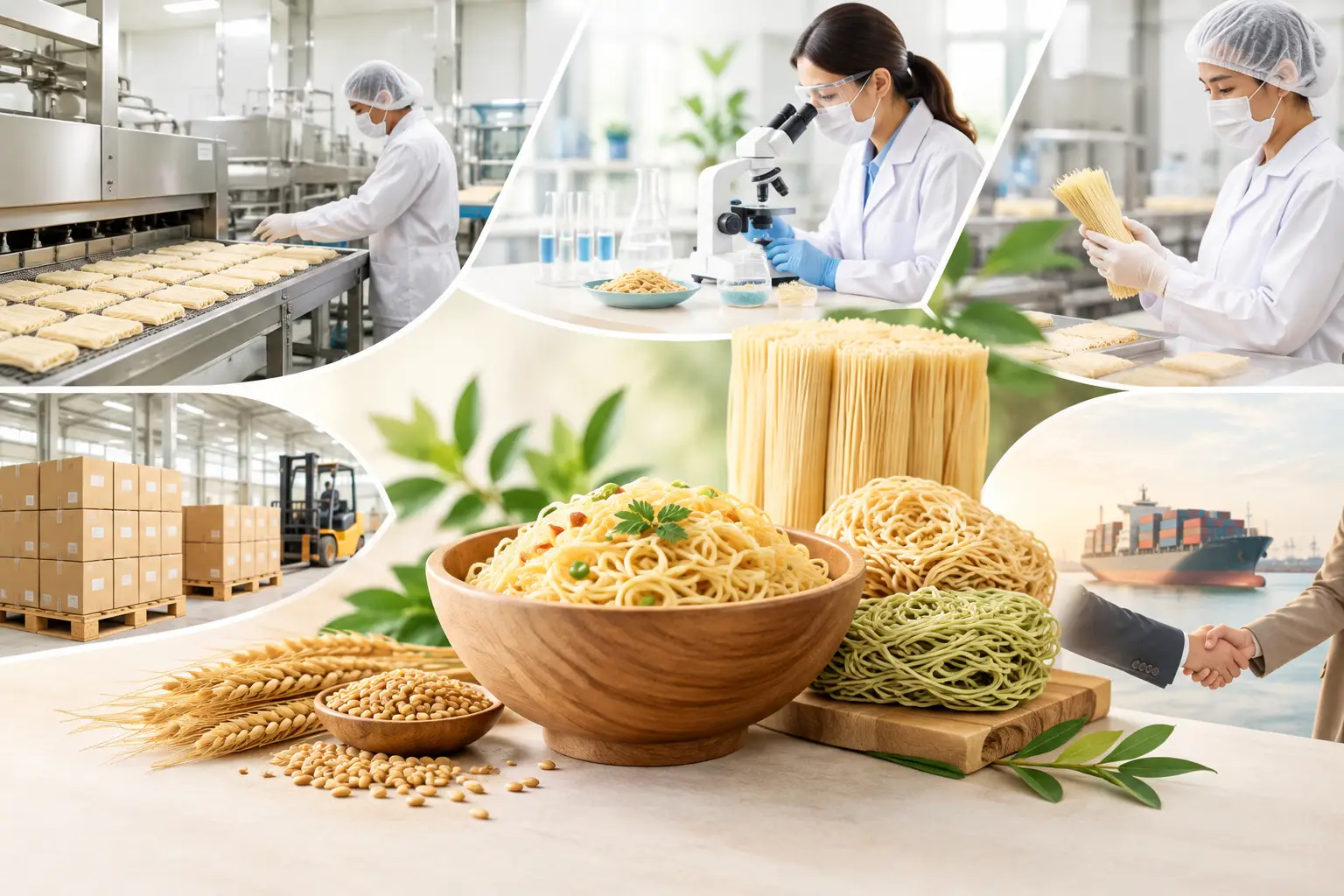
This is where manufacturing knowledge matters. Flour selection, particle size, protein level, water ratio, resting time, sheeting, cutting, steaming, frying or air-drying, and final moisture control all influence the finished noodle. When alternative ingredients are introduced, each of these variables may need adjustment. A formula that performs in a small kitchen trial is not automatically ready for full-scale production.
Air-dried noodles are likely to remain an important platform for functional innovation. They provide a familiar dry-noodle format while giving product developers flexibility to work on ingredient and nutrition positioning. However, air-drying is not a universal answer. The desired noodle type, target texture, preparation method, product cost, and market expectations should determine whether air-dried or fried processing is the better fit.
For foodservice customers, cooked holding performance deserves early attention. A noodle that is excellent immediately after cooking may soften too quickly in a delivery bowl or buffet application. For retail, the priority may be consistent preparation across different home kitchens. Product development should evaluate the actual serving situation rather than relying on a single cooking test.
Clean Labels Will Need Practical Definitions
“Clean label” remains influential, but it means different things in different markets. Some buyers are focused on shorter ingredient lists. Others prioritize familiar ingredients, transparent labeling, or the absence of specific additives. A useful clean-label strategy is not simply removing ingredients. It is developing a product that meets the intended label direction while maintaining safety, quality, texture, and operational consistency.
This requires practical trade-offs. Removing or replacing an ingredient can change processing behavior and shelf stability. A shorter declaration may create new demands on raw-material quality and process controls. Product teams should define their non-negotiables at the start, including ingredient restrictions, allergen considerations, target claims, preferred noodle format, and destination markets.
The earlier these decisions are made, the fewer costly revisions are needed later. An experienced OEM or ODM manufacturer can help translate a marketing brief into a technically workable specification before packaging artwork, purchase planning, or launch schedules are finalized.
Claims Need Evidence, Not Ambiguity
Functional products often fail commercially when the front-of-pack message is stronger than the formulation can support. Nutrition statements and ingredient claims should be reviewed against the rules that apply in the sales market, with substantiation and documentation handled appropriately.
For B2B buyers, this means selecting a manufacturing partner that can work from clear specifications and maintain traceable quality systems. It also means avoiding vague claims that may create compliance questions for importers, retailers, or foodservice customers. A focused, supportable proposition is more valuable than a long list of loosely defined benefits.
Customization Will Move From Novelty to Portfolio Strategy
The next generation of functional noodles will not be limited to one premium SKU. Brands will increasingly use noodle platforms to create product families for different channels and audiences. A core noodle recipe may be adapted into multiple portion sizes, noodle widths, seasoning pairings, pack formats, or nutrition-led variations.
This approach can help a business build a more coherent range while keeping sourcing and production more manageable. For example, a brand may develop a retail air-dried noodle line, a foodservice bulk format, and a child-friendly portion using related manufacturing capabilities. Each product still needs its own performance testing, but the portfolio can benefit from shared ingredient knowledge and quality standards.
Customization should be purposeful. Changing noodle shape, thickness, color, or packaging only adds value when it supports preparation, shelf presentation, portion control, market positioning, or operational efficiency. Too many variations too early can complicate inventory, forecasting, and quality management.
Export Readiness Will Shape Product Development Earlier
Functional noodle brands increasingly need to think across borders from the beginning. Importers and distributors want products that are not only differentiated, but also supported by reliable documentation, stable specifications, suitable packaging, and manufacturing systems that inspire confidence.
Export readiness affects choices that may seem minor at the concept stage. Ingredient availability must be dependable. Packaging must protect the product through its intended distribution conditions. Label space must accommodate market-specific information. Product specifications must be clear enough for purchasing, quality teams, and commercial partners to work from the same standard.
Malaysia offers a strong base for Asian noodle manufacturing because it combines regional noodle knowledge with export-oriented food production. For international buyers, the right partner should be able to discuss product format and commercial intent alongside food safety controls, certification requirements, and repeatable manufacturing processes.
What Buyers Should Ask Before Developing a Functional Noodle
Before moving into trials, procurement and product teams should align on a few essential questions. What is the product’s primary reason to exist? Which ingredient or formulation direction supports that purpose? What texture and cooking behavior are expected? Where will the product be sold and consumed? What evidence will be required for the proposed label claims?
They should also assess the manufacturer’s ability to scale the concept without losing consistency. This includes ingredient sourcing controls, batch-to-batch standards, process capability, packaging options, and relevant food safety certifications. ISO 22000, HACCP, GMP, MeSTI, and Halal certification can provide useful assurance when evaluated alongside the manufacturer’s actual quality practices and product-development process.
A good development conversation is specific. Rather than asking for a “healthy noodle,” provide a target consumer, channel, noodle style, preparation method, desired ingredient direction, preferred packaging, and key commercial constraints. That gives the manufacturer a workable starting point and helps identify trade-offs early.
Build the Product Around Repeatable Quality
The most promising functional noodle products will be those that balance market appeal with manufacturing discipline. They will offer a clear reason for being, perform reliably in the intended application, and fit a supply model that distributors, retailers, and foodservice operators can trust.
For businesses developing private-label or custom dry noodles, Tehki Food approaches this work as a manufacturing partnership: translating a product brief into practical choices around noodle type, ingredients, texture, portioning, and packaging. The useful next step is not to chase every trend, but to define the one functional proposition your market can understand, your customers can enjoy, and your supply chain can deliver consistently.