
When a noodle product performs well in one shipment but falls short in the next, the issue is rarely just the recipe. More often, it comes back to manufacturing discipline. That is where GMP food manufacturing benefits become commercially important for brand owners, importers, distributors, and foodservice buyers who need consistency they can plan around.
For B2B buyers, Good Manufacturing Practice is not a box-ticking exercise. It shapes how ingredients are handled, how production areas are managed, how staff follow procedures, and how quality is maintained from batch to batch. In practical terms, GMP helps reduce avoidable variation and supports a more dependable supply base. For businesses building a private-label noodle line or expanding into export markets, that matters far more than a certificate on paper.
Why GMP food manufacturing benefits matter in real operations
A GMP-based operation creates order where food production can easily become inconsistent. It establishes standards for sanitation, process control, equipment maintenance, personnel hygiene, storage, documentation, and corrective action. Each of those areas affects product quality, food safety, and production reliability.
For a buyer, the benefit is not abstract. If you are managing your own brand, you need products that match your specification every time. If you are importing, you need confidence that the manufacturer is operating with clear controls that can stand up to customer requirements and market expectations. If you are supplying foodservice, menu consistency depends on product consistency. GMP supports that foundation.
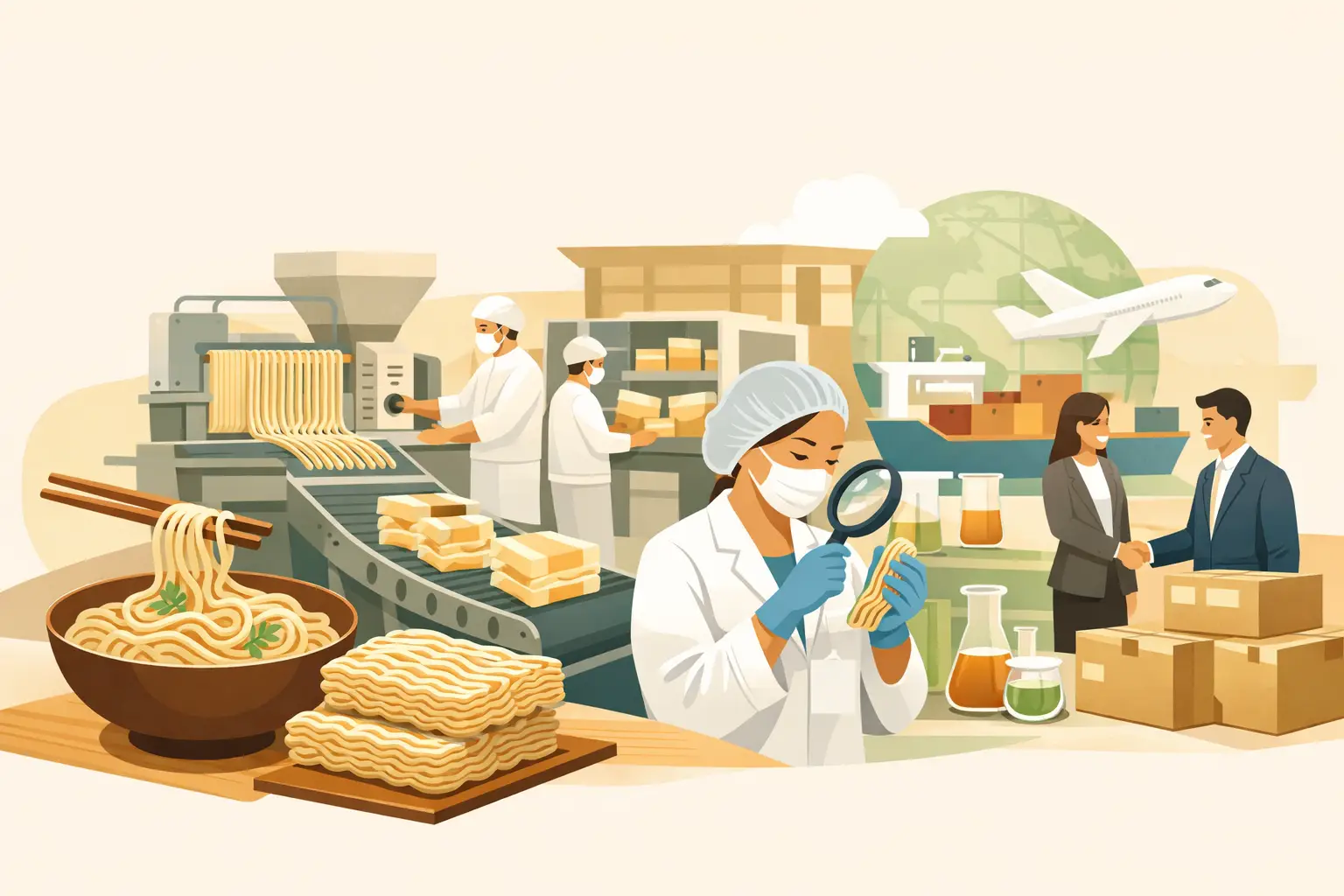
This is especially relevant in dry noodle manufacturing, where texture, thickness, moisture control, ingredient handling, and packaging accuracy all influence the final product. A manufacturer may offer many noodle formats, but without disciplined production systems, customization can create more risk instead of more value.
Better control over food safety and quality
One of the most immediate GMP food manufacturing benefits is stronger day-to-day control over food safety and quality. GMP does not replace broader food safety systems, but it provides the operating environment those systems rely on.
Clean production areas, controlled material flow, scheduled sanitation, and defined staff practices all reduce the chance of contamination and handling errors. That lowers the likelihood of preventable issues reaching finished goods. For B2B buyers, this can mean fewer disruptions, fewer quality complaints, and better confidence in ongoing supply.
Quality also becomes easier to manage when standards are documented and repeatable. Instead of relying on individual operator habits, GMP-based production uses procedures. That matters when your noodle product needs to maintain a specific bite, shape, cooking performance, or visual appearance across repeated orders.
There is a practical trade-off here. Manufacturers with stronger controls may appear more structured and less improvisational, especially during product trials or change requests. But for most commercial buyers, that structure is a strength. It helps protect the product once it moves beyond development and into scaled production.
More consistent output across batches
Batch consistency is one of the biggest concerns in OEM and ODM food manufacturing. Even small deviations can affect customer acceptance, retail performance, or foodservice execution. GMP reduces that risk by tightening control over raw materials, line setup, process checks, and finished product handling.
In noodle manufacturing, consistency is not only about taste. It can affect noodle breakage, net weight accuracy, color uniformity, cooking behavior, and pack presentation. When a manufacturing partner follows disciplined GMP procedures, these details are monitored more systematically.
That consistency supports commercial planning. Brand owners can launch with greater confidence. Importers can reorder with fewer concerns about unexpected changes. Distributors can manage complaints more effectively when product specifications are stable. Foodservice operators can maintain menu standards more reliably.
It is worth noting that GMP does not mean zero variation. Agricultural ingredients, supply changes, and product complexity still require active management. The benefit of GMP is that variation is more likely to be identified, controlled, and documented rather than ignored.
Stronger documentation and traceability
Good documentation is often underestimated until a problem appears. One of the less visible but highly valuable GMP food manufacturing benefits is better traceability. When raw materials, production records, cleaning activities, and quality checks are properly documented, issues can be investigated faster and with more accuracy.
For buyers, this supports risk management. If a market asks for product records, specification details, or production references, a GMP-oriented manufacturer is generally better prepared to respond. This does not just help during audits or customer reviews. It also helps during routine account management, especially when multiple SKUs, packaging formats, or export destinations are involved.
Traceability is particularly useful for customized noodle products. When a buyer requests specific ingredients, portion sizes, or packaging configurations, documentation helps ensure those details are translated correctly into manufacturing instructions. That reduces confusion between development intent and production reality.
Better support for scaling and repeat orders
A product that works in a sample run may not perform the same way in larger production unless the factory has disciplined systems behind it. GMP helps bridge that gap. It supports repeatability, training, process stability, and clearer production handovers.
For business buyers, this becomes important once a product moves from concept to growth. Early-stage private-label projects often focus heavily on recipe and packaging, but long-term success depends on whether the manufacturer can keep delivering the same standard as volumes increase.
This is where an experienced noodle manufacturer adds value. The benefit is not only technical compliance. It is the ability to scale a product without losing control over practical details like texture, drying condition, pack consistency, and handling standards. Buyers looking at OEM or ODM supply should view GMP as part of manufacturing readiness, not just a certification line.
Export readiness and market confidence
Many B2B buyers source with future market expansion in mind. A GMP-based manufacturing environment helps support that direction because it signals a more organized, auditable, and internationally relevant operating standard.
Different markets have different requirements, and GMP alone does not guarantee access everywhere. But it does strengthen the manufacturer's overall credibility. For importers and brand owners, that can make discussions with retail buyers, distributors, and internal quality teams more straightforward.
This is one reason Malaysia-based manufacturers with recognized food safety and quality systems can be attractive partners for regional and international brands. In Tehki Food's case, GMP sits alongside other established certifications that help demonstrate disciplined manufacturing for export-oriented dry noodle production.
The commercial benefit is trust. Not blind trust, but practical confidence that the factory is operating with systems that support broader market expectations. That can shorten due diligence, improve supplier acceptance, and reduce uncertainty during onboarding.
A better foundation for product customization
Customization is valuable only when it can be controlled. Many buyers want noodle products tailored in formulation, noodle type, portion size, packaging, or market positioning. Without sound manufacturing practices, those variations can increase complexity and inconsistency.
GMP helps create the control needed to manage customized production more reliably. Clear process instructions, line hygiene, material identification, and batch records all become more important when a manufacturer is running multiple product specifications.
For example, a child-focused noodle format, an air-dried noodle product, and a standard dry noodle line may each require different handling considerations. GMP supports that operational discipline. It helps a manufacturer adapt to different product concepts while still protecting quality expectations.
That said, buyers should understand that customization under controlled manufacturing may require clearer specifications and more structured approvals. This is usually a positive sign. It shows the manufacturer is trying to produce accurately, not simply agree quickly.
Why buyers should look beyond the certificate
Not all GMP claims carry the same value. Serious buyers should look beyond whether a manufacturer mentions GMP and consider how it shows up in operations. Are procedures defined? Are production environments controlled? Is documentation organized? Are quality systems aligned with the complexity of the product category?
The strongest GMP food manufacturing benefits come from execution, not marketing language. A well-run manufacturer uses GMP to support everyday decisions on hygiene, process consistency, training, storage, maintenance, and corrective action. That is what protects product reliability over time.
For noodle brands and food businesses, the right manufacturing partner should make quality feel structured rather than uncertain. GMP is one of the clearest signs that the factory is built to support that expectation.
A dependable product starts long before the noodle reaches the pack. It starts with how the factory works when no one is watching.