
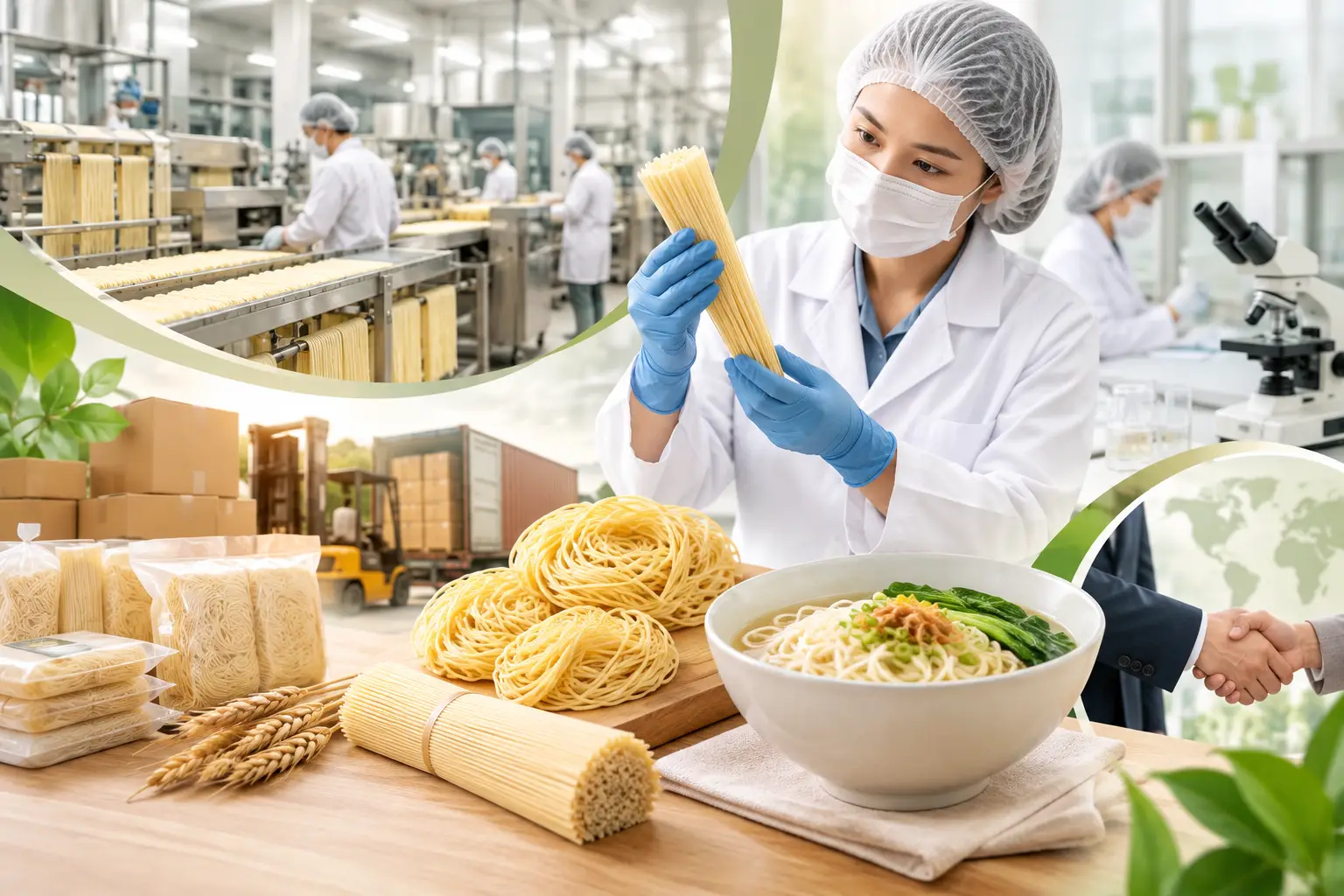
A dry noodle may look simple on a specification sheet, but its commercial quality is decided across dozens of small controls: flour behavior, dough moisture, strand formation, drying conditions, packing integrity, and cooking performance. This guide to noodle quality assurance helps brand owners, importers, distributors, and foodservice buyers assess what dependable noodle quality should look like before a product reaches the market.
For private-label and OEM projects, quality assurance is not limited to a final inspection. It is the system used to make sure every approved production batch continues to match the agreed product standard. That consistency protects the brand, supports buyer confidence, and reduces costly issues after distribution.
What Noodle Quality Assurance Covers
Quality control and quality assurance are related, but they serve different purposes. Quality control checks the product at specific points. It may include checking noodle width, moisture, weight, appearance, or seal quality. Quality assurance is broader. It establishes the procedures, records, training, supplier controls, and corrective actions that prevent those problems from occurring repeatedly.
For dry Asian noodles, a useful assurance program follows the product from incoming materials through manufacturing, packing, storage, and release. The goal is not to make every batch identical in an unrealistic sense. Natural ingredient variation exists. The goal is to keep variation within clear, commercially acceptable limits that have been agreed with the customer.
A buyer should therefore ask more than, “Does the sample taste good?” A production-ready evaluation asks whether the manufacturer can reproduce the approved sample at scale, document its controls, and respond effectively when a result falls outside specification.
Start With a Clear Product Specification
The strongest quality system cannot compensate for an unclear brief. Before production begins, the manufacturer and customer need a practical written specification that turns a noodle concept into measurable requirements.
For an OEM or ODM noodle project, this usually includes the noodle format, ingredients, allergen requirements, strand dimensions, portion weight, target texture after cooking, color expectations, breakage tolerance, packaging format, coding requirements, and storage conditions. If the product is intended for a particular export market or sales channel, labeling and documentation needs should also be identified early.
Texture deserves particular attention because words such as “firm,” “springy,” and “soft” can mean different things to different buyers. A product development team should define how the noodle is prepared, including water volume, cooking time, resting time, and any rinse or stir-fry step. A noodle that performs well in soup may not be the right choice for a quick-service stir-fry application.
The specification should also state what can vary and what cannot. For example, slight visual variation may be acceptable for a traditional-style noodle, while portion weight or pack seal integrity may require tighter control. This prevents unnecessary disputes and directs quality resources toward the factors that matter most to the final customer.
Control Ingredient Quality Before Production
Noodle consistency starts well before mixing. Flour, starches, salt and functional ingredients all influence dough handling, color, texture, and finished-product stability. Incoming materials should be approved against defined requirements rather than accepted only on supplier reputation.
Flour performance is especially significant. Changes in protein level, water absorption, particle characteristics, or gluten behavior can affect dough development and the finished bite of the noodle. A capable manufacturer monitors ingredient performance and adjusts within validated process parameters when appropriate. However, major changes should not be made informally when they could alter the customer-approved product.
Supplier approval, incoming inspection, traceability records, and appropriate storage are all part of this first line of defense. Materials need to be protected from contamination, moisture exposure, pest activity, damage, and mix-ups. Clear identification and stock rotation help ensure that the right ingredients enter the right production run.
For products with clean-label, child-friendly, or customized ingredient requirements, this discipline becomes even more important. A simpler ingredient list may require more precise process control because there may be fewer formulation tools available to maintain the desired texture or processing tolerance.
Monitor the Manufacturing Process, Not Just the Finished Noodle
A finished-product check can identify a problem, but it cannot recover an entire batch that has already been produced incorrectly. Effective noodle quality assurance uses in-process checks at the points where quality is formed.
During mixing and dough preparation, operators monitor dough consistency and moisture behavior. During sheeting, slitting, or strand forming, they check thickness, width, surface condition, and strand definition. These factors influence cooking time, texture, and the visual appearance of the noodle block or cake.
Drying or frying is another critical stage, depending on the noodle type. Air-dried noodles require controlled removal of moisture to achieve the intended finished condition without excessive brittleness, deformation, or uneven drying. Fried noodle products require control of the relevant process conditions to maintain a consistent product profile. In either format, manufacturers need defined operating parameters, trained personnel, and verification checks.
The right control points depend on the noodle. Thin rice noodles, wheat-based ramen-style noodles, infant and toddler noodle formats, and broad flat noodles do not behave the same way on a production line. Trying to force one universal standard across all products can create unnecessary waste or weaken product performance. The better approach is a product-specific control plan based on the approved formulation and format.
Verify Food Safety and Traceability Systems
For B2B buyers, product quality and food safety cannot be separated. A noodle may meet expectations for color and texture, yet still be unsuitable if the manufacturing system cannot demonstrate controlled handling, sanitation, allergen management, and traceability.
Buyers should look for manufacturers that operate recognized food safety systems and can provide relevant documentation during supplier approval. Certifications such as ISO 22000, HACCP, GMP, MeSTI, and Halal can provide useful assurance when they apply to the manufacturing site and product scope. They do not replace customer due diligence, but they indicate that the supplier works within structured management systems.
Traceability deserves focused attention. A manufacturer should be able to connect a finished pack or production lot to its production date, ingredient records, packaging materials, and relevant quality checks. If an issue is identified, this information supports targeted investigation and corrective action rather than broad, disruptive uncertainty.
Allergen management should also be discussed at the project stage. This includes ingredient declarations, production scheduling, cleaning controls, and labeling review. The exact risks depend on the facility and formulation, so buyers should request information that relates directly to their intended product rather than relying on general assumptions.
Test the Qualities Customers Actually Experience
Laboratory and line checks are necessary, but dry noodles must also be evaluated as food. A commercially sound quality program combines measurable tests with controlled cooking assessment.
Finished-product testing may include moisture-related checks, dimensions, net weight, visual inspection, breakage level, foreign-material controls, and pack integrity. The final scope should reflect the product and market requirements. A tightly curled noodle cake, for example, may need a different visual and structural assessment than individually portioned flat noodles.
Cooking evaluation should follow the agreed preparation method. Assessors can review hydration, cooking tolerance, strand separation, bite, surface texture, color, aroma, and broth or sauce compatibility. For foodservice buyers, holding performance may matter as much as initial eating quality. For retail products, the noodle must perform reasonably for an end user who may not follow ideal preparation conditions.
Sensory evaluation should be structured, not casual. Retained samples, comparison against an approved reference, and documented observations help a manufacturer identify gradual quality drift before it becomes a market complaint.
Packaging Is Part of the Product Standard
A well-made noodle can lose value through weak packaging. Packaging protects the product from handling damage, environmental exposure, and presentation issues during distribution. It also carries the brand information buyers depend on for identification, preparation, and market compliance.
Quality assurance checks should confirm the correct packaging material, artwork version, coding, seal quality, count, and pack weight. For multi-component products, controls should also verify that the correct components are packed together. Incorrect artwork or coding can create a serious commercial problem even when the noodle itself is acceptable.
Export-oriented projects need additional care because products may pass through longer supply chains and more handling points. Carton strength, pallet configuration, lot identification, and shipment documentation should be considered alongside the retail pack. The practical question is whether the product can arrive in the same acceptable condition in which it left the factory.
Build Quality Into the Manufacturer Relationship
The best guide to noodle quality assurance is ultimately a working relationship, not a checklist used only during supplier selection. Buyers should share market feedback, complaint patterns, new packaging needs, and changes in intended use. Manufacturers should communicate material or process concerns early, maintain records, and provide a defined route for handling deviations.
At Tehki Food, quality assurance is most useful when it supports the full development path: converting a product concept into a controlled specification, validating production performance, and maintaining consistency as volumes grow. This is especially valuable for customers developing customized dry Asian noodles where formulation, texture, portioning, and packaging must work together.
A dependable noodle partner does not promise that quality happens automatically. It shows how quality is specified, checked, recorded, and improved. For buyers building a long-term noodle brand or foodservice range, that discipline is what turns an approved sample into a product customers can continue to trust.