
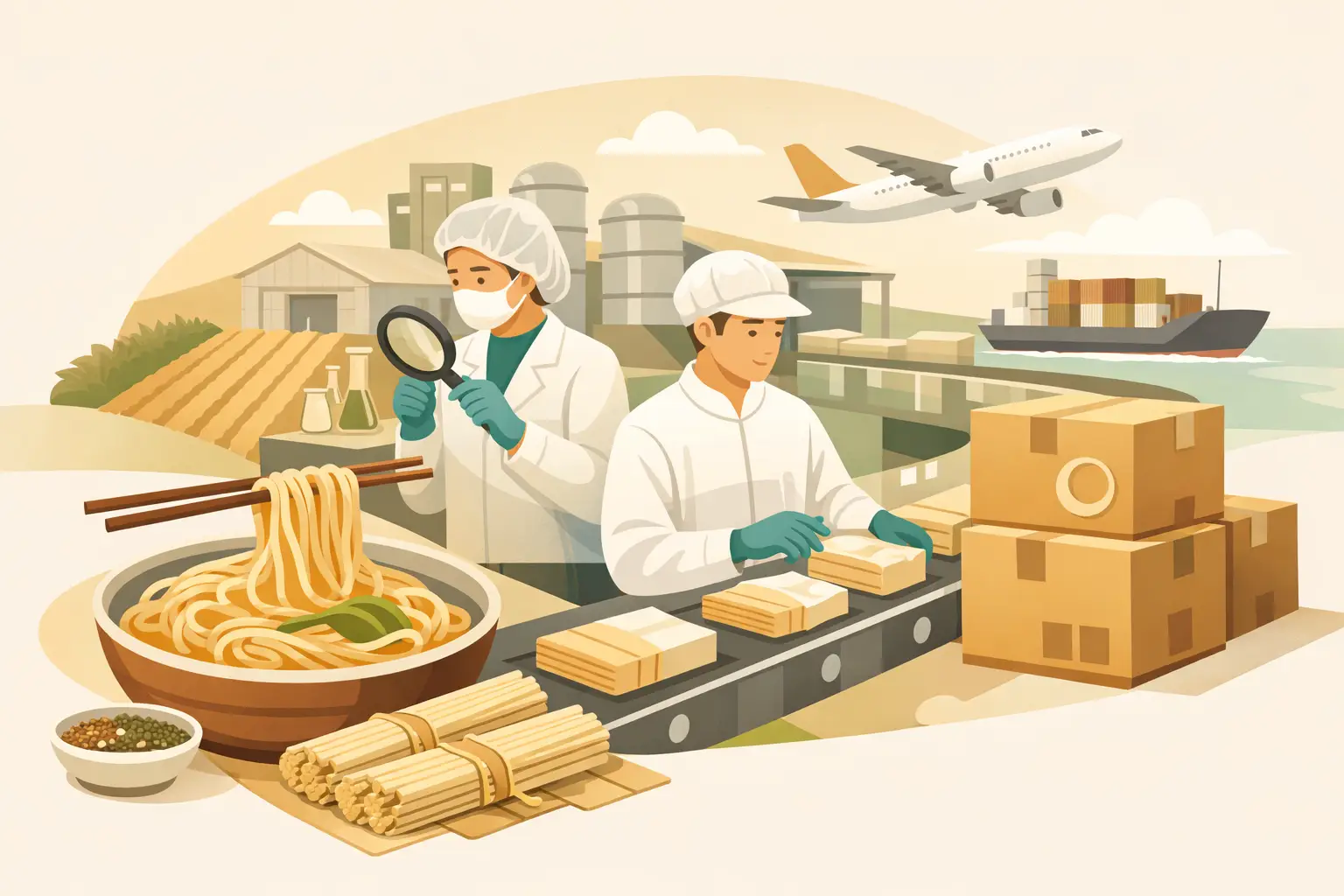
A halal noodle export success story rarely begins with a container leaving the factory. It begins much earlier, when a brand owner or importer turns a market opportunity into specifications that a manufacturer can produce consistently. The difference matters. A product may look promising in samples, but export growth depends on whether its ingredients, noodle texture, packaging, documentation, and production controls can hold up across repeat orders.
For B2B buyers, the useful lesson is not simply that halal noodles can reach international markets. It is that success becomes repeatable when product development and export planning are treated as one commercial process. That approach helps private-label brands, distributors, and food companies reduce surprises after launch while creating a noodle range that fits local customer expectations.
What Makes a Halal Noodle Export Success Story Repeatable
A strong export program is built on consistency rather than a single successful shipment. Buyers need confidence that the noodles they approve today can be manufactured to the same agreed standard as demand grows. This includes more than the basic noodle formula. It covers raw material control, supplier management, product specifications, batch records, packaging accuracy, and quality checks throughout production.
Halal certification is an important part of that foundation for markets and customers that require it. However, certification alone does not create a commercially successful noodle product. The product must also meet the practical needs of its destination market: the preferred noodle style, cooking performance, serving format, retail price positioning, and distribution channel.
For example, an air-dried noodle designed for a health-conscious retail range may need a different texture, portion format, and pack presentation than a fried noodle intended for a value-focused grocery channel. A foodservice buyer may prioritize cooking consistency and back-of-house handling, while a distributor may focus on carton configuration and product stability during transport. Export-ready development accounts for these differences before production is scaled.
Start With a Product Brief That Can Be Manufactured
Many private-label projects lose time because the initial brief is too broad. Terms such as "premium," "healthy," or "authentic" may guide an idea, but they do not give a manufacturer enough detail to build a controlled product. A practical brief translates commercial intent into measurable decisions.
That means defining the noodle format, such as air-dried, fried, or another dry Asian noodle style. It also means agreeing on target noodle thickness, texture after cooking, ingredient preferences, net weight, packaging type, and intended sales channel. For infant and toddler noodle concepts, the formulation and physical product requirements need especially careful review to ensure the product design matches the intended category and market expectations.
The best briefs also identify what cannot change. A brand may be flexible on carton artwork but firm on a specific noodle bite. Another may require a particular ingredient direction but accept more than one pack format. Distinguishing essential requirements from preferences helps the development process move faster and supports more realistic cost planning.
Samples Should Test More Than Taste
Sample approval is a critical stage, but tasting alone is not enough. A noodle should be evaluated in the way it will be used in the market. That can include cooking time, water absorption, texture retention, appearance, breakage, and compatibility with the intended broth, sauce, or preparation method.
If the product will be sold through retail, packaging should be assessed for shelf presentation, legibility, and handling. If it is intended for foodservice, the buyer should consider whether kitchen staff can prepare it reliably during busy service periods. Small operational details can become major commercial issues once a product reaches multiple customers or markets.
Build Quality Systems Into the Commercial Plan
Reliable manufacturing is not separate from brand growth. It is what protects it. Importers and brand owners need a partner that can operate with documented food safety and quality systems, clear product controls, and disciplined production practices.
At Tehki Food, certifications including ISO 22000, HACCP, GMP, MeSTI, and Halal support a manufacturing approach built around controlled processes and traceability. For buyers, the practical value is greater confidence when developing dry noodle products for export-oriented supply chains. It also provides a stronger base for internal supplier reviews, customer discussions, and ongoing product management.
Still, every destination market and customer account may have its own requirements. Buyers should confirm market-specific labeling, language, ingredient declaration, and import documentation needs early in the project. A capable manufacturer can provide relevant product information, but the importer or brand owner should ensure the final market presentation aligns with the requirements of the country where the product will be sold.
This is where early coordination prevents costly rework. Changing a label, carton marking, or product specification after mass production is far more difficult than resolving it during artwork approval and pre-production planning.
Choose Customization That Supports Scale
Customization is valuable when it gives a product a clear market role. It is less useful when it creates unnecessary complexity. The most effective private-label noodle programs focus on the choices that customers notice and that the supply chain can support over time.
For some brands, that may mean an air-dried noodle format with a clean, modern pack design. For others, it may mean a traditional noodle texture, a family-oriented portion size, or a format developed for restaurant and catering use. The goal is not to customize every feature. The goal is to create a product that is distinct enough to earn placement and practical enough to reorder consistently.
Packaging deserves the same discipline. A retail pouch, multipack, foodservice bag, or customized house-brand carton each creates different handling and merchandising considerations. Artwork must be accurate, but it also needs to work within production and packing processes. Clear approval stages for packaging files, printed materials, and finished-product specifications help prevent version control problems when a range expands.
Plan for Growth Before the First Launch
An export launch should be designed with the next order in mind. This does not mean producing an oversized range on day one. It means establishing specifications and production methods that can support additional markets, larger orders, or related SKUs without rebuilding the product from scratch.
A sensible approach is to begin with one clearly defined noodle concept, confirm performance in the target channel, and then extend the range based on real demand. A distributor might start with one popular noodle type and later add a complementary format. A brand owner may first launch a core retail pack, then develop a larger foodservice format once market acceptance is established.
This staged approach creates useful learning. It shows which claims, pack sizes, flavors, and usage occasions resonate with buyers without placing the entire business plan on an untested assortment. It also gives the manufacturer and customer a clearer basis for improving forecasts, production planning, and packaging procurement.
Treat Export Communication as a Production Tool
The strongest manufacturing partnerships are built on specific, timely communication. Purchase orders, artwork approvals, product revisions, forecasts, and quality feedback should move through clear contacts and documented processes. Informal instructions can create avoidable risk, especially when multiple teams are involved across countries.
Buyers should share demand outlooks as early as possible, even when forecasts are preliminary. Manufacturers can then plan materials, packaging, and production capacity more effectively. In return, a manufacturing partner should communicate product development considerations, specification questions, and approval requirements clearly rather than allowing assumptions to enter production.
When an issue appears, the right response is not to assign blame. It is to identify whether the cause lies in the product brief, material specification, production process, packing method, or market handling. This problem-solving discipline is one of the less visible reasons some private-label programs continue to grow while others stall after their first launch.
A halal noodle export program becomes a genuine success story when every repeat order reinforces the buyer's confidence. Start with a precise product brief, build quality controls into every decision, and choose a manufacturing partner that can help turn a market concept into a dependable product line.