
A noodle range can look promising on paper and still fail once it reaches production, export review, or category testing. For B2B buyers, choosing a healthy Asian noodles supplier is not just about finding a factory that can make noodles. It is about finding a manufacturing partner that can turn a health-focused concept into a repeatable, commercially viable product.
That distinction matters more now because buyers are under pressure from several directions at once. Retailers want clearer product positioning. Foodservice operators want consistency and practical handling. Brand owners want room to differentiate without creating unnecessary production risk. Importers and distributors want products that are easier to place across multiple channels. In that environment, the right supplier needs to offer more than a catalog.
What "healthy" should mean in a B2B noodle brief
In consumer marketing, "healthy" is often used too loosely. In B2B sourcing, it needs to be defined in product terms. A healthy Asian noodles supplier should be able to discuss formulation choices, processing methods, portion formats, ingredient direction, and target market requirements in a clear and disciplined way.
For some buyers, that may mean air-dried noodles instead of fried noodles. For others, it may mean simpler ingredient positioning, child-friendly noodle development, or a texture and portion size better suited to controlled meal applications. The point is not that one format is always better than another. The point is that the supplier should understand how processing and formulation choices affect product positioning, manufacturing stability, and customer acceptance.
A capable supplier will also be careful with claims. If a manufacturer speaks in vague promises without grounding the discussion in ingredients, process, and labeling practicality, that is usually a warning sign. Strong B2B suppliers talk about what can be made, how it can be standardized, and where trade-offs may appear.
A healthy Asian noodles supplier should think beyond the recipe
The recipe is only one part of the decision. Buyers often start with noodle type, flavor direction, or desired ingredient profile, but manufacturing success depends on a wider set of factors.
Texture consistency is one of them. Dry noodles must perform reliably across batches, whether the end use is retail packs, private-label multipacks, meal kits, or foodservice preparation. If the texture shifts too much from one production run to another, even a well-positioned product can create complaints downstream.
Packaging compatibility is another factor. A supplier may be able to produce a good noodle, but if the noodle format does not fit the intended packing style, carton system, or market presentation, the project becomes harder to scale. This is especially relevant for private-label programs, where packaging structure and branding requirements are often fixed early.
Then there is commercial fit. Some concepts are attractive in development but difficult to produce consistently at scale. An experienced supplier will tell you when an idea is realistic, when it needs adjustment, and when a simpler route may produce a stronger long-term result.
What to evaluate before you shortlist a supplier
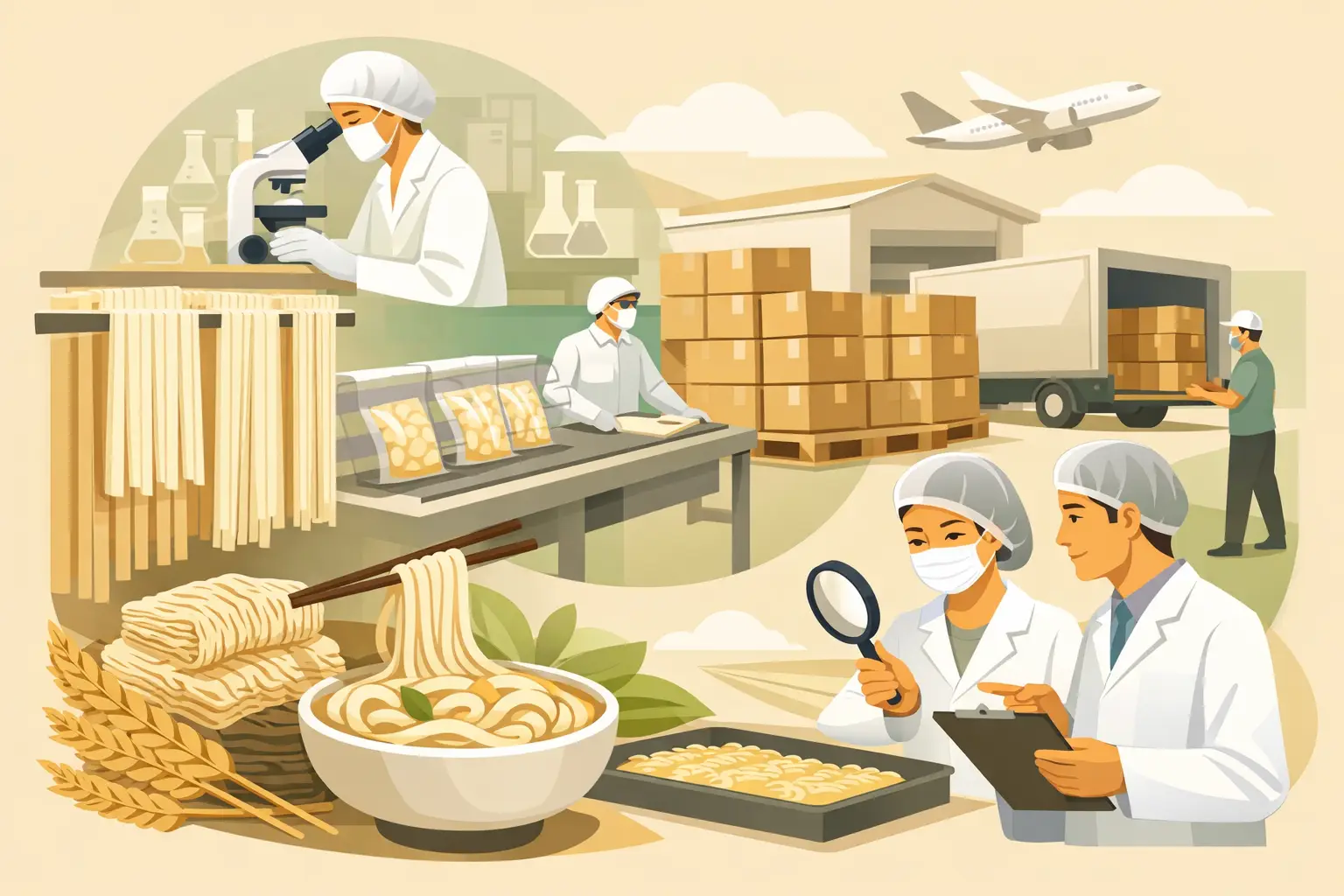
The first area to review is manufacturing capability. Buyers should know whether the supplier is working within the dry noodle category in a focused way and whether the factory can support different formats such as air-dried noodles, fried noodles, and specialized products for specific market segments. A broad product conversation is useful, but practical category depth matters more.
The second area is food safety and quality systems. A supplier handling OEM or ODM development for export and private label should be able to demonstrate structured quality management and recognized food safety practices. Certifications such as ISO 22000, HACCP, GMP, MeSTI, and Halal can help buyers assess whether the manufacturer operates with the level of discipline expected in regulated supply chains and multi-market distribution.
The third area is customization capability. Many buyers do not need an off-the-shelf noodle. They need a product adjusted for brand identity, market preference, customer age group, cooking application, or packaging format. That could include changes in noodle width, shape, texture, ingredient direction, or portion size. A supplier that only offers standard products may be fine for straightforward trading, but it is less suitable for private-label growth.
The fourth area is communication quality. This sounds basic, but it directly affects project success. A reliable supplier should be able to discuss specifications clearly, respond with realistic guidance, and flag technical or commercial issues early. If communication is vague during sourcing, it rarely improves once production starts.
Why processing method matters in healthier noodle positioning
When buyers are building a health-conscious noodle range, processing method often becomes central to the brief. Air-dried noodles, for example, are commonly considered by brand owners and importers looking for a different product profile from conventional fried formats. That does not automatically make them the right fit for every market, but it does create useful positioning options.
The right supplier should be able to explain how different processing choices affect noodle texture, cooking behavior, product handling, and market suitability. This matters because healthier positioning still has to work commercially. A noodle that aligns with a better-for-you concept but performs poorly in preparation or lacks the expected eating quality may not hold its place on shelf or menu.
This is where manufacturing experience becomes valuable. A supplier with practical OEM and ODM experience can usually help buyers refine the brief instead of simply accepting it at face value. That can save time and reduce expensive trial-and-error later.
Custom development is often where supplier quality becomes obvious
Standard manufacturing is one thing. Custom development shows how capable a supplier really is.
A healthy noodle concept usually requires balancing several factors at once. The buyer may want a cleaner product direction, a specific noodle bite, child-friendly usability, or a format designed for regional market preferences. Those goals can work together, but they can also create tension. A change that improves one aspect of the product may affect another.
A dependable manufacturing partner will manage that process with discipline. Instead of overpromising, they will help define workable product parameters and guide the development path toward a result that can be repeated consistently. That is especially important for importers, brand owners, and food companies that need confidence before committing to market launch.
For example, child-focused noodle products may require a different approach to noodle cut, texture, and portion planning than general family retail products. Foodservice noodles may require stronger consistency in cooking performance and holding characteristics than retail formats. Export-focused private-label products may need packaging and specification alignment that supports multiple destination markets. These are not small details. They shape whether a product performs well after launch.
Why manufacturing location can support export strategy
For international buyers, sourcing from a healthy Asian noodles supplier in Malaysia can offer practical value when the supplier combines Asian noodle expertise with export-oriented manufacturing systems. The location itself is not the only advantage. What matters more is whether the manufacturer is set up to support documentation discipline, scalable production, and product formats suited to international distribution.
That is why buyers should assess the whole operating model, not just the origin. A factory may be geographically well placed but still lack the consistency or structure needed for long-term supply. On the other hand, a manufacturer with strong process control, food safety systems, and OEM or ODM development experience can support market expansion much more effectively.
Tehki Food fits this partner model by focusing on dry Asian noodle manufacturing for B2B customers that need customization, dependable quality systems, and export-ready product development rather than one-size-fits-all supply.
The best supplier relationship is built on realism
Business buyers do not need dramatic claims from a manufacturer. They need a supplier that understands the category, communicates clearly, and can build products that hold up in real commercial conditions.
That is especially true for healthier noodle concepts. Market demand may be moving toward cleaner positioning, air-dried formats, and more specialized noodle products, but demand alone does not guarantee a good product. The supplier still needs to deliver consistency, practical formulation support, and quality control that protects the brand behind the pack.
If you are evaluating suppliers, pay close attention to how they talk about development. Do they understand your channel, target market, and product goals? Can they explain trade-offs without making the process sound complicated? Do they treat quality systems and customization as part of the same conversation? Those are often better indicators than a long product list.
A strong manufacturing partner helps you make better decisions before production begins. That is usually where the real value starts.