

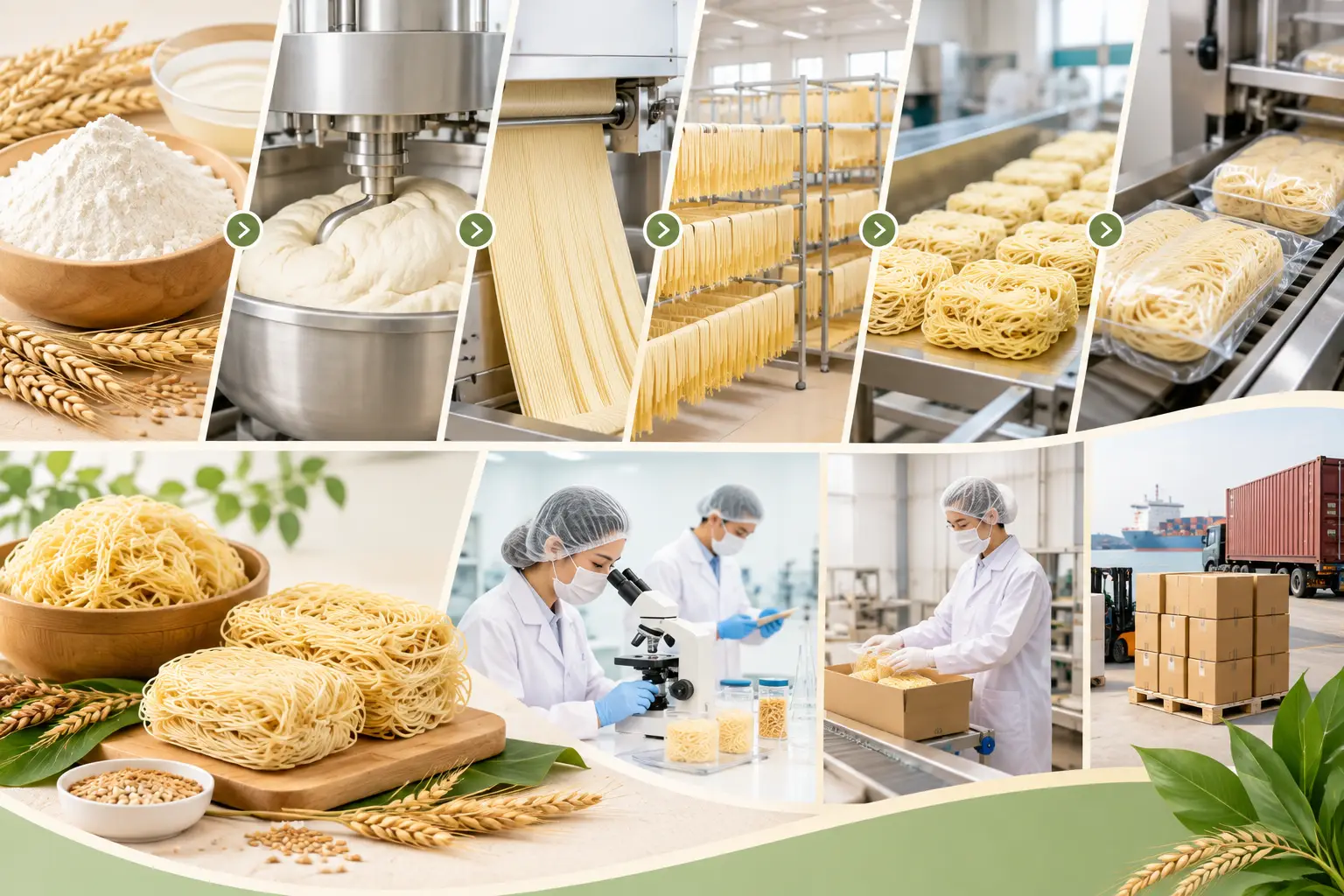
A buyer asking, “how are air-dried noodles made? from dough preparation to packaging,” is usually evaluating more than a production sequence. They are assessing whether a noodle can deliver consistent cooking performance, the right eating texture, dependable handling through distribution, and a format that fits their brand or foodservice application.
Air-dried noodles are produced by forming noodle dough into strands or blocks, then removing moisture through controlled hot-air drying rather than deep-frying. The principle is straightforward. The manufacturing discipline behind it is not. Flour behavior, water level, dough development, drying conditions, and package protection must work together to produce a stable, repeatable dry noodle product.
How Are Air-Dried Noodles Made From Dough to Packaging?
The process begins with product design, continues through controlled processing, and ends with packaging that protects the finished noodles through storage, handling, and export distribution. Specific equipment settings and process steps vary by noodle style, thickness, portion format, and intended preparation method, but the core workflow follows a clear path.
1. Formulation starts with the intended noodle
Before ingredients enter the mixer, the manufacturer defines what the noodle needs to do. A thin noodle intended for quick preparation behaves differently from a thicker wheat noodle designed for soup, stir-fry, or a premium retail meal kit. Texture expectations, cook time, soup compatibility, portion weight, and target market all influence formulation choices.
Wheat flour is commonly the foundation for many Asian dry noodles. Water, salt, and selected processing aids may be included depending on the noodle type. Some styles use alkaline ingredients to create their characteristic color, aroma, firmness, and bite. Egg, vegetable powders, grains, or other approved ingredients can also be considered where they support the product concept.
For private-label projects, formulation is where commercial requirements need to be addressed early. A clean-label direction, child-friendly format, Halal requirements, ingredient preferences, or a specific nutritional positioning may affect ingredient sourcing and process behavior. A viable formula is not simply one that sounds appealing on a product brief. It must also run reliably at production scale.
2. Mixing creates a workable, uniform dough
Measured dry ingredients are blended before water is added in a controlled amount. The goal is to distribute moisture evenly and develop a dough with the right consistency for sheeting. Noodle dough is generally firmer and less hydrated than bread dough, so it may appear granular or crumbly at first rather than smooth and elastic.
Mixing time matters. Under-mixing can leave dry pockets and uneven texture. Excessive mixing can create unnecessary heat or alter the dough’s handling characteristics. Manufacturers monitor the process closely because small variations in water absorption between flour batches can affect the downstream line.
The mixed dough may rest briefly before further processing. This allows moisture to equalize and gives the flour components time to hydrate. The result is a more stable dough mass for sheeting and a more consistent noodle structure.
3. Sheeting and rolling build the noodle structure
The rested dough is fed through rollers to form a continuous dough sheet. It passes through a series of calibrated rollers that gradually reduce thickness. Reducing thickness in stages is important because it helps create an even sheet without placing excessive stress on the dough.
Sheet thickness is a critical control point for product consistency. It influences strand weight, drying behavior, cooking time, and the final eating experience. A noodle that is too thick may dry unevenly or require longer preparation. One that is too thin may be more fragile during packing and distribution.
In a well-managed production environment, roller settings, line speed, and sheet appearance are checked throughout the run. This is especially important for OEM and ODM production, where a brand may require a particular noodle width, bite, or portion format that differs from standard items.
4. Slitting forms the strands and portions
Once the sheet reaches the required thickness, cutting rollers slit it into noodle strands. The width, shape, and wave pattern can be adapted according to the product specification. Straight noodles, wavy noodle blocks, nests, and individually portioned bundles each require different handling on the line.
At this stage, the noodles may be cut to length, folded, or arranged into a cake or block. Accuracy matters because portion consistency affects retail presentation, foodservice portion control, and the practical use of seasoning or meal components supplied by the customer.
The noodle’s final format should be considered alongside packaging from the beginning. A delicate nest may need different protection than a compact noodle cake. Designing the noodle and pack as separate decisions can lead to avoidable breakage or inefficient case packing later.
5. Heat treatment may set the noodle before drying
Many air-dried instant-style noodle processes include steaming or another controlled heat-treatment stage before drying. This cooks or gelatinizes the starch structure so the noodles can rehydrate efficiently when prepared by the end user. The exact heat profile depends on noodle thickness, recipe, and intended preparation method.
Not every dry noodle follows the same route. Some traditional noodle types are dried after forming without the same pre-cooking process, while others may use a different thermal step. This distinction is why buyers should clarify whether they need an air-dried instant noodle, a conventional dried noodle, or another noodle format entirely.
Where heat treatment is used, time and temperature need careful control. Insufficient treatment can affect rehydration and texture. Excessive treatment may weaken strand integrity or produce an undesirable eating quality. The objective is a noodle that performs predictably after drying and preparation.
6. Controlled air drying removes moisture without frying
The formed noodles enter a drying system where heated, moving air gradually removes moisture. Unlike fried noodles, air-dried noodles are not immersed in oil to reduce moisture. This process can support product concepts that seek a non-fried noodle format, although ingredient and nutrition claims should always be verified against the finalized product specification.
Drying is one of the most sensitive stages of manufacturing. Air temperature, humidity, airflow, residence time, and product loading must be balanced. If moisture is removed too quickly, the surface may dry before the center, increasing the risk of cracking. If drying is too slow or inconsistent, the finished product may not meet the desired stability and quality standards.
The target is not simply a dry noodle. It is a noodle with controlled residual moisture, consistent texture, suitable strength, and reliable rehydration performance. Manufacturers typically verify these outcomes through in-process monitoring and finished-product quality checks.
7. Cooling, inspection, and quality verification protect consistency
After drying, noodles need to cool under controlled conditions before packing. Packing a warm product can create condensation inside the package, which is undesirable for dry product quality. Cooling also allows the product to stabilize before inspection and handling.
Quality teams inspect appearance, portion weight, noodle integrity, moisture-related parameters, and other product-specific requirements. Depending on the production setup and customer specification, controls may also include foreign-material detection, seal checks, coding verification, and traceability records.
For B2B buyers, these checks are not secondary paperwork. They help protect consistent product delivery across batches and markets. A dependable manufacturer should operate established food safety and quality systems, with documentation that supports customer audits, export requirements, and ongoing supplier management.
8. Packaging is part of product protection, not an afterthought
The finished noodles are packed into the agreed format, such as individual retail packs, multipacks, foodservice portions, or bulk configurations. Packaging materials must provide appropriate protection from moisture, physical damage, and normal distribution handling. The correct choice depends on the noodle shape, channel, destination, and how long the product may move through warehouses and retail networks.
Primary packs are sealed and coded, then packed into secondary cartons or cases for transport. Label layout, language needs, barcode placement, case configuration, and pallet requirements should be confirmed early for export-focused projects. A well-made noodle can still face commercial problems if its packaging does not match the realities of the destination market.
What B2B Buyers Should Specify Early
The most efficient air-dried noodle development projects begin with a clear brief. Buyers should define the noodle type, intended use, desired texture, portion size, ingredient direction, pack format, and target market. If the product will be sold as a private-label item, artwork timing and packaging specifications should also be considered alongside manufacturing development.
It also helps to establish how performance will be evaluated. For example, a foodservice buyer may prioritize cooking tolerance and bowl presentation, while a retail brand may focus on portion consistency, breakage resistance, and consumer preparation time. There is rarely one “best” air-dried noodle. There is a best-fit noodle for a particular commercial application.
At Tehki Food, air-dried noodle development is approached as a manufacturing partnership: aligning noodle format, process control, food safety systems, and packaging practicality with the customer’s market objective. The strongest result comes from treating dough preparation, drying, and packaging as one connected product system - not as separate steps on a factory line.