
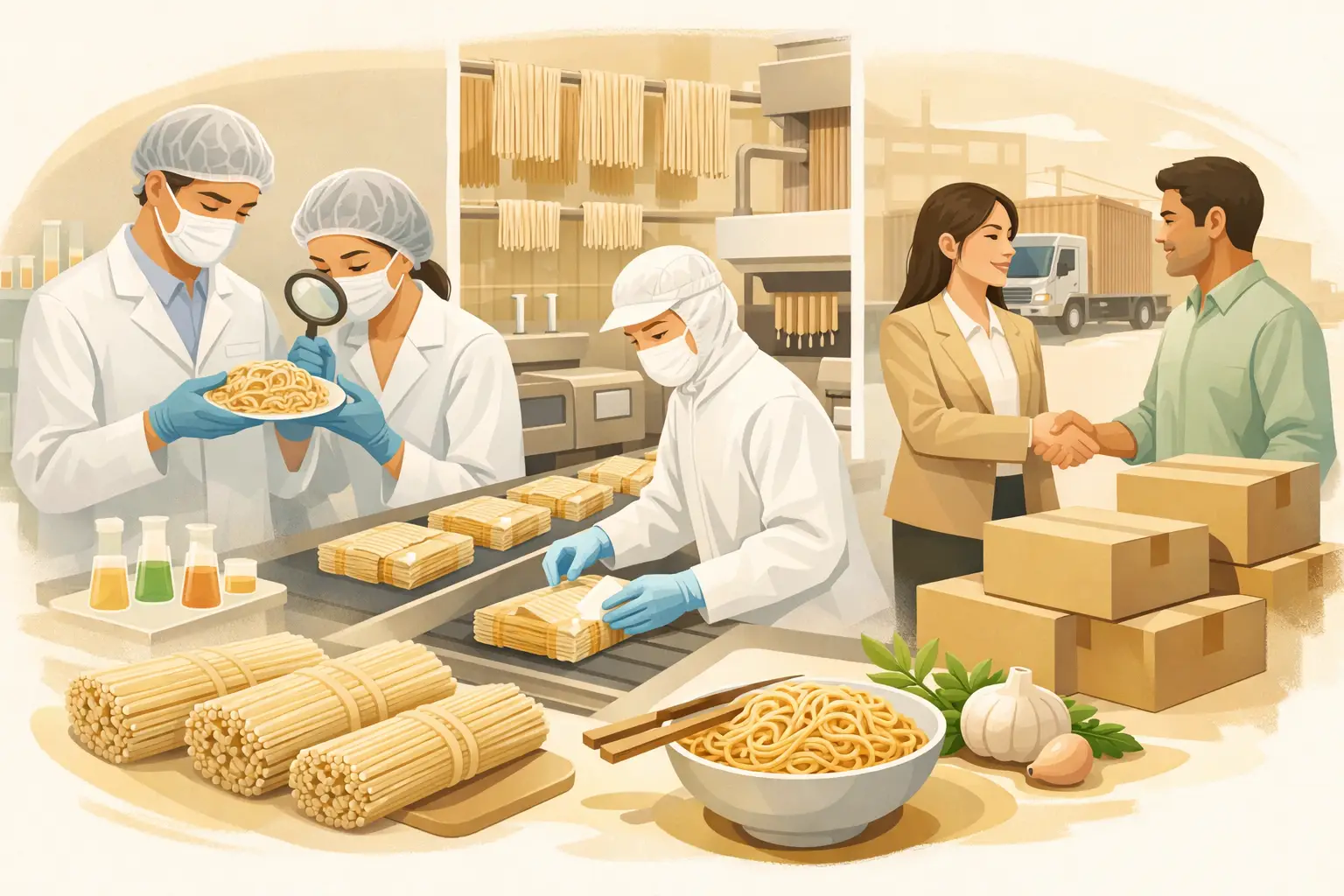
One bad batch can cost more than a return or a complaint. For a noodle brand owner, importer, or foodservice buyer, inconsistency creates ripple effects across purchasing, inventory, customer satisfaction, and brand reputation. That is why how consistent product quality builds long-term noodle business trust is not just a quality topic. It is a commercial issue that affects retention, growth, and market confidence.
In B2B food manufacturing, trust is rarely built by promises alone. It is built when each shipment performs the way the buyer expects. The noodle texture is familiar. The cooking behavior is stable. The noodle count, portioning, appearance, and packaging quality remain aligned with the approved standard. Buyers remember that kind of reliability because it reduces risk in their own business.
Why consistency matters more than a single good shipment
Many suppliers can produce a sample that looks right. Fewer can maintain the same result over multiple production runs, changing raw material conditions, and growing order volumes. That gap is where long-term trust is won or lost.
A distributor does not only need noodles that taste good in one evaluation. They need confidence that the product their sales team presents this quarter will match what arrives next quarter. A foodservice operator needs menu consistency across outlets. A private-label brand needs customers to repurchase without noticing unwanted differences in texture, breakage, color, or cooking response.
When quality shifts from batch to batch, the buyer absorbs the operational cost. Their team spends more time checking goods, handling complaints, adjusting expectations, or explaining product variation to downstream customers. Even when the issue is not severe enough to trigger a formal claim, it weakens confidence. Over time, buyers begin looking for a more dependable manufacturing partner.
How consistent product quality builds long-term noodle business trust in practice
Trust in the noodle category is practical. Buyers do not define it in abstract terms. They define it by outcomes.
First, consistency supports repeat purchasing. If a product performs the same way each time, procurement teams can reorder with less hesitation. That matters in wholesale, retail, and foodservice because purchasing decisions are often shaped by predictability, not novelty.
Second, consistency protects the buyer's own brand. If noodles sold under a private label vary too much, end customers notice. The package may carry the brand owner's name, but the manufacturing issue sits behind it. A reliable OEM or ODM partner helps protect that brand equity by producing within agreed specifications, not by treating each batch as a fresh interpretation.
Third, consistency improves planning. Stable product quality helps importers, category managers, and food companies reduce friction across quality checks, merchandising, and customer service. That does not remove the need for controls, but it reduces surprises.
What buyers actually mean by product quality
In noodles, quality is broader than taste. Commercial buyers usually assess a combination of physical, technical, and compliance-related factors.
Texture is one of the most obvious. A noodle that is too soft, too brittle, or inconsistent in bite can create problems for both retail and foodservice applications. But texture alone is not enough. Buyers also look at strand uniformity, moisture control, cooking stability, breakage levels, seasoning compatibility where relevant, and packaging integrity.
Then there is specification discipline. A product may be acceptable in general terms but still fail commercially if it drifts from the approved format. For example, a child-focused noodle concept may require a specific portion size, milder formulation direction, or gentler texture profile. An air-dried noodle line may need a certain appearance and cooking performance that supports a healthier product position. Meanwhile, fried noodle may serve end user that prefer traditional and familiar taste. In export business, even small deviations can complicate distribution or market acceptance.
Quality also includes food safety systems and documented controls. Certifications such as ISO 22000, HACCP, GMP, MeSTI, and Halal matter because they provide buyers with a clearer framework for how consistency is managed. Certification alone does not guarantee a perfect product, but it does signal that the manufacturer is operating with structured systems rather than informal judgment.
Consistency starts long before production
A common mistake is to treat quality as something checked at the end of the line. In reality, consistency begins with product design, raw material control, process discipline, and clear documentation.
For OEM and ODM noodles, the development stage is especially important. If the target texture, noodle thickness, ingredient profile, and packaging format are not defined properly, production consistency becomes harder to maintain. A dependable manufacturer works to translate a concept into measurable standards. That gives both parties a shared reference point.
Raw material variation is another real factor. Wheat-based products, starch systems, oils, and other inputs can behave differently over time. Strong manufacturers do not ignore that reality. They manage it through supplier control, incoming checks, process monitoring, and adjustment discipline. The goal is not to pretend variability does not exist. The goal is to keep finished product performance within a stable range that protects the buyer.
Process control matters just as much. Drying conditions, mixing balance, dough handling, cutting accuracy, and packing control all affect the final result. In noodles, small shifts in manufacturing can become visible in cooking or shelf presentation. That is why consistency depends on repeatable systems, trained teams, and routine verification.
The trust value of fewer surprises
Business buyers usually do not expect perfection in a simplistic sense. They expect control. They want to know that if an issue appears, it is identified early, communicated clearly, and handled responsibly.
This is an important distinction. Trust is not built because problems never happen. Trust is built when the manufacturer has the systems and discipline to reduce problems and respond professionally when needed. For importers and distributors managing multiple accounts, this matters a great deal. They need supply partners who help them stay credible with their own customers.
Consistency also reduces hidden costs. A stable product means fewer internal escalations, fewer inspection concerns, less market confusion, and stronger confidence when expanding distribution. These savings may not always appear as a line item, but buyers feel them quickly.
Why long-term trust matters in noodle OEM and ODM partnerships
In private-label and customized noodle programs, the relationship is rarely transactional. Product development, packaging alignment, specification control, and market fit all require cooperation over time. If trust is weak, every discussion becomes slower and more defensive.
A manufacturer that consistently delivers approved quality becomes easier to work with. Buyers are more willing to expand SKUs, test new formats, or enter new channels when the production foundation is stable. That can include moving from one noodle type into a broader range such as air-dried noodles, fried noodles, or child-friendly concepts designed for a specific market need.
There is also a scaling advantage. A supplier may perform well at pilot level but struggle when volumes increase. Long-term trust grows when quality remains controlled as orders become larger or more complex. For brand owners and importers planning regional growth, that reliability is often more valuable than aggressive short-term promises.
What to look for in a manufacturing partner
If your business depends on dry noodle supply, evaluating consistency should go beyond product sampling. Ask how specifications are defined and maintained. Review whether the manufacturer can support customization without losing process control. Check whether their quality systems are formalized and relevant to the markets you serve.
It is also worth assessing communication quality. A strong manufacturing partner is transparent about what can be standardized, what may require adjustment, and where trade-offs exist. For example, a cleaner-label direction, a different noodle thickness, or a child-oriented format may change production behavior. An experienced manufacturer explains those implications early so expectations stay realistic.
This is where a company like Tehki Food can be relevant to B2B buyers seeking both flexibility and control. In noodle manufacturing, trust does not come from saying yes to every request. It comes from helping customers develop products that are commercially viable, manufacturable at scale, and supported by reliable quality systems.
Consistent quality is a growth strategy
The strongest noodle businesses are not built only on product ideas. They are built on repeatable delivery. When customers know what they will receive, they buy with more confidence, promote with less hesitation, and plan with fewer contingency measures.
That is the real business case behind consistency. It strengthens the buyer-supplier relationship, protects private-label credibility, and creates a more stable path for long-term account growth. In a category where many products can look similar on paper, dependable quality is often the difference buyers remember.
If you are building or expanding a noodle line, choose a manufacturing partner that treats consistency as part of your commercial success, not just a factory checkpoint. Over time, that decision does more than reduce risk. It gives your business something every serious buyer wants to keep - trust.