

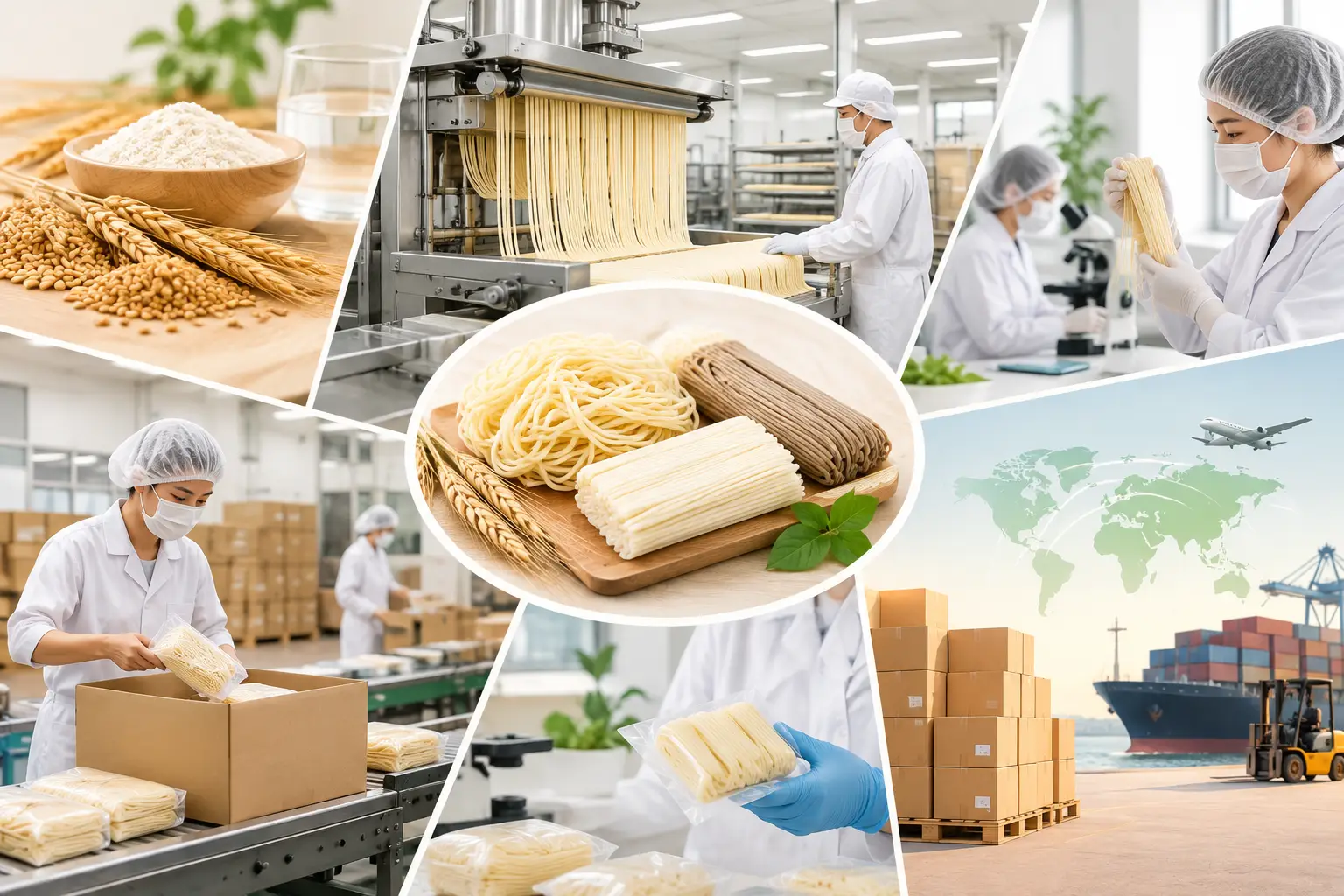
A Japanese-style noodle product can look simple on a shelf, but its consistency depends on hundreds of controlled decisions before it reaches an importer, distributor, or foodservice kitchen. How a noodle factory produces authentic Japanese-style noodles for global markets is not simply a matter of copying a recipe. It requires translating recognizable noodle characteristics into a repeatable, safe, export-ready manufacturing system.
For brand owners, the key question is not whether a noodle is labeled Japanese-style. It is whether the manufacturer can deliver the intended bite, appearance, cooking performance, and product stability from one production run to the next, while adapting the format to the target market.
What makes a Japanese-style noodle authentic in production?
Authenticity in Japanese-style noodles is usually expressed through the eating experience rather than one fixed formula. Depending on the product concept, buyers may be looking for a firm and springy ramen-style texture, the smooth surface of udon, or a thinner noodle that cooks quickly while holding its structure in soup or sauce.
These expectations influence every manufacturing decision. Flour selection affects color and gluten development. Water absorption affects dough handling and finished texture. The choice and level of alkaline ingredients, where appropriate for the noodle style, can influence color, aroma, and the characteristic chew associated with certain ramen-style products. Thickness, width, wave pattern, and drying method also change how noodles hydrate and perform after cooking.
A responsible manufacturer does not treat “Japanese-style” as a generic claim. The product brief should define what it means for the intended customer and market. A retail instant noodle may need a compact cake format and rapid rehydration. A foodservice noodle may need greater tolerance for holding in broth. A private-label range may prioritize a cleaner ingredient statement or an air-dried format. The best specification depends on the commercial use case.
How a noodle factory produces Japanese-style noodles at scale
The process begins with formulation control. Flour and other dry ingredients are specified according to their functional role, not just their cost. Protein level, ash level, granulation, and water absorption behavior can all affect dough consistency. For a factory serving multiple markets, approved raw materials and supplier controls are essential because small ingredient variations can change noodle texture at scale.
Dough mixing and resting
Dry ingredients are blended before water and selected functional ingredients are added at controlled levels. Noodle dough is typically lower in moisture than bread dough, so the target is often a crumbly, evenly hydrated mixture rather than a soft, fully developed mass. Even distribution matters. Inconsistent hydration can create weak spots, uneven color, or variations in cooking behavior.
The dough is then rested before sheeting. This stage allows moisture to distribute more evenly and gives the gluten structure time to relax. Rushing this step can make the dough difficult to sheet consistently, particularly for finer cuts or noodles that require a defined surface texture.
Sheeting, compounding, and cutting
The rested dough passes through rollers to form sheets. In many Japanese-style noodle processes, the dough is compounded and progressively reduced through multiple rolling stages. This helps create a more uniform sheet and supports the texture customers expect after cooking.
Sheet thickness is controlled closely because it affects both bite and rehydration. A small change can alter the final noodle weight, cooking time, and sauce or broth pickup. The sheet is then cut to the required width and may be formed into straight strands, waves, nests, or portioned blocks depending on the product format.
For OEM and ODM projects, this is where customization becomes visible. A buyer can develop a thinner ramen-style noodle for a quick-cook cup format, a broader noodle for a premium bowl presentation, or a child-friendly portion with a softer eating profile. However, every change should be tested against manufacturing practicality. A distinctive shape is only valuable if it remains stable through drying, packing, transport, and preparation.
Cooking treatment and drying method
The next stage depends on the noodle type. Some dry noodles are steamed before drying to set their structure and support rehydration. The drying method then has a major effect on product positioning, texture, appearance, and process efficiency.
Air-dried noodles are produced by reducing moisture through controlled heat and airflow. They can suit brands seeking a non-fried noodle format and often require careful management of drying conditions to prevent cracking, uneven moisture, or an undesirable texture after cooking. The process must balance sufficient drying with protection of the noodle structure.
Fried noodles are dried through a frying process that rapidly removes moisture and creates a porous structure. This can support fast rehydration and a familiar instant noodle eating experience. It also requires disciplined control of frying conditions, oil management, product weight, and finished moisture.
Neither option is automatically better. Air-dried noodles may align with one product concept, while fried noodles may better meet the preparation expectations of another channel or market. A capable manufacturing partner helps buyers assess the trade-off rather than forcing every concept into one production method.
Quality control is what protects consistency
A noodle factory producing for export cannot rely only on final inspection. Quality must be built into raw material approval, documented operating procedures, in-process checks, and finished product evaluation.
During production, teams monitor dough condition, sheet thickness, noodle dimensions, portion weight, drying performance, and product moisture. Finished noodles are assessed for visual appearance, breakage, odor, cooking time, and texture after preparation. These checks help ensure that a noodle developed during sampling can be reproduced during commercial production.
Food safety systems matter just as much as sensory quality. Buyers should look for manufacturers that operate recognized food safety and quality programs, with clear hygiene controls, traceability practices, and documented processes. Certifications such as ISO 22000, HACCP, GMP, and MeSTI provide useful assurance that the factory has structured systems behind its production claims.
For global markets, documentation and packaging control are particularly important. Product labels, ingredient declarations, pack configuration, carton markings, and pallet requirements may differ by destination. These details are not secondary administrative tasks. A well-made noodle can still face costly delays if packaging specifications and export documentation are not aligned with the buyer’s market requirements.
Adapting Japanese-style noodles for different markets
Global buyers often need a product that respects the expected Japanese-style noodle experience while fitting local consumer habits and sales channels. This may mean adapting portion size for a regional retail format, selecting a noodle thickness that works with local cooking practices, or designing packaging for distributors handling mixed product ranges.
Flavor is often customized separately through soup bases or seasoning, but the noodle itself must work with the intended application. A noodle for rich broth may need stronger resilience. A noodle for stir-fry may need lower stickiness and better resistance to breakage. A noodle served in a quick-service setting may need predictable preparation across multiple operators.
Product development should therefore include practical cooking tests, not just factory measurements. Testing the noodle in the actual broth, sauce, or preparation method gives a more accurate view of market performance. Importers and brand teams should provide a clear brief covering target format, preparation method, desired texture, packaging needs, and destination market expectations early in the project.
Choosing a manufacturing partner for private-label development
For a private-label or OEM program, the most useful factory relationship is collaborative and specific. The manufacturer should be able to explain which elements of a request are feasible, which changes may affect cost or production stability, and where a product needs further testing before scale-up.
Tehki Food supports this process by combining dry Asian noodle manufacturing knowledge with flexible product development for export-oriented customers. For buyers building a Japanese-style noodle range, the goal is not simply to select an existing noodle. It is to establish a specification that can be produced reliably, packed appropriately, and maintained as the business grows.
A well-developed Japanese-style noodle is the result of controlled formulation, disciplined processing, and clear communication between the brand and factory. When those foundations are in place, global market expansion becomes a practical manufacturing project rather than a compromise on product identity.