
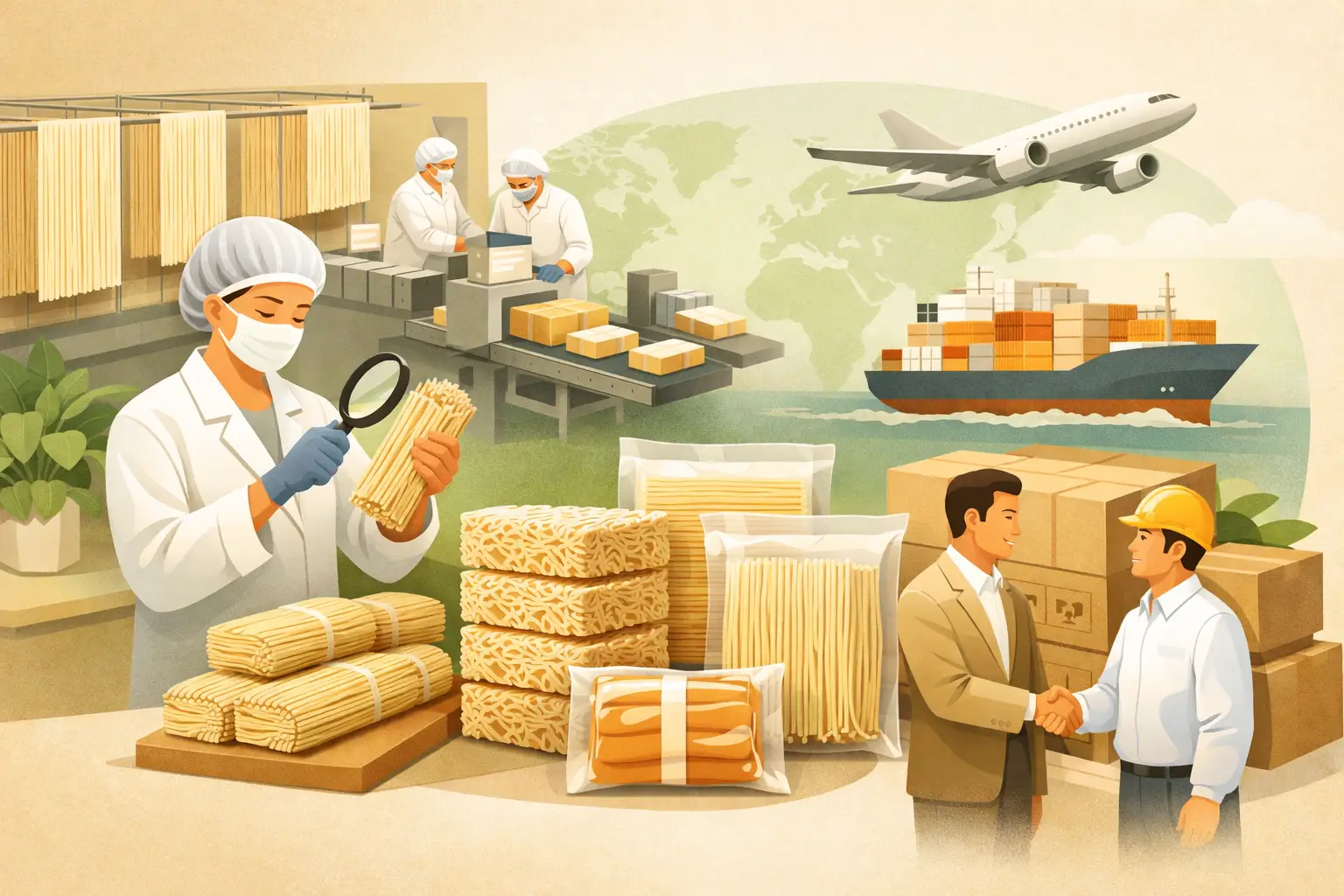
A noodle product can look right in a sample review and still fail once it reaches export markets. The difference usually comes down to systems, not appearance. For buyers evaluating how noodle manufacturers meet international export standards, the real question is whether a factory can control food safety, product consistency, documentation, and market-specific requirements at scale.
For importers, brand owners, and foodservice buyers, export readiness is not a single certificate. It is the result of disciplined manufacturing, clear specifications, and a factory team that understands how one product may need different technical and packaging decisions for different markets. That is especially true for dry Asian noodles, where texture, cooking performance, ingredient profile, and labeling all affect commercial success.
How noodle manufacturers meet international export standards in practice
The practical side of export compliance starts long before production. A capable manufacturer builds export readiness into sourcing, formulation, process control, packaging, and release procedures. If any one of those areas is weak, problems tend to show up later as customs delays, customer complaints, inconsistent product performance, or unnecessary reformulation work.
For noodle manufacturing, food safety management is the baseline. Certifications such as ISO 22000, HACCP, GMP, MeSTI, and Halal help demonstrate that the factory is operating under recognized controls. But buyers should look beyond the certificate list. What matters is how those systems are applied in everyday operations - raw material approval, allergen handling, hygiene controls, traceability, batch coding, process monitoring, and corrective action when something falls outside specification.
That distinction matters because export customers are buying repeatability, not just compliance on paper. A factory may be technically certified and still struggle if procedures are not consistently followed across shifts, product types, or packaging runs.
Food safety systems are the foundation, not the finish line
Dry noodles are often seen as straightforward products, but export buyers know the risk profile is broader than many assume. Ingredient sourcing, moisture control, handling practices, metal detection, packaging integrity, and warehouse conditions all influence whether the finished product arrives in the right condition.
Manufacturers that serve international markets usually work with documented hazard analysis and preventive controls throughout production. This includes identifying critical risks, defining acceptable limits, monitoring production points, and keeping records that can support customer audits or technical reviews. In B2B supply, that recordkeeping is often just as important as the process itself.
There is also a practical trade-off here. Some buyers want broader ingredient flexibility or faster product development, while export compliance often requires tighter raw material approval and change control. A dependable manufacturing partner knows how to balance innovation with control, especially for private-label or OEM projects.
Ingredient control and supplier approval
Export-standard production depends heavily on supplier management. Flour, starches, oil where relevant, and functional ingredients all need approved specifications. If ingredient quality shifts from batch to batch, noodle texture, color, breakage rate, and cooking performance can shift with it.
This is why experienced manufacturers do not treat procurement as a separate issue from compliance. They qualify suppliers, define acceptance criteria, and review incoming materials against product requirements. That becomes even more important for specialized products such as air-dried noodles, child-focused noodle formats, or cleaner-label concepts where formulation tolerances may be tighter.
Product specifications drive consistency across markets
One of the clearest signs of export readiness is a well-developed product specification. Buyers often focus on the finished noodle sample, but technical documents are what make repeat production possible. A specification should define the noodle format, dimensions, ingredient composition, process type, target moisture or other internal quality measures, packaging format, labeling details, and expected cooking characteristics.
For international business, specification discipline helps prevent avoidable disputes. The same noodle concept may need adjustments depending on the destination market, distributor preference, or end use. Retail packs, foodservice formats, and institutional packs do not always share the same packaging priorities. Likewise, a product developed for one market's labeling expectations may need revision for another.
Good manufacturers manage this with version control, approval workflows, and sample validation before commercialization. That approach reduces the risk of informal changes slipping into production.
Labeling and documentation are part of the product
A compliant noodle product is not only what is inside the pack. Label content, case markings, product descriptions, and shipping documentation are part of export performance. Many shipment issues happen because product information is incomplete, inconsistent, or not aligned across documents.
Manufacturers supporting export business typically help organize the technical side of this process. That may include ingredient declarations, allergen information, pack configuration details, batch identification, and supporting documentation requested by the buyer or destination market. Exact requirements vary, which is why a factory serving multiple export customers needs a process for market-specific checks rather than assumptions.
There is no universal export template that works everywhere. Some markets are more demanding on language, labeling format, or product classification. Others are more focused on certification alignment or import documentation. The manufacturer that handles these differences well tends to save the customer time and rework.
How noodle manufacturers meet international export standards through process control
Once product specifications are approved, process consistency becomes the next challenge. Noodle manufacturing involves more than mixing and drying. Dough development, sheeting, slitting, steaming where applicable, drying or frying method, cooling, portioning, and packing all affect the final product.
Factories producing for export usually rely on standardized operating parameters and in-process checks to keep each batch aligned. That includes monitoring factors that influence noodle texture, appearance, and pack integrity. If a product is sold under a customer's own brand, small inconsistencies can quickly become a brand issue rather than just a factory issue.
This is where manufacturing experience matters. Traditional noodle know-how is useful, but export supply also requires modern production discipline. A manufacturer should be able to explain how it protects consistency across larger runs, different SKUs, and evolving customer requirements.
Packaging suitability matters more than many buyers expect
Export-ready packaging has to do several jobs at once. It must protect the noodle during handling and transit, support clear coding and traceability, and align with the customer's sales channel. A pack that works for local distribution may not be ideal for longer shipping routes or different retail environments.
The right packaging decision depends on the product and market. Private-label retail products may prioritize brand presentation and shelf organization, while foodservice packs may emphasize efficiency and operational convenience. The manufacturer should be able to advise on practical packaging choices without losing sight of compliance and handling performance.
Audit readiness and traceability build buyer confidence
International buyers do not only want products. They want confidence that issues can be investigated quickly if something goes wrong. That is why traceability and audit readiness are central to export manufacturing.
A capable factory should be able to trace raw materials into finished batches and track those batches through packing and dispatch records. This supports quality review, complaint handling, and customer verification. It also shows that the manufacturer is set up for long-term supply relationships, not just one-off transactions.
For B2B customers, this often becomes a deciding factor during supplier selection. Two factories may offer similar noodle formats, but the one with stronger records, clearer change management, and better audit preparedness usually presents lower operating risk.
Customization must still fit a controlled manufacturing environment
Many export buyers need something more specific than a standard noodle range. They may want a house-brand product, a different texture profile, a child-friendly format, an air-dried concept, or a pack size that fits a certain distribution model. Customization can be a commercial advantage, but only when it is developed within a controlled manufacturing process.
That means product development should be tied to feasibility review, technical validation, and production capability. Not every good concept scales well, and not every market-ready sample performs the same way in larger production. Experienced OEM and ODM manufacturers know where flexibility is possible and where tighter control is necessary.
This is one reason business buyers often prefer a partner with both formulation capability and factory discipline. At Tehki Food, that combination is especially relevant for customers building export-ready dry Asian noodle products under their own brand.
The most reliable export programs are built on clear communication from the start. Buyers should expect transparent discussions around specifications, certifications, packaging suitability, documentation needs, and production controls. When those conversations happen early, the result is usually a smoother path to launch and a product that performs more consistently in the market.