
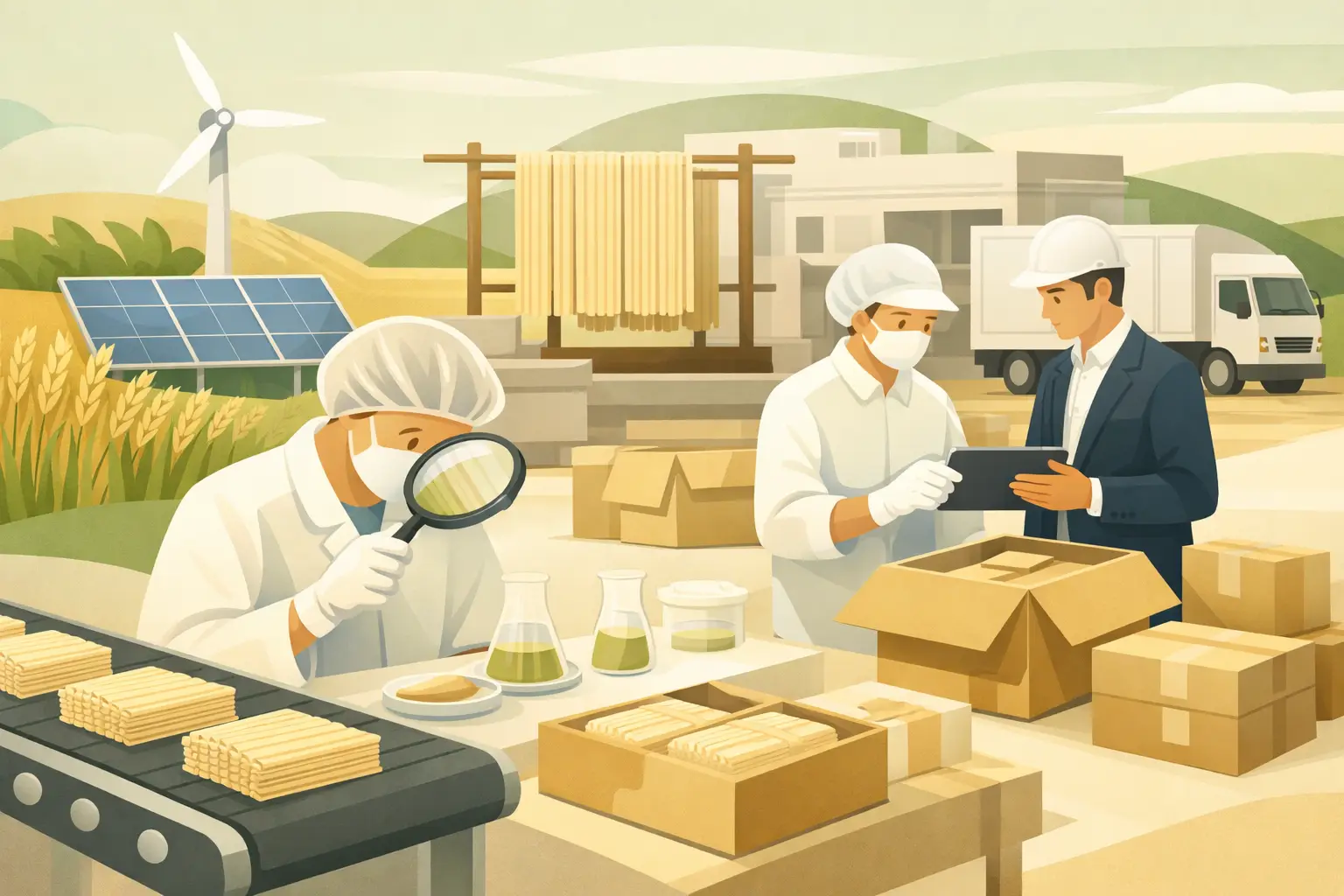
A noodle factory does not become more sustainable because it adds one eco-friendly material or installs one new machine. Real change shows up in the details that matter to buyers - energy use per batch, water efficiency, ingredient selection, waste control, packaging choices, and whether those improvements can hold up at commercial scale. That is exactly how sustainable practices are changing noodle production: not as a branding exercise, but as a manufacturing shift that affects cost control, product design, compliance readiness, and long-term supply reliability.
For brand owners, importers, distributors, and foodservice buyers, this change is no longer peripheral. Sustainability now influences procurement conversations alongside texture, cooking performance, packaging format, and certification standards. In noodle manufacturing, the practical question is not whether sustainability matters. It is which practices create measurable value without undermining consistency or commercial viability.
Why sustainability is moving closer to the production line
In the past, sustainability was often treated as a packaging issue or a corporate responsibility message. Today, it is moving deeper into operations. Buyers are asking more specific questions about how products are made, how ingredients are sourced, and whether manufacturers can support cleaner, more efficient production models without creating supply risk.
This matters especially in dry noodle manufacturing, where production volumes can be high and operational efficiency directly affects margins. Drying methods, frying processes, raw material yield, rejected output, and packaging waste all shape the environmental footprint of a noodle product. They also shape business performance. When manufacturers reduce waste, improve process control, or optimize energy use, the benefits are not only environmental. They can also improve consistency, reduce avoidable cost, and support more stable production planning.
How sustainable practices are changing noodle production at the process level
The biggest changes are often happening inside the factory rather than on the product label. Manufacturers are reviewing how dough is mixed, sheeted, steamed, dried, cut, portioned, and packed. Each stage offers opportunities to reduce resource use, but the right approach depends on noodle format and intended market.
Air-dried noodles are one clear example. Compared with fried noodle formats, air-drying can support a product direction that uses a different processing approach and may align better with certain brand positioning goals. That said, air-drying also requires careful control of time, temperature, humidity, and product handling to maintain texture and cooking performance. A more sustainable method only works commercially if the final noodle still performs as expected in retail or foodservice use.
Energy efficiency is another major area of change. Modern production lines increasingly focus on reducing unnecessary heat loss, improving equipment efficiency, and managing utilities more carefully. These upgrades can make a meaningful difference, but they require investment and process discipline. For B2B buyers, this is worth paying attention to because a manufacturer that manages production efficiently is often better positioned to deliver consistent output over time.
Water management is also becoming more important, especially in facilities handling large production runs. Better cleaning systems, process monitoring, and waste reduction practices can lower water use while supporting hygiene standards. Here again, the balance matters. Sustainability initiatives cannot come at the expense of food safety or quality assurance. In a professionally managed facility, those goals should support each other rather than compete.
Ingredients are part of the sustainability conversation too
When people ask how sustainable practices are changing noodle production, ingredients are a major part of the answer. Sustainable manufacturing is not only about what happens on the line. It also includes how raw materials are selected, standardized, and managed.
For noodle manufacturers, flour quality and supply consistency remain central. A sustainable ingredient strategy has to work within the realities of agricultural variation, price movement, and regional supply conditions. Buyers may want cleaner labels, simpler formulations, or alternative ingredient directions, but every ingredient change affects dough behavior, machinability, drying response, and finished texture.
This is where manufacturing expertise becomes critical. It is relatively easy to propose a more sustainable concept on paper. It is harder to turn that concept into an export-ready noodle product that can be produced consistently at scale. Ingredient substitutions or formulation adjustments need technical validation, not just marketing appeal.
There is also growing interest in sourcing practices and supplier accountability. For B2B customers, this does not always mean demanding a single sustainability claim. More often, it means looking for a manufacturing partner that takes supplier evaluation, traceability, and quality control seriously. Responsible sourcing is not a separate department issue. It affects reliability across the entire product line.
Packaging changes are visible, but they are not the whole story
Packaging is often the most visible sign of sustainability, so it gets attention first. Lighter materials, reduced packaging volume, and more considered format design can all contribute to lower material use. For private-label and OEM buyers, packaging decisions also affect freight efficiency, shelf presentation, damage risk, and market suitability.
Still, packaging choices have trade-offs. A material that appears more sustainable may be less suitable for moisture control, transport durability, or machine compatibility. In dry noodle products, packaging has a practical job to do. It needs to protect product integrity through storage, handling, and distribution. A commercially sound sustainability strategy must weigh environmental goals against operational performance.
For that reason, the strongest manufacturing partners usually approach packaging as part of total product development. The question is not simply whether a pack uses less material. The better question is whether the overall format supports the brand’s market, logistics model, and product quality requirements.
Sustainability is changing what buyers expect from manufacturers
Sustainability is also changing the criteria used to evaluate manufacturing partners. Buyers still care about certifications, product consistency, and customization capability. Those fundamentals have not changed. What has changed is that sustainability is increasingly viewed as part of manufacturing maturity.
A capable noodle manufacturer should be able to discuss process efficiency, waste handling, ingredient control, and packaging practicality in clear commercial terms. Buyers do not need vague promises. They need confidence that sustainability-related improvements are supported by quality systems, documented processes, and realistic production planning.
This is especially important for OEM and ODM projects. New product development often involves balancing multiple goals at once: cleaner formulations, target price, desired texture, export readiness, and packaging preferences. Sustainable improvements can add value, but only if the manufacturer can manage those variables without compromising product stability.
For example, a distributor may want an air-dried private-label noodle that aligns with a healthier product direction. A foodservice operator may want portion-controlled dry noodles with efficient packaging and dependable cooking results. An importer may need assurance that product specifications remain stable across repeat orders. In each case, sustainability matters, but only within a broader commercial framework.
The business case is practical, not theoretical
Some sustainability discussions become too abstract to be useful. In manufacturing, the business case is more direct. Reduced material waste can improve yield. Better process control can reduce rework. Efficient equipment can lower utility pressure over time. Smarter packaging design can improve freight efficiency. Stronger supplier management can reduce disruption risk.
None of this means every sustainable change lowers cost immediately. Some initiatives require upfront investment, product redevelopment, or packaging adjustments. Some may improve brand positioning more than short-term margin. Others may work well for one noodle category but not for another. Fried noodles, air-dried noodles, and child-focused noodle concepts each come with different technical and market considerations.
That is why a practical manufacturer avoids one-size-fits-all claims. The right sustainability approach depends on product format, sales channel, customer market, and production requirements. What matters most is whether the manufacturer can assess those variables honestly and build a workable solution around them.
What to look for in a sustainable noodle manufacturing partner
For B2B buyers, sustainability should be assessed through capability, not slogans. A dependable partner should be able to show how operational improvements fit within food safety systems, quality controls, and scalable manufacturing. Certifications such as ISO 22000, HACCP, GMP, MeSTI, and Halal remain important because they indicate disciplined production management. Sustainability works best when it is built on that same operational foundation.
It is also worth looking for a partner that understands product customization in practical terms. Sustainable product development often involves trade-offs between ingredient choices, processing methods, pack design, and final market expectations. A manufacturer with real OEM and ODM experience is more likely to navigate those trade-offs effectively than one that treats sustainability as a surface-level add-on.
For companies developing export-oriented dry noodle products, this matters even more. Export readiness depends on consistency, documentation, quality assurance, and packaging suitability. Sustainable improvements have to fit within those requirements, not sit outside them. Manufacturers such as Tehki Food that combine noodle expertise with structured quality systems are better positioned to support that kind of long-term product development.
The direction is clear. Sustainability is becoming part of how noodle products are designed, made, packed, and evaluated in the market. For serious buyers, the real opportunity is not to chase trends, but to work with a manufacturer that can turn responsible production into dependable commercial outcomes.