
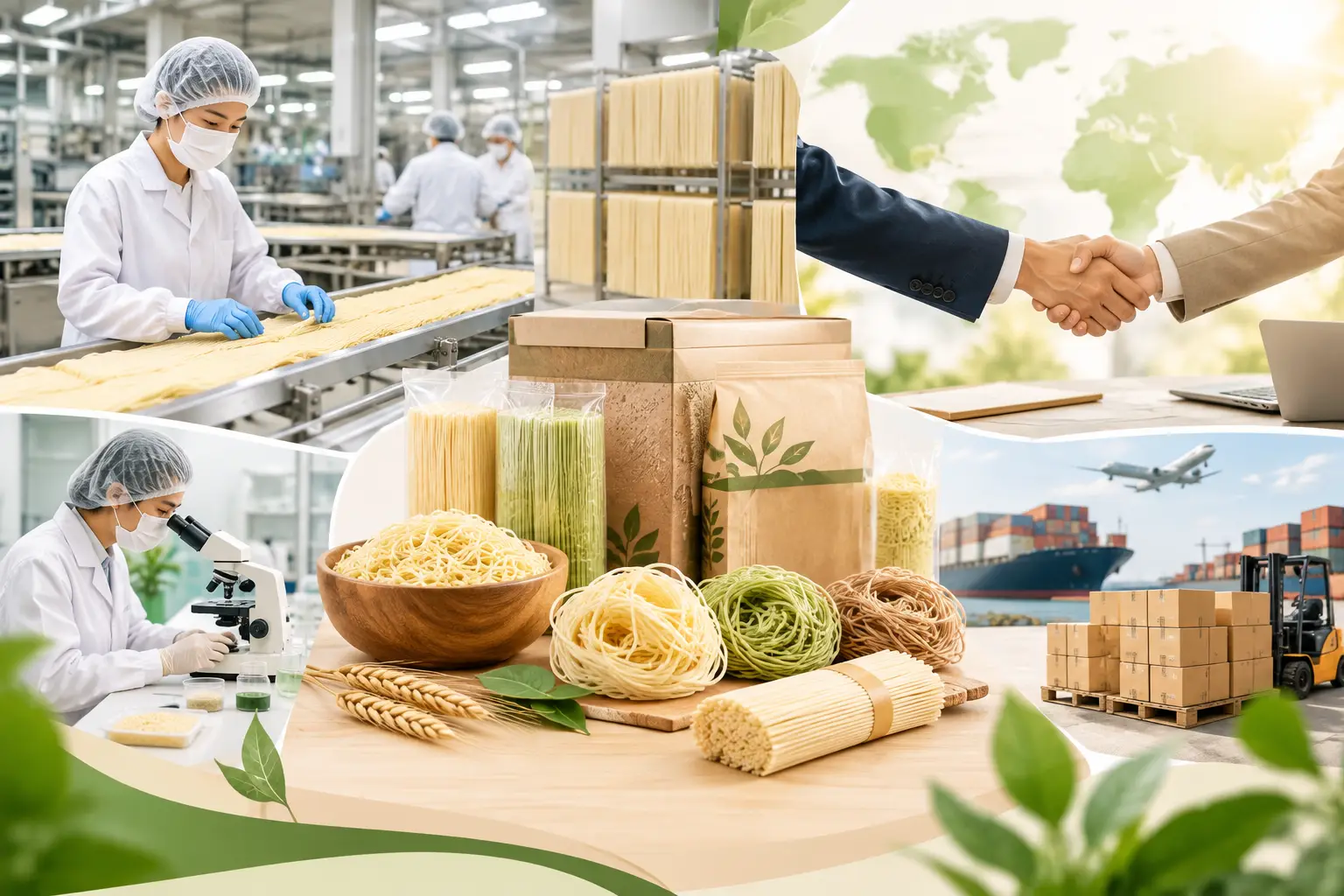
An organic noodle line can look straightforward on a product brief: certified ingredients, a familiar noodle format, and packaging ready for your brand. The difficulty appears when that product must move reliably across borders, meet buyer specifications, and remain consistent from the first shipment to the next. Knowing how to choose an organic noodle exporter for international markets means evaluating far more than a supplier’s product catalog.
For brand owners, importers, distributors, and foodservice buyers, the right exporter should function as a manufacturing partner. They need to manage ingredient traceability, document controls, product consistency, packaging requirements, and the practical details that support an export program. Organic positioning may help differentiate a range, but dependable manufacturing determines whether that range can grow.
Start With Organic Ingredient Control
The first question is not simply whether the exporter offers an organic noodle. Ask how the manufacturer controls the ingredients used to make it. A credible supplier should be able to explain the sourcing process for core materials such as flour, starches, oils, seasonings, and any vegetable or specialty ingredients included in the formulation.
Organic product development often involves more documentation and tighter material management than conventional production. Ingredient specifications should be clear, current, and matched to the requirements of your target market. If your concept includes a short ingredient list, plant-based positioning, or a child-focused format, the supplier should also be able to discuss how those requirements affect formulation and production planning.
It is also worth asking how ingredients are identified, stored, and released for manufacturing. The goal is not to audit every process detail during an initial discussion. The goal is to confirm that the exporter has a disciplined system rather than relying on informal assurances.
Verify Food Safety Systems and Export Documentation
International buyers need evidence, not broad claims. Before moving into product development, review the manufacturer’s food safety credentials and quality management practices. Certifications such as ISO 22000, HACCP, GMP, and MeSTI can indicate that a facility follows established controls for food safety, hygiene, traceability, and production management.
Certifications alone do not answer every question. Ask what documents the exporter can prepare or support for your destination market and product category. Requirements differ by country, retailer, and channel, so a supplier should be willing to clarify what is available and what information must be confirmed with your importer, regulatory adviser, or local authority.
Useful discussions include product specifications, ingredient declarations, allergen information, batch traceability, packaging details, certificates of analysis where applicable, and export documentation procedures. A supplier that responds clearly to these questions is usually better prepared for the realities of international trade.
Assess Whether the Noodle Format Fits Your Market
“Organic noodles” are not a single product category. The best choice depends on the customer, serving occasion, price position, preparation method, and retail format in your market.
An air-dried noodle may support a lighter product concept and can suit brands looking for a modern, health-conscious position. Fried noodles may be more suitable where a familiar texture or preparation experience is expected. Traditional Asian noodle styles can provide authenticity, while smaller portions or softer-texture concepts may be relevant for infant and toddler noodle ranges.
The exporter should understand that noodle quality is not limited to appearance. Texture, cooking tolerance, breakage resistance, thickness, shape, and flavor absorption all influence the final customer experience. A noodle that performs well in a factory sample may still require adjustment after testing in your intended preparation method.
Ask for a practical conversation about the trade-offs. For example, a cleaner-label formula may limit certain processing options. A delicate noodle may need more protective packaging. A premium ingredient choice can change cost structure and supply planning. An experienced manufacturer should explain these factors early, not after the product brief has been approved.
Look for Real OEM and ODM Capability
Private-label buyers often need more than a standard product with a new logo. You may need a specific noodle width, a different portion size, a custom seasoning concept, or packaging designed for a particular retail shelf. This is where OEM and ODM capability matters.
OEM manufacturing is appropriate when you have a defined product specification and need a capable producer to manufacture it consistently. ODM support is more useful when you have a market opportunity or brand direction but need assistance shaping the product itself. The supplier should be able to identify which approach fits your project.
When evaluating customization, ask direct questions about the areas that can be adapted. These may include noodle type, texture, ingredients, cake weight, serving size, seasoning format, packaging material, and pack configuration. The answer should be specific. A manufacturer that says everything can be customized without discussing production practicality may create problems later.
Strong product development support is especially valuable for businesses entering a category for the first time. It can help convert an early idea into a product that can be manufactured, packed, transported, and sold with fewer surprises.
Evaluate Production Consistency Before You Scale
A sample is a starting point, not proof of long-term capability. International programs depend on the exporter’s ability to make the same product repeatedly while maintaining agreed specifications.
Ask how the manufacturer manages quality checks during production and how it handles nonconforming product. Understand how batches are identified and what process is followed if a question arises after shipment. These are operational questions, but they protect your brand when products are distributed across several markets or retail locations.
Capacity should be considered in practical terms. You do not need to request confidential production details, but you should understand whether the supplier’s equipment, planning process, and raw-material sourcing can support your anticipated growth. A smaller launch may be suitable for a new concept, while a regional retail rollout requires stronger confidence in repeatable production and supply coordination.
Consistency also applies to packaging. Printed materials, coding, sealing, carton configuration, and pallet preparation all affect whether products arrive in acceptable condition. An exporter with experience in dry noodle manufacturing should understand that the package is part of product quality, not an afterthought.
Choose an Exporter That Communicates Like a Partner
International sourcing involves distance, time zones, approvals, and changing requirements. Clear communication is therefore a commercial advantage. Your exporter should provide answers that are practical, documented when needed, and aligned with the stage of your project.
During supplier evaluation, pay attention to how the team handles questions that do not have a simple yes-or-no answer. Do they explain what can be done, what requires validation, and what may create cost or production implications? That level of transparency is more valuable than quick promises.
A good manufacturing partner should also understand the different needs of importers, brand owners, and foodservice buyers. A distributor may prioritize dependable specifications and market-ready documentation. A brand owner may need packaging development and product differentiation. A foodservice operator may focus on cooking performance, portion control, and operational convenience. The right exporter adjusts the discussion to your business model.
A Practical Supplier Review Process
Before committing to an organic noodle exporter, organize your evaluation around the information that affects both product quality and commercial execution. Request product specifications and ingredient details, review food safety certifications, discuss applicable documentation, and test samples using your intended preparation method.
Then assess the supplier’s development flexibility, packaging capability, traceability approach, production consistency, and communication process. If your launch involves private labeling, confirm who is responsible for each approval point, from artwork and packaging content to final product specifications.
It may be tempting to choose based mainly on the lowest initial quotation. That approach can create higher costs later if the product requires rework, documentation is incomplete, or quality varies between shipments. The better decision is usually the manufacturer that can balance quality, customization, export discipline, and realistic commercial planning.
How to Choose an Organic Noodle Exporter With Confidence
The most suitable exporter is not necessarily the one with the longest product list. It is the one that can show control over ingredients, produce noodles that fit your market, support your required documentation, and communicate honestly about what the project needs to succeed.
For businesses developing export-ready dry Asian noodle products, Malaysia-based manufacturers such as Tehki Food can offer relevant experience in OEM and ODM production, air-dried and fried noodle formats, private-label development, and established food safety systems. The right next step is a focused product discussion built around your market, your brand requirements, and the operational details that will matter after the first order.