
A noodle product can look straightforward on a procurement sheet, yet the wrong manufacturing partner can create costly problems later: inconsistent cooking performance, packaging that does not suit the market, limited reformulation options, or documentation gaps that delay a launch. Knowing how to choose the right noodle supplier in Malaysia: a complete B2B guide gives brand owners, distributors, and foodservice buyers a more practical way to assess long-term fit, not simply compare quotations.
For B2B buyers, the best supplier is rarely the one offering the lowest initial unit cost. It is the manufacturer that can repeatedly make the required product, maintain defined quality standards, communicate clearly, and support the product as demand, channels, and market requirements change.
Start With the Product You Actually Need
Before approaching manufacturers, define the commercial role of the noodle product. A retail private-label range, a foodservice menu component, an export product, and a toddler-focused noodle line may all require different specifications, packaging formats, and development processes.
Be specific about noodle style, thickness, shape, ingredient preferences, cooking method, target texture, and intended use. For example, a noodle designed for soup needs to hold its structure differently from one intended for stir-frying. A product positioned around a simpler ingredient declaration may need a different formulation approach than a conventional fried noodle product.
You should also clarify whether you need an existing product format with your branding or an OEM/ODM development project. Existing formats can be efficient when speed and proven manufacturing methods are the priority. Custom development offers more differentiation, but it requires alignment on technical feasibility, ingredient availability, testing, and packaging from the beginning.
A capable supplier will ask detailed questions rather than immediately promise every option. That is a positive sign. It shows that the manufacturer is considering whether the desired product can be produced consistently at commercial scale.
Assess Food Safety and Quality Systems First
Food safety is not a marketing add-on. It is a core purchasing requirement, especially when products will move through multiple distributors, export channels, or retail systems. Ask suppliers to explain their quality management approach, facility controls, traceability practices, and documentation process.
Relevant third-party certifications can provide useful assurance when they are current and appropriate to your business needs. Depending on your target market and customer requirements, buyers may look for systems such as ISO 22000, HACCP, GMP, MeSTI, and Halal certification. The value is not only in displaying certificates. It is in how those systems are applied to raw material handling, production controls, finished-product checks, corrective actions, and batch traceability.
Quality consistency matters just as much as safety. Request clear specifications for moisture, noodle dimensions, appearance, texture, cooking instructions, and pack weight where applicable. A supplier should be able to explain how these attributes are monitored from batch to batch.
If you are sourcing for children’s products, premium retail, or a tightly specified foodservice application, the review should be even more detailed. The product has to perform as intended every time, not just during an early sample evaluation.
Evaluate Manufacturing Capability, Not Just Product Samples
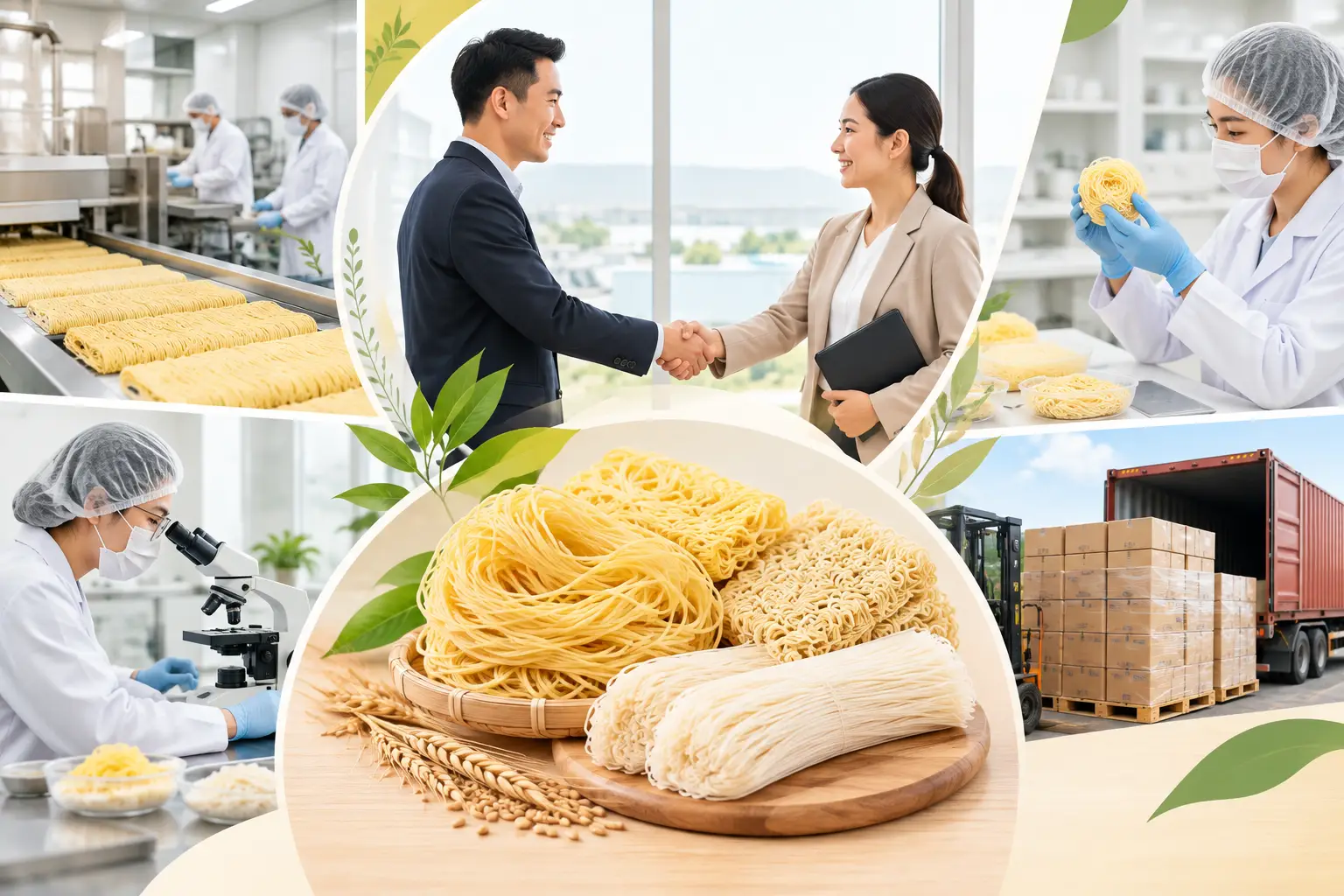
A good sample confirms potential. It does not, by itself, prove that a supplier can support your business at scale. During supplier evaluation, ask how the product will be produced, what equipment is involved, and what controls protect consistency as volumes increase.
For dry Asian noodles, the production method affects product positioning and eating quality. Air-dried noodles and fried noodles, for instance, have different manufacturing processes and may suit different market objectives. Buyers seeking a lighter-format noodle concept may favor air-dried options, while other product categories may require the familiar characteristics of fried noodles.
The supplier should also have practical flexibility across formats. That may include noodle types, ingredient choices, portion sizes, block shapes, bundles, and packaging configurations. Flexibility does not mean every request should be accepted without review. It means the manufacturer can identify workable options and explain the implications for production, product quality, and cost structure.
Ask how the factory manages production planning when multiple SKUs are running. A supplier with disciplined scheduling and changeover procedures is better positioned to reduce avoidable variation between products.
Check Customization Depth for Private Label Projects
Private-label noodles need more than a logo printed on a pouch. The right manufacturing partner should be able to support decisions that influence how the product is received by buyers and end users: noodle format, formulation direction, texture, serving size, cooking instructions, and pack presentation.
Customization should be commercially useful, not customization for its own sake. A distinct product concept may help a brand stand out, but excessive complexity can make procurement and quality management harder. The right balance depends on your category position and distribution model.
Discuss ingredient preferences early. This is particularly relevant for clean-label concepts, vegetable-based formulations, products for younger consumers, and market-specific taste requirements. A responsible manufacturer will distinguish between a preferred concept and a technically stable, manufacturable product.
Packaging deserves equal attention. It needs to protect the noodles, carry required product information, work with available packing equipment, and suit the way the item will be displayed, shipped, or stored. A package that looks attractive but creates operational complications can weaken an otherwise strong product launch.
Review Communication and Development Discipline
Supplier communication becomes most visible when a project changes. Artwork may need revision, an ingredient may require replacement, or a cooking result may not meet the original target. These are normal realities of food product development. What matters is whether the manufacturer responds with clear information, realistic options, and documented next steps.
Ask who will manage your account and how technical questions are handled. Procurement teams need commercial clarity, while product developers may need detailed feedback on noodle texture, processing limitations, and formulation choices. A supplier that can coordinate both conversations reduces friction during development.
It is also useful to understand the sampling and approval process. Confirm how product specifications, packaging artwork, reference samples, and final approvals will be recorded. Informal agreements can cause confusion later, especially when a product is transferred between teams or introduced into new markets.
Consider Export Readiness and Market Fit
Malaysia is a practical sourcing location for businesses seeking Asian noodle products for domestic and international distribution. Still, export readiness should be evaluated product by product and market by market. Documentation expectations, labeling formats, pack language, and customer requirements can vary significantly.
Ask whether the supplier has experience preparing export-oriented products and coordinating the information buyers commonly need for import, distribution, or retailer onboarding. Experience does not remove the buyer’s responsibility to confirm destination-market requirements, but it can make the process more organized.
Market fit also includes taste and use occasions. A noodle product that performs well in one region may need a different format, portion, or preparation method elsewhere. Manufacturers with practical ODM capability can help buyers adapt a concept without losing the core identity of the product.
Compare Total Value Instead of Unit Price Alone
Price matters, but it should be reviewed alongside quality controls, product consistency, customization support, packaging practicality, and communication reliability. A lower quotation can become expensive if it results in repeated revisions, inconsistent product performance, or weak documentation.
When comparing suppliers, use the same brief and request the same level of detail from each manufacturer. This makes comparisons more meaningful. Consider the full operating picture: whether the supplier understands your product, can meet your quality expectations, supports your route to market, and has a process for managing change.
For a growing brand, the ideal partner should be able to support an initial launch while offering room to develop adjacent formats later. That could mean adding new noodle types, adapting portions for foodservice, or creating differentiated packaging for new retail channels.
Questions Worth Asking Before You Commit
A productive supplier discussion should cover more than product availability. Ask how the manufacturer controls batch consistency, what certifications and quality systems support the facility, how it approaches customized development, and how specifications are approved and maintained.
You should also ask how the supplier manages packaging compatibility, ingredient changes, product documentation, and export-oriented requests. These questions reveal whether the business operates as a manufacturing partner or only as a transaction-focused vendor.
A facility visit or structured technical review can be valuable when the project is strategically important. It allows buyers to assess housekeeping, process discipline, quality practices, communication style, and the people behind the commercial proposal.
Choose a Partner That Can Support the Next Stage
The right noodle supplier should make product development more controlled, not more complicated. Look for evidence of sound food safety systems, repeatable manufacturing, relevant noodle expertise, and a willingness to discuss trade-offs honestly.
For businesses developing private-label or customized dry noodle products, Tehki Food combines Malaysian noodle manufacturing experience with OEM/ODM support across air-dried, fried, child-friendly, and tailored noodle formats. The most useful next step is to prepare a focused product brief and begin the conversation with the operational details that will define a successful launch.