

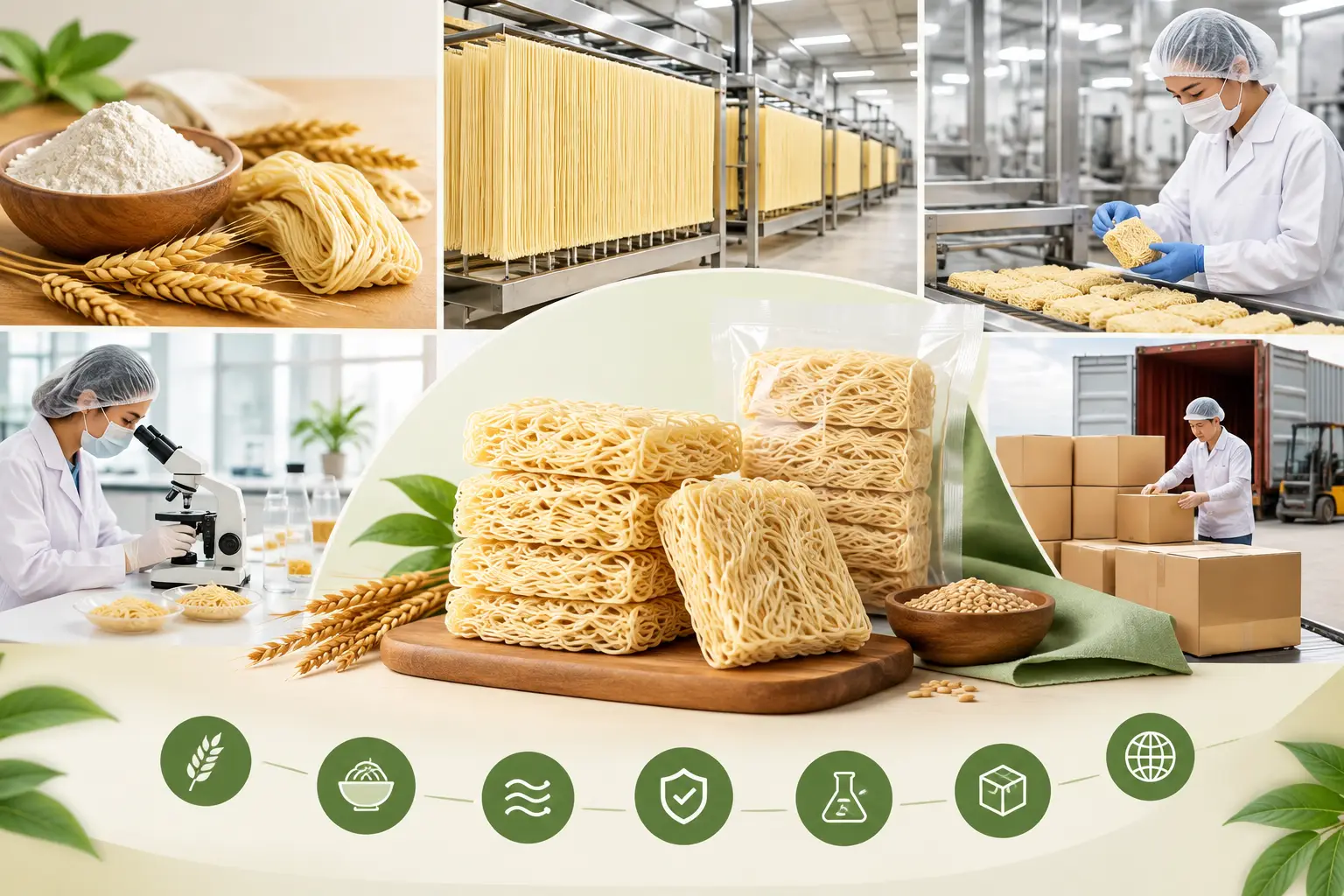
Air-dried noodles are not simply fresh noodles left to dry. For businesses learning how to create air dried noodles as a commercial product, the real work lies in controlling dough behavior, noodle structure, moisture removal, food safety, and final pack performance. Each stage affects whether the noodles cook evenly, maintain their intended bite, and arrive in market-ready condition.
For a private-label brand, importer, or foodservice buyer, air-dried noodles can support a differentiated dry noodle range without relying on a fried format. But a successful product requires more than selecting a drying method. It requires a manufacturing process designed around the intended consumer experience, distribution channel, ingredient position, and packaging format.
Start With the Product Brief, Not the Production Line
The most efficient development projects begin with a clear commercial brief. Before flour is mixed, the product team should define what the noodle needs to be: a quick-cook retail noodle cake, a premium straight noodle for soup, a wider noodle for stir-fry, or a small-format product for child-focused ranges. These are different products, even when their ingredient lists appear similar.
Texture is usually the first decision. A firmer, more elastic noodle may require a different flour specification, hydration level, sheeting process, and drying profile than a softer noodle designed for short cooking times. Shape matters as well. Fine strands dry and rehydrate differently from flat ribbons or thicker round noodles.
The commercial brief should also cover serving size, pack style, seasoning compatibility where applicable, target markets, and whether the brand needs a particular ingredient direction. A manufacturer can then assess which choices work together and where trade-offs may arise. For example, reducing thickness may shorten cooking time, but it can also make noodles more vulnerable to breakage during handling and transit.
Build a Dough That Can Withstand Drying
Air-dried noodle quality begins with a dough that is consistent from batch to batch. Wheat flour is commonly the foundation, while water, salt, and selected functional ingredients may be used depending on the desired noodle style. Ingredient selection affects dough strength, color, extensibility, and the finished eating texture.
Mixing must distribute water evenly without overworking or underdeveloping the dough. Inconsistent hydration can create weak spots that lead to uneven sheeting, irregular strands, or variable drying. At scale, this is why controlled mixing time, water temperature, and ingredient dosing are practical quality controls rather than minor process details.
After mixing, the dough is rested before it moves through rolling and sheeting. This gives the dough time to relax and become easier to process consistently. It then passes through a series of rollers that gradually reduce thickness. Reducing thickness in controlled stages helps preserve a uniform structure and avoids unnecessary stress on the dough.
Forming the Noodle Shape
Once the sheet reaches the required thickness, it is cut into strands or formed into the specified noodle profile. The strands may be steamed or otherwise cooked as part of the process, depending on the product design. This step helps set the noodle structure before drying.
For a branded product, the objective is repeatability. The noodle width, thickness, wave pattern, strand length, and cake weight should align with the approved specification. A product may look appealing in a development sample but prove difficult to pack consistently if its shape is too fragile or its portion format is not stable on the production line.
How to Create Air Dried Noodles With Controlled Moisture Removal
Air drying removes moisture using managed airflow, temperature, humidity, and time rather than a frying stage. The goal is not simply to make the noodle dry. It is to reduce moisture in a controlled way while preserving the noodle's structure and supporting consistent rehydration during cooking.
Drying too quickly can create a dry exterior while leaving moisture less evenly distributed inside the noodle. That imbalance can affect texture, increase cracking risk, and make final quality less predictable. Drying too slowly may create production inefficiencies and requires close control of the processing environment.
A well-designed drying profile commonly uses more than one condition across the drying cycle. Early stages are managed carefully so the noodle surface does not harden too abruptly. Later stages continue moisture reduction until the finished noodle meets the manufacturer’s established product standard. The right profile depends on noodle thickness, shape, pre-drying preparation, and the desired final texture.
This is where manufacturing capability matters. Air drying is often viewed as a simple alternative to frying, but it requires disciplined process monitoring. Teams need to control operating conditions, inspect product appearance, and verify that the product performs as expected after cooking.
Verify Cooking Performance Before Approving the Product
A dry noodle is only successful if it performs well in the way customers will actually prepare it. Product evaluation should therefore include cooking tests throughout development and routine production checks.
The testing approach should reflect the intended use. Retail noodle products may be assessed for cook time, water absorption, strand separation, soup compatibility, and bite after standing. Foodservice noodles may need to hold their texture longer before service. Products intended for a sauce application should be tested with that sauce, since cling and absorption can change the eating experience.
Visual checks are equally useful. The finished noodle should have a consistent color and shape, with limited breakage and a stable portion form. After cooking, the noodle should be evaluated for firmness, elasticity, surface smoothness, and any tendency to become excessively soft or sticky.
No single texture is right for every market. Some buyers may prefer a more resilient noodle, while others prioritize a gentler bite or faster preparation. Defining this preference early prevents a common development issue: approving a product based on dry appearance without agreeing on its cooked performance.
Design Packaging Around Protection and Market Needs
Air-dried noodles need packaging that protects them from physical damage and environmental exposure through distribution. The right packaging format depends on whether the product is sold as individual portions, multi-packs, foodservice packs, or included in a broader meal kit.
Packaging decisions should be made alongside product development, not after the noodle is finalized. A tightly formed noodle cake may suit one pack type, while a looser nest or long-stick noodle requires different handling and protection. The chosen format can affect breakage rates, packing efficiency, visual presentation, and the practicality of downstream logistics.
For export-oriented products, manufacturers and buyers should also align on pack dimensions, labeling needs, outer carton configuration, and handling expectations. These details are operational, but they influence whether a product can move reliably from factory to destination market.
Put Food Safety and Process Control Into the Development Plan
A scalable noodle project needs documented controls at every relevant stage, from incoming ingredients to finished-product release. This includes supplier management, equipment hygiene, allergen controls where relevant, process monitoring, traceability, and inspection procedures.
For B2B buyers, certifications and factory systems provide valuable assurance, but they should be matched by day-to-day production discipline. ISO 22000, HACCP, GMP, MeSTI, and Halal-certified manufacturing systems can support a structured approach to quality and food safety when they are implemented consistently across operations.
It is also helpful to agree on product specifications before commercial production begins. These specifications may cover noodle dimensions, portion weight, appearance, cooking method, packaging requirements, and approved quality parameters. Clear documentation gives both the brand owner and manufacturer a shared reference point when managing future production runs.
Choose a Manufacturing Partner That Can Scale the Approved Product
Developing a sample is one task. Reproducing the approved noodle consistently at commercial volume is another. Buyers should look for a manufacturer that understands the relationship between formulation, machinery settings, drying control, packaging, and quality verification.
Customization should be practical rather than open-ended. A capable OEM or ODM partner can help narrow choices into a product that is distinctive, manufacturable, and appropriate for the intended sales channel. That may involve adapting noodle thickness, shape, ingredient direction, portion size, or pack presentation without compromising production consistency.
Tehki Food supports this development approach by combining Asian noodle manufacturing experience with quality-focused systems and flexible dry noodle formats. For brands building an air-dried noodle range, the most productive next step is to bring a defined market brief, target texture, and packaging goal to the development discussion. That creates a stronger foundation for a noodle product that is ready to be produced, protected, and presented with confidence.