
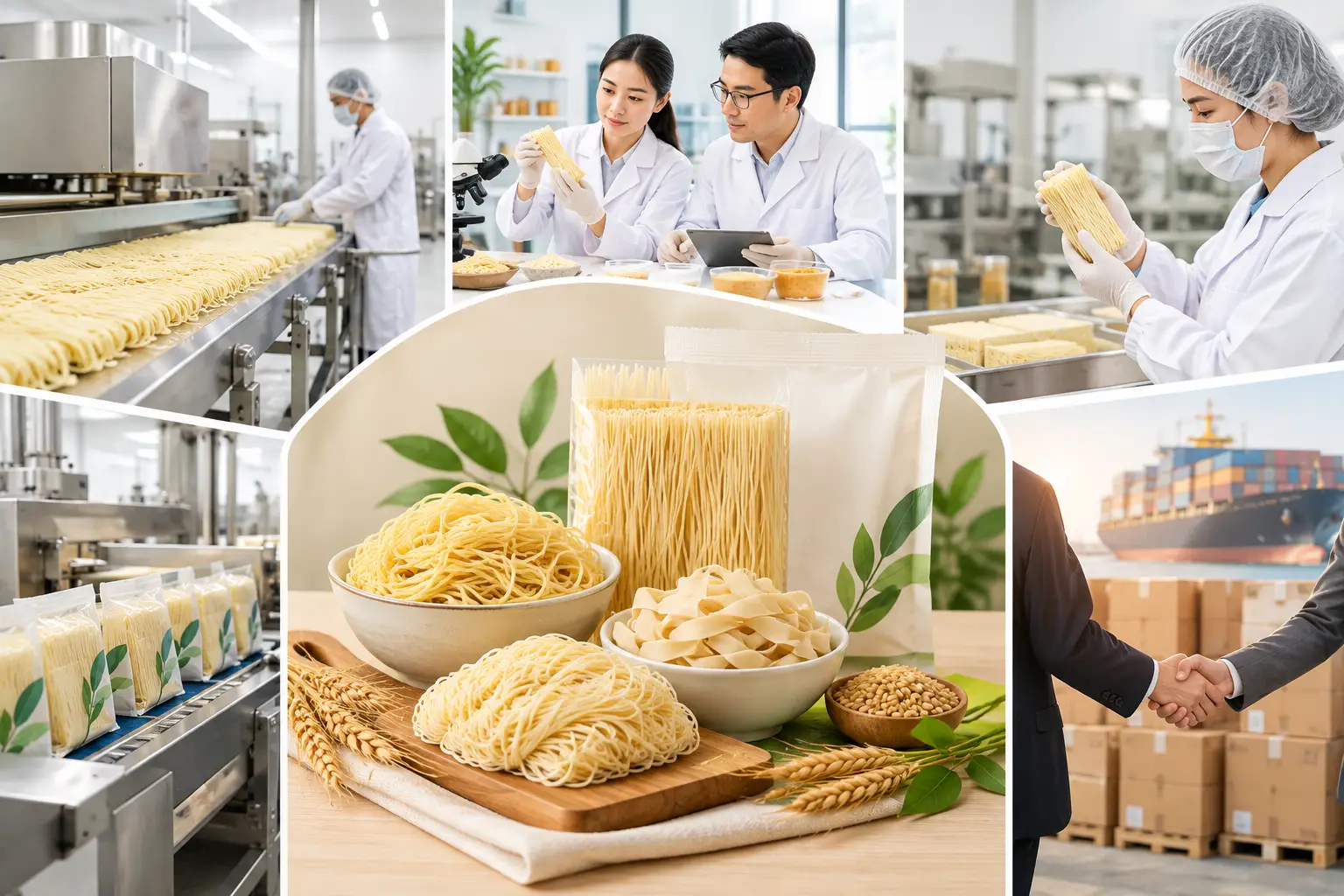
A noodle concept can look promising on a product brief and still fail at the factory floor. The noodles may cook too slowly, break during packing, lose their intended bite after distribution, or cost more to produce than the target market will accept. Knowing how to develop OEM noodle products means turning a commercial idea into clear, manufacturable specifications that can be repeated consistently at scale.
For brand owners, importers, distributors, and foodservice buyers, the process is not simply choosing a noodle and adding packaging. It requires decisions about format, texture, ingredients, cooking performance, quality controls, and market requirements. The earlier these decisions are aligned with a manufacturing partner, the more efficiently the product can move from concept to launch.
Start With the Product's Commercial Role
Before discussing flour blends or noodle thickness, define what the product needs to achieve in the market. A private-label retail noodle, a foodservice portion pack, and a child-focused noodle product may all use dry Asian noodle formats, but they are developed against different priorities.
A retail brand may need a distinctive visual identity, convenient portioning, and a format that suits the cooking habits of its target customers. A distributor may prioritize reliable carton configuration and a product profile that works across several sales channels. A foodservice operator may focus more closely on batch cooking performance, holding quality, and consistency when served with broth, sauce, or stir-fry applications.
The strongest development briefs state the intended customer, sales channel, target market, proposed price position, and use occasion. They also identify which product attribute cannot be compromised. For some brands, that is a firm, springy texture. For others, it may be an air-dried format, a simplified ingredient approach, child-friendly strand size, or a traditional regional noodle style.
Define the Noodle Format Before Customizing
Noodle development becomes more efficient when the base format is selected early. The manufacturing process, expected texture, cooking method, packing approach, and cost structure can differ significantly between formats.
Air-dried noodles are often considered when a brand wants a lighter-processing product position and a clean, straightforward eating experience. Fried noodles may be selected for their familiar preparation characteristics and compatibility with certain instant noodle concepts. Traditional dry Asian noodle styles can be developed in different widths, shapes, and textures depending on the intended dish and regional preference.
Ingredient decisions should follow the format rather than be treated as an afterthought. Wheat-based formulations, vegetable inclusions, egg-free concepts, seasoning compatibility, and requested ingredient exclusions can all affect dough handling and final product performance. A change that sounds simple on a marketing brief may alter color, elasticity, drying behavior, breakage rates, or cooking tolerance.
This is also where a manufacturer should ask practical questions. Will the noodle be served in soup, tossed with sauce, or stir-fried? Is it expected to remain stable after a few minutes of holding? Does the consumer cook a single portion or a family pack? Is the product intended for younger children, where strand length and texture may need more careful consideration? These details guide formulation and process choices.
Build a Specification That a Factory Can Produce
A useful OEM specification is specific enough to support production, but flexible enough to allow sensible manufacturing adjustments during trials. Vague requests such as "premium noodles" or "healthier noodles" do not provide a production team with measurable targets.
A practical specification should cover the noodle type, target net weight, strand width or shape, intended cooking method, desired texture, ingredient direction, pack format, and key visual expectations. It should also identify the intended market and whether the product will be distributed locally or prepared for export channels.
Texture deserves particular attention. Buyers often describe the desired outcome with terms such as chewy, soft, smooth, firm, or bouncy. Those descriptions are useful, but they should be tested against a defined cooking method. A noodle can perform well when cooked exactly to the recommended time yet become overly soft if customers commonly cook it longer. Development should account for likely real-world preparation, not only ideal test conditions.
Packaging requirements belong in the specification from the beginning. Pack size affects portioning, filling, carton planning, and the consumer's perception of value. Packaging materials and pack construction must also help protect the product during storage and transport. For export-focused programs, labeling space, language needs, outer-carton requirements, and destination-market documentation should be considered early rather than added after product approval.
Use Samples to Test Performance, Not Just Appearance
A sample review should be a structured business decision, not a quick tasting session. The first sample is designed to confirm direction. It may reveal that the strand is too thick, the cook time is unsuitable, the color does not match the brand position, or the noodle needs better sauce adhesion.
Assess samples using the same preparation method customers are likely to use. For soup noodles, test the product in the intended broth and observe whether the texture remains acceptable over time. For stir-fry applications, test how well the noodles separate, absorb sauce, and withstand tossing. For foodservice use, evaluate batch preparation and holding conditions where relevant.
Feedback should be consolidated before the next development round. Conflicting feedback from multiple stakeholders can create delays unless one person or team has authority to make final product decisions. A clear feedback document is more effective than general comments. It should state what is approved, what needs adjustment, and which changes are essential versus preferable.
It is also wise to test the complete product presentation. A noodle may be approved on its own but need adjustment once paired with a seasoning sachet, sauce component, or branded package. The final consumer experience is shaped by the complete system.
Plan Quality and Food Safety Into OEM Noodle Development
Quality assurance is not a final inspection activity. It begins with raw material standards, process control, approved specifications, and traceable documentation. A dependable OEM partner should be able to explain how product consistency is managed from ingredient receiving through manufacturing, packing, and finished-product checks.
For B2B buyers, recognized food safety systems provide useful assurance when assessing a manufacturing partner. Tehki Food operates with ISO 22000, HACCP, GMP, MeSTI, and Halal certifications, supporting customers that need documented quality and food safety practices as part of their supplier evaluation.
However, certification alone does not replace product-specific planning. Each project should establish the relevant quality attributes, such as noodle appearance, weight control, moisture-related parameters, cooking performance, pack integrity, and labeling accuracy. The required level of documentation may vary depending on the buyer's internal processes, product category, and destination market.
If a product is intended for export, involve the importer, regulatory adviser, or destination-market team in the development process. Manufacturing capability and market entry requirements must work together. Ingredients, claims, labels, and packaging information should be reviewed against the needs of the destination market before full commercial production is scheduled.
Balance Customization With Production Practicality
Customization creates differentiation, but every customization has a manufacturing consequence. A unique noodle shape may require different processing settings. A specialty ingredient can affect supply planning. A highly detailed package may add complexity to packing operations. These are not reasons to avoid customization. They are reasons to prioritize the changes that add genuine value to the buyer and end user.
The most commercially durable noodle programs typically focus on a few meaningful points of difference. This could be an air-dried noodle format, a distinctive texture, a regional noodle profile, a family-oriented portion size, or packaging designed for a specific channel. Trying to make every part of the product unique can increase development time and make consistency harder to maintain.
Cost discussions should also be grounded in the complete product design. Ingredient selection, noodle format, pack size, printing requirements, and outer packaging all contribute to the finished product's commercial viability. A manufacturer can provide more useful guidance when it understands the intended market position rather than being asked to match a target cost without a defined specification.
Prepare for a Controlled Commercial Launch
Once the product is approved, the focus shifts from concept validation to repeatable production. Final artwork, approved specifications, packaging materials, quality checkpoints, and communication procedures should be confirmed before the first commercial run. Any late change to formulation, pack design, or product positioning should be reviewed for its effect on manufacturing and quality.
A well-managed launch also creates a basis for improvement. Initial market feedback may show that customers want a different portion size, a revised cooking instruction, or another noodle variant within the same brand family. When the core product platform is well documented, future extensions can be developed with greater confidence and less unnecessary rework.
The right OEM noodle project is not defined only by an attractive pack or a successful sample. It is defined by a product that fits its market, can be manufactured consistently, and gives the brand a practical foundation for long-term growth.