

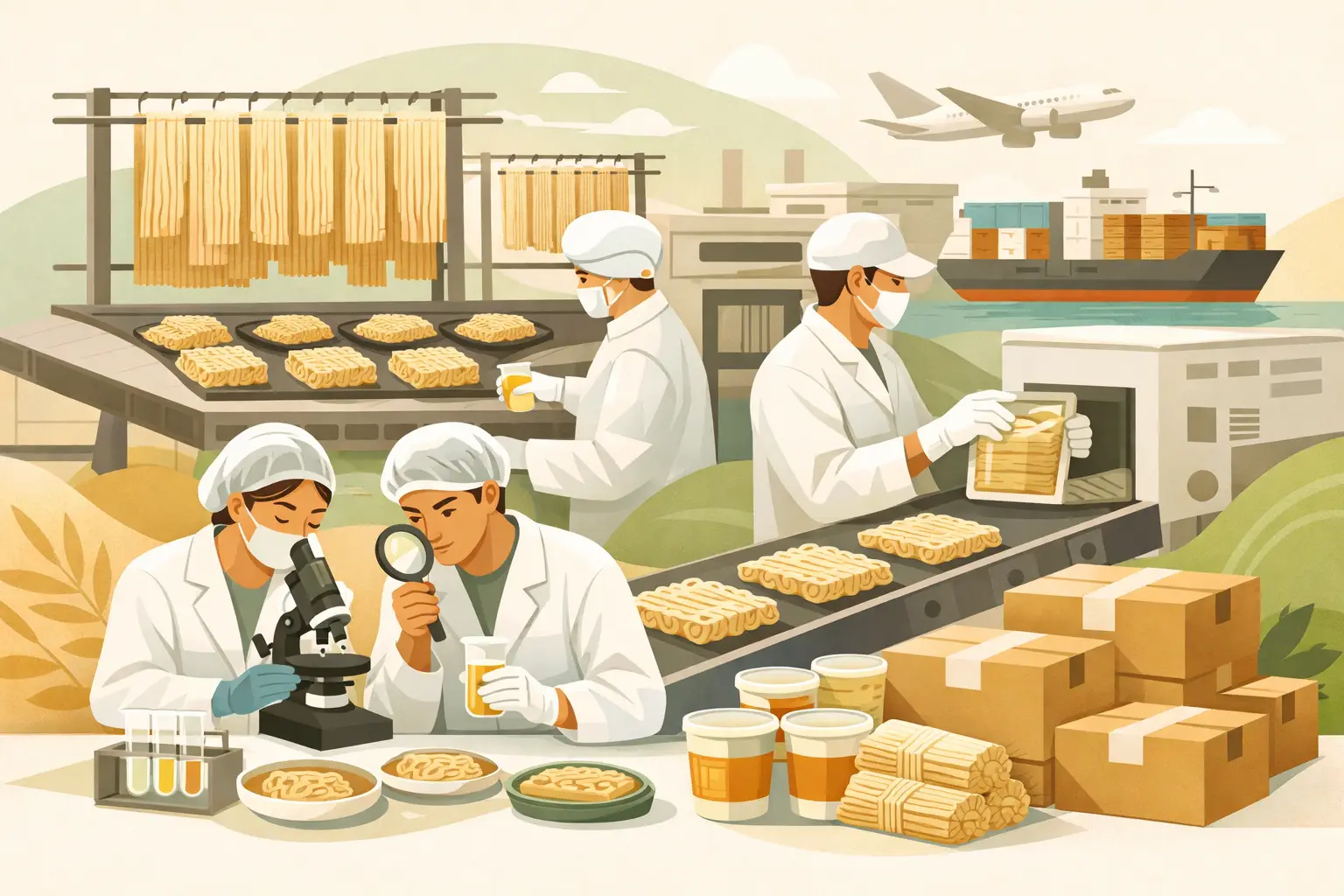
A noodle product can look straightforward on paper - flour, water, process, pack. In manufacturing, it is rarely that simple. The importance of research and development in noodle manufacturing becomes clear when a product must deliver the same texture, cooking performance, safety standard, and commercial viability across repeated production runs and different markets.
For brand owners, importers, distributors, and foodservice buyers, R&D is not a side function. It is what turns a noodle concept into a product that can actually be produced at scale, packed correctly, shipped with confidence, and accepted by the market. Without strong development work, even a promising noodle idea can struggle with inconsistency, weak differentiation, or manufacturing inefficiency.
Why research and development matters in noodle manufacturing
In B2B noodle manufacturing, R&D sits between market demand and factory execution. It connects what buyers want with what can be produced reliably. That includes noodle type, thickness, bite, color, ingredient profile, cooking time, portion weight, and packaging fit. Each of these factors affects the final product, but they also affect one another.
A small formulation adjustment can change dough handling. A different noodle width can affect drying behavior. A cleaner ingredient label may influence texture stability. This is why development work needs to be practical, not theoretical. A product is only successful when it works under real production conditions.
The value of R&D is also commercial. It helps reduce expensive trial-and-error after launch. It improves first-time-right product development. And it gives buyers a clearer path when they want to build a private-label line, adapt a product for a target market, or create a differentiated noodle format.
The importance of research and development in noodle manufacturing for product quality
Quality in noodles is not defined by one factor. It is a combination of appearance, texture, cooking performance, flavor compatibility, and consistency from batch to batch. R&D helps establish the right balance before full-scale production begins.
For dry Asian noodles, texture is often the first issue that needs close development. Some customers want a firmer, springier bite. Others need a softer profile for child-friendly formats or specific foodservice applications. Reaching that result depends on more than ingredient selection. Process settings, dough hydration, sheeting, cutting, steaming, frying or air-drying conditions, and moisture control all play a role.
This is where a capable manufacturer adds value. Instead of treating noodles as a commodity, R&D evaluates how each technical decision affects the finished product. The goal is not only to make a noodle that tastes acceptable in one sample run. It is to build a quality standard that can be repeated consistently.
Consistency is what buyers actually purchase
Many B2B buyers are not only buying noodles. They are buying predictability. A distributor wants confidence that the product received this month will match the one sold last month. A foodservice operator needs the same cooking result across outlets. A brand owner needs consumer complaints to stay low and product reputation to remain stable.
R&D supports that consistency by setting validated product specifications and process parameters. It also helps identify acceptable tolerances before they become larger production problems. This matters even more for export-oriented products, where product variation can create avoidable friction across channels and markets.
R&D supports customization without losing control
Customization is a major reason companies work with OEM and ODM noodle manufacturers. A buyer may want a house-brand noodle with a certain width, portion size, ingredient preference, or cooking profile. That sounds simple until each request starts affecting machinability, pack format, and production efficiency.
Research and development makes customization practical. It allows a manufacturer to assess what can be adjusted safely and efficiently, and what may need compromise. In some cases, the requested texture may require a different processing approach. In others, the preferred ingredient profile may be possible, but only with careful reformulation to maintain product stability and appearance.
This is where technical honesty matters. Good R&D does not say yes to everything. It helps define the best achievable version of the product based on manufacturing reality. That protects both the buyer and the manufacturer from costly misalignment later.
Different markets need different noodle solutions
A noodle developed for retail may not suit foodservice. A product intended for one export market may need a different portion format, label structure, or cooking performance in another. Even within the same category, customer expectations vary.
R&D helps translate these differences into workable product decisions. For example, a foodservice noodle may need better holding performance after cooking, while a retail product may place more emphasis on shelf presentation and home-use convenience. Infant and toddler noodle concepts may require extra care in shape, texture behavior, and ingredient selection. These differences are manageable, but only when product development is handled methodically.
Food safety and compliance start long before production
In manufacturing, safety is not added at the end. It is built into the product and process from the beginning. R&D contributes by evaluating raw materials, processing steps, moisture targets, and packaging compatibility before scale-up.
This matters because a product that performs well in a test kitchen may behave differently in a factory environment. Industrial production introduces variables such as line speed, drying consistency, handling, and pack sealing conditions. If these are not considered during development, a product can become harder to control once production expands.
A strong R&D function works closely with quality and production teams. That coordination helps ensure that product ideas are aligned with established food safety systems and manufacturing standards such as HACCP, GMP, and broader certified quality frameworks. For serious buyers, this alignment is part of supplier confidence.
Cost control is also part of development
Some companies treat R&D as a cost center. In practice, it is often one of the clearest ways to prevent waste. Poorly developed products can create line inefficiencies, excess rejects, unstable yields, packaging issues, and repeated reformulation work. All of that affects margin.
Effective noodle R&D looks at product performance and production practicality together. A formulation may be technically possible, but if it slows production or creates unnecessary complexity, it may not be commercially sensible. Likewise, a lower-cost formula is not always the better option if it weakens texture, increases complaints, or causes inconsistency.
This is why development decisions should not be based on ingredient cost alone. The better question is total manufacturing value. That includes process efficiency, repeatability, pack compatibility, and market fit. In many cases, the most commercially sound product is the one that balances quality targets with operational stability.
Innovation in noodles is often incremental, but still valuable
Not every successful noodle product is radically new. In this category, useful innovation is often incremental. A better texture profile, a cleaner formulation direction, an air-dried alternative, a more suitable portion size, or improved child-friendly format can all create meaningful market value.
The importance of research and development in noodle manufacturing is that it gives manufacturers and buyers a structured way to pursue these improvements. Instead of chasing trends loosely, they can assess whether a concept is manufacturable, relevant to the target market, and sustainable over time.
For companies building private-label or export-ready noodle lines, this matters a great deal. Product development is not only about launching something different. It is about launching something that can continue performing once orders scale.
R&D strengthens the manufacturer-buyer relationship
In B2B manufacturing, the best partnerships are built on more than supply. Buyers want a manufacturer that can think through product details, identify risks early, and recommend workable options. That is one reason R&D capability often separates a transactional supplier from a long-term manufacturing partner.
When a manufacturer can support formulation adjustment, texture development, process validation, and practical customization, conversations become more productive. The buyer gains clearer technical guidance. The development process becomes faster and more realistic. Expectations are easier to manage on both sides.
This is especially relevant for companies entering new categories or expanding their noodle range under their own brand. They may know the market opportunity well, but still need factory-level input on what the product should look like in production terms. A manufacturer with real development capability helps close that gap.
Tehki Food approaches this as a manufacturing discipline, not just a sample-making exercise. For B2B customers, that means product development is tied to consistency, food safety, scalability, and market practicality from the start.
Research and development is what gives noodle manufacturing its commercial discipline. It helps good ideas become stable products, and it helps stable products remain relevant as markets change. For buyers choosing a manufacturing partner, that capability is not a bonus feature. It is often the difference between a noodle that merely exists and a noodle line that can grow with confidence.