

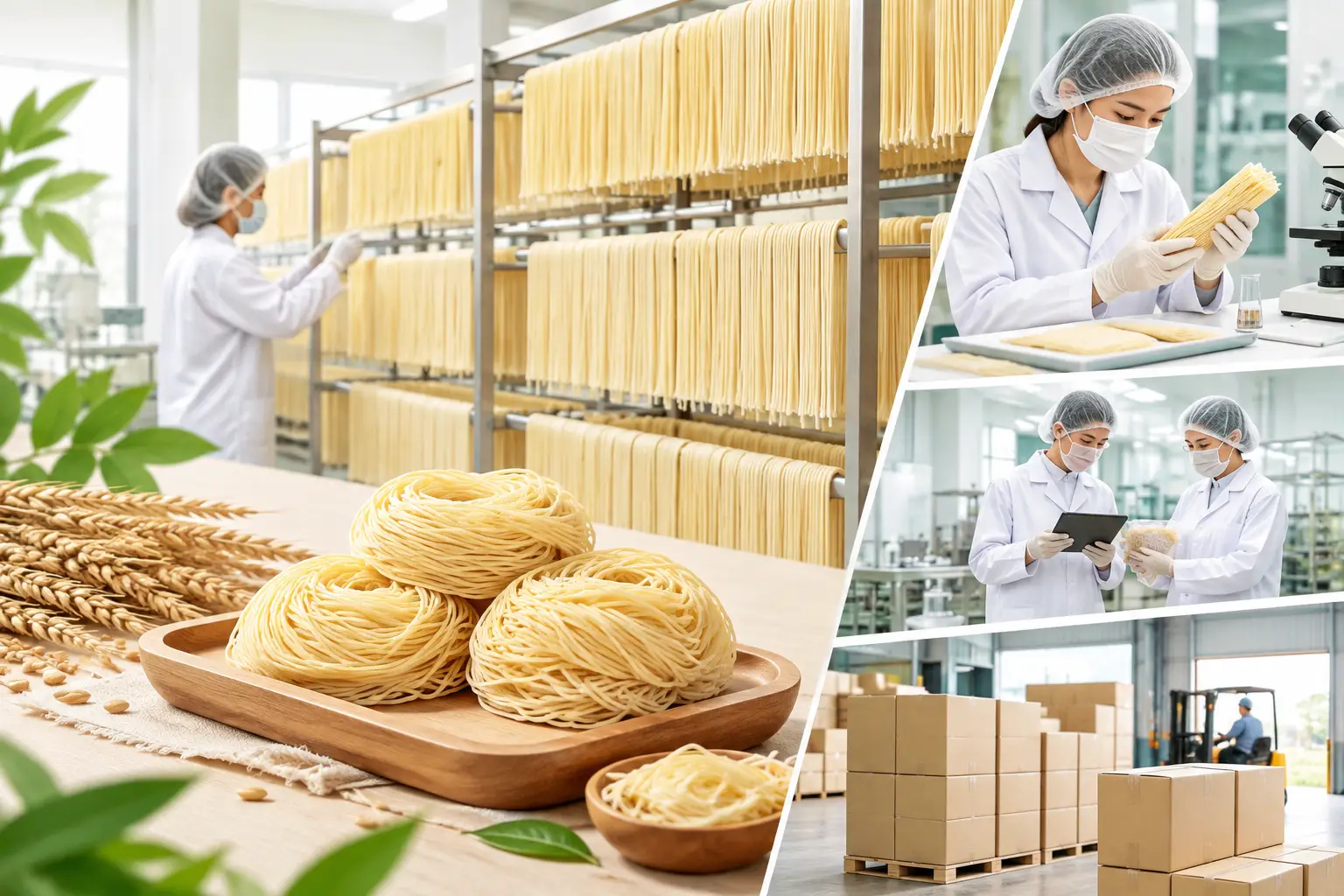
A noodle can look finished long before it is stable enough to pack. For brand owners, understanding the drying process and quality factors behind indoor air-dried noodles is essential because drying affects far more than moisture removal. It shapes cooking performance, texture, appearance, breakage rates, flavor retention, food safety management, and the consistency customers expect from every pack.
For private-label and export-oriented products, air drying is not simply a lower-oil alternative to fried noodles. It is a controlled manufacturing stage that must be matched to the noodle formula, strand thickness, product format, packaging plan, and intended market. A well-designed process helps create a noodle that rehydrates predictably and remains dependable through handling, distribution, and preparation.
What Indoor Air-Dried Noodles Are
Indoor air-dried noodles are formed noodles dried in a controlled indoor environment rather than being fried to reduce moisture. Depending on the product, the process may use managed airflow, temperature, humidity, and staged drying time. The aim is to reduce water activity to a suitable level while protecting the noodle structure.
The term "air-dried" can describe several production approaches. Some noodles are dried slowly at moderate conditions, while others move through multiple drying zones with carefully adjusted temperature and airflow. The best approach depends on the noodle type. Fine wheat noodles, rice-based noodles, mixed-grain products, and child-focused formats can each respond differently to the same drying conditions.
For B2B buyers, this distinction matters. Product specifications should not stop at the label claim of air-dried. They should define the expected noodle format, cooking time, texture after rehydration, breakage tolerance, pack weight, and intended preparation method. These details give a manufacturer a practical target for process development.
The Indoor Drying Process, Step by Step
Drying begins well before noodles enter the drying area. Flour selection, water ratio, mixing, dough resting, sheeting or extrusion, cutting, and steaming all influence how moisture moves out of the noodle later. A dough that is not uniform can dry unevenly, producing variation from one strand or cake to another.
After forming, many Asian noodle formats are steamed or otherwise cooked to set the starch structure. At this point, the noodle contains substantial moisture and is delicate. It needs to be handled carefully before and during drying to prevent deformation, sticking, or surface damage.
Controlled removal of moisture
In the drying stage, air circulation carries moisture away from the noodle surface. Heat supports evaporation, but more heat is not automatically better. If the exterior dries too fast while the center remains comparatively moist, the noodle can develop internal stress. This may later show up as cracking, excessive brittleness, uneven cooking, or a rough texture after rehydration.
A staged process is often more reliable than a single aggressive drying condition. Early stages can remove surface moisture gently, while later stages continue drying as the noodle structure becomes more stable. Temperature, relative humidity, airflow volume, air direction, and residence time must work together rather than being managed as isolated settings.
The final cooling period also deserves attention. Packaging noodles while they are still too warm can create condensation risk inside the pack. Controlled cooling helps prepare the product for packing and supports a more stable finished condition.
Why indoor control makes a difference
Indoor drying gives manufacturers more control over environmental variables than open-air drying. That control supports repeatability across production days and seasons, which is particularly valuable for brands that require consistent products across multiple shipments or markets.
However, controlled equipment alone does not guarantee quality. Sensors, process records, preventive maintenance, sanitation practices, and verification checks are equally important. The useful question for a buyer is not whether a factory has a dryer, but whether it has a documented process for achieving and confirming the intended product condition.
Quality Factors That Matter to Buyers
Moisture and water activity
Moisture content is a central quality measure, but it does not tell the whole story. Water activity provides additional insight into the amount of water available for microbial activity and quality deterioration. Manufacturers use these controls as part of a broader food safety and product stability program.
Targets vary by formula and noodle format. Drying a product below the level needed for stable handling may increase fragility, while insufficient drying can create quality and safety concerns. The appropriate range should be validated for the specific product rather than borrowed from an unrelated noodle type.
Texture after cooking
The real test of a noodle occurs in the bowl. Air-dried noodles should rehydrate evenly and deliver the texture promised by the product concept, whether that is firm and springy, soft and smooth, or suitable for a child-friendly application.
Drying can alter the way water returns to the noodle during cooking. A process that creates excessive surface hardening may slow rehydration or cause an uneven bite. Conversely, a noodle with weak structure may become overly soft or break apart. Product development should therefore include cooking trials under realistic conditions, not just visual inspection of the dry noodle.
Appearance, shape, and breakage
Consumers may never see a factory drying profile, but they will notice a pack filled with broken noodle pieces or cakes that do not hold their shape. Strand alignment, cake integrity, color consistency, and a clean surface all affect perceived quality.
Breakage is influenced by moisture level, noodle thickness, handling design, cooling, and packaging protection. It also depends on the supply chain. A product intended for long-distance export may need a more protective pack configuration than one supplied locally, even when the noodle itself is identical.
Formula compatibility
Ingredients influence drying behavior. Wheat flour characteristics, starch systems, salt level, egg ingredients where applicable, vegetable powders, fiber-containing ingredients, and seasoning inclusions can change dough handling and moisture movement. A clean-label or reduced-additive concept may require additional process development to maintain the target texture and manufacturing efficiency.
This is why OEM and ODM projects benefit from early feasibility work. A commercially attractive formula must also run consistently on production equipment and retain its intended quality after drying, packing, transport, and preparation.
Food Safety and Process Discipline
Air-dried noodle quality depends on disciplined manufacturing controls, not on one final inspection. Ingredient approval, allergen management where applicable, hygiene zoning, equipment cleaning, traceability, and finished-product checks all contribute to a dependable system.
For buyers, recognized food safety systems such as HACCP, GMP, and ISO 22000 provide useful assurance that critical controls are structured and monitored. Certification should be considered alongside practical evidence of manufacturing capability: clear specifications, batch records, testing plans, change-control practices, and effective communication when product adjustments are needed.
Packaging is part of this system as well. It should protect noodles from moisture exposure, physical damage, and the conditions expected during storage and transport. The most suitable material and format depend on the noodle shape, unit size, secondary packing method, and destination market requirements.
Selecting an Air-Dried Noodle Manufacturing Partner
A productive sourcing discussion starts with the commercial objective. Is the product designed for retail shelves, foodservice kitchens, meal kits, or a specialty export range? Does the buyer need a familiar noodle style, a healthier-positioned air-dried concept, a smaller portion, or custom packaging for a house brand?
The manufacturing partner should then translate that objective into measurable product requirements. These commonly include noodle dimensions, raw material preferences, cooking method, target texture, seasoning compatibility, packaging format, quality checks, and documentation needed for the destination market. Clear alignment at this stage reduces costly changes later.
Tehki Food supports this process by combining dry Asian noodle manufacturing knowledge with practical OEM and ODM development. For customers building an air-dried noodle range, the focus should be on a product that is manufacturable, consistent, and suited to its commercial channel, not simply a sample that performs well once.
Build Quality Into the Brief
The strongest air-dried noodle projects treat drying as a core product-design decision, not a back-end factory detail. When the formula, noodle shape, drying profile, quality controls, and packaging are developed together, buyers are better positioned to create products that perform reliably from production line to final preparation.
A clear brief, realistic product testing, and an experienced manufacturing partner give the drying process the attention it deserves - before the first commercial pack reaches the market.