
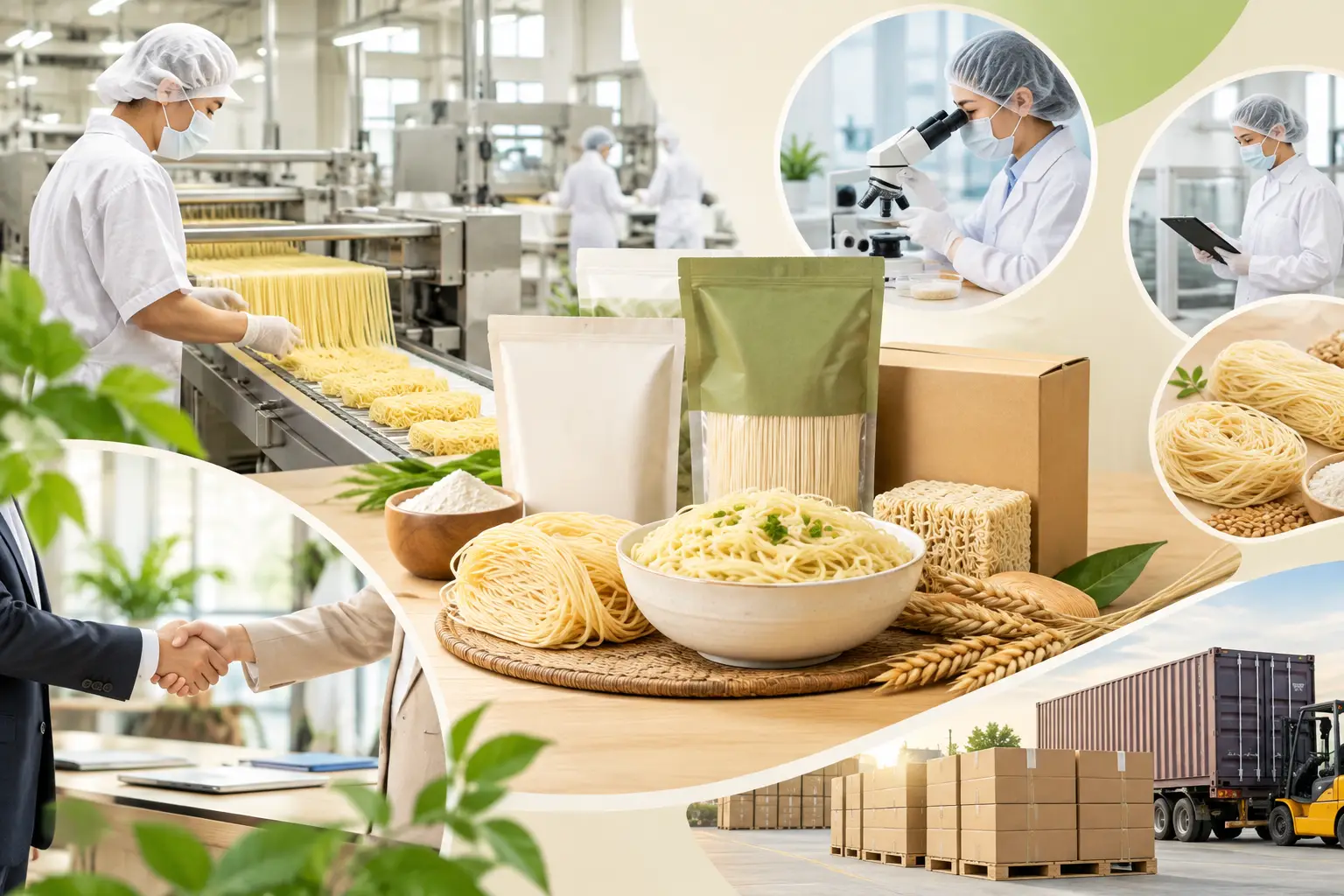
A noodle product can look simple on the shelf, yet it depends on many controlled decisions behind the scenes: flour selection, dough handling, drying or frying method, noodle texture, portioning, packaging, and quality checks. Noodle co-packing gives brand owners a practical way to bring those decisions together through an experienced manufacturing partner rather than building production capacity from scratch.
For private-label brands, importers, distributors, and foodservice businesses, the value is not merely having noodles packed under a chosen name. The right arrangement supports repeatable product quality, a format that fits the intended market, and a production process designed to scale responsibly as demand develops.
What Noodle Co-Packing Means for B2B Buyers
Noodle co-packing is a manufacturing service in which a specialist produces and packs noodle products for another business to sell under its own brand, or as part of its own product range. Depending on the project, the customer may provide an established specification, or work with the manufacturer to develop one.
The scope can range from producing a familiar dry noodle format with customer-branded packaging to developing a more differentiated product. Examples include air-dried noodles for a lighter product position, fried noodles for a traditional instant noodle format, child-friendly noodle portions, or noodles made with selected ingredients to support a clean-label concept.
This model is particularly useful when a business has market access, brand direction, and distribution capability but does not operate a dedicated noodle factory. It can also suit established food companies that need added manufacturing capacity or access to a noodle format outside their existing technical capabilities.
The key distinction is partnership. A capable co-packer should understand how a product concept translates into consistent factory output, not simply receive packaging artwork and run a production order.
Why Manufacturing Fit Matters More Than a Low Unit Cost
Procurement teams naturally compare costs, but noodle co-packing decisions should not be made on price alone. A low initial quote can become expensive if the noodle breaks during distribution, cooks inconsistently, does not match the approved sample, or requires repeated packaging revisions.
Manufacturing fit begins with the intended use of the product. Noodles designed for retail may need strong shelf presentation, easy preparation instructions, and portion sizes suited to household use. A foodservice noodle may need to hold its texture in broth, stir-fry, or batch preparation. Export products also require packaging and handling considerations that protect the noodles through longer supply chains.
Texture is another commercial consideration. The desired bite, thickness, curl, cooking time, and rehydration performance all influence formulation and processing. A product that performs well in a development kitchen may need further adjustment before it performs consistently at production scale.
The most productive conversations happen early, when the buyer can explain the target market, product application, sales channel, and desired price position. This gives the manufacturer a clearer basis for recommending a suitable noodle type and production approach.
Choosing the Right Noodle Format
There is no single best noodle format. The right option depends on the brand's category strategy, consumer expectations, and distribution requirements.
Air-Dried Noodles
Air-dried noodles are often considered by brands seeking a product format with a health-conscious or premium positioning. The drying process can support a distinct noodle texture and product story, but the formulation and cooking performance still need to match the intended eating experience. This format may suit retail ranges that want to differentiate from conventional fried noodle products.
Fried Noodles
Fried noodles remain relevant in many established instant noodle categories because they deliver familiar preparation and texture characteristics. For brands entering markets where this format is widely understood, a fried noodle product may be the commercially practical choice. The decision should be based on the target category, not on assumptions that one processing method is always better than another.
Specialty and Child-Friendly Products
Specialty concepts require more development discipline. Infant and toddler noodle products, for example, call for careful consideration of noodle size, texture, ingredient selection, and age-appropriate product positioning. Similarly, clean-label or ingredient-focused concepts must be evaluated for how each formulation choice affects manufacturability, appearance, taste, and stability.
A reliable manufacturer helps identify these trade-offs before packaging is finalized and inventory commitments are made.
Product Development Should Start With a Clear Brief
A useful co-packing brief does not need to be overly technical, but it should be specific enough to guide development. Start with the product's intended channel and customer. Then define the noodle type, preferred eating characteristics, pack format, and any ingredient or labeling requirements that are central to the brand.
It also helps to identify what cannot be compromised. For one buyer, that may be a particular noodle width or cooking behavior. For another, it may be a packaging format that fits an existing retail display. Importers may prioritize documentation and export readiness, while foodservice operators may place greater emphasis on performance after cooking.
From there, the manufacturer can assess whether an existing production format can be adapted or whether a more tailored development process is needed. Using a proven format may simplify the launch path. A customized concept can create stronger market differentiation, but it usually requires more alignment on samples, specifications, and quality expectations.
Packaging Is Part of Product Performance
In dry noodle manufacturing, packaging has a functional role as well as a branding role. It must protect the product, support efficient packing, and remain suitable for the route to market. A visually strong design is not enough if the pack format does not protect noodle integrity or work reliably on the packing line.
Brand owners should consider the practical details early: single portions or multipacks, retail-ready outer cartons, required language panels, preparation instructions, and how the product will be handled after leaving the factory. Packaging choices can also influence case configuration, warehouse handling, and how easily a distributor can manage the product.
The manufacturer should review packaging feasibility before the final design is approved. This reduces the risk of discovering late in the process that a chosen material, size, or closure is unsuitable for the product or equipment.
Quality Systems Build Confidence Across the Supply Chain
For B2B buyers, quality is not limited to the finished noodle. It includes ingredient control, process monitoring, traceability, hygienic production practices, and consistent documentation. These systems matter because distributors, retailers, and import partners need confidence that each production run will meet the agreed standard.
When assessing a noodle co-packing partner, buyers should ask how specifications are controlled, how samples are approved, and how changes are managed. They should also understand the facility's food safety framework and relevant certifications. ISO 22000, HACCP, GMP, MeSTI, and Halal certification can provide useful assurance when they are supported by disciplined daily operations.
Consistency is especially valuable for businesses building repeat purchases. If a brand's first production performs well but later batches vary in texture, color, or cooking behavior, customer trust can be difficult to recover. A factory's quality culture therefore has a direct effect on commercial outcomes.
A Better Way to Evaluate a Noodle Co-Packing Partner
The strongest manufacturing relationships are built on operational clarity. Rather than asking only whether a supplier can make noodles, buyers should assess whether the partner can support the product from concept through repeat production.
Useful questions include whether the manufacturer has experience with the desired noodle format, whether it can offer practical customization, how it manages quality approvals, and how it supports export-oriented requirements. It is also worth discussing communication processes. Clear updates during product development and production planning can prevent small misunderstandings from becoming expensive delays.
Tehki Food works with B2B customers seeking OEM, ODM, and private-label dry Asian noodle solutions, combining traditional noodle knowledge with controlled modern manufacturing. For buyers, the goal is not complexity for its own sake. It is a commercially viable product that can be produced consistently and presented with confidence under the customer's brand.
A well-chosen co-packing partner gives a noodle brand room to focus on its market, customers, and distribution while keeping manufacturing quality at the center of the product. Start with a clear brief, test the details that affect real-world performance, and choose a partner prepared to build for the next production run, not only the first one.