
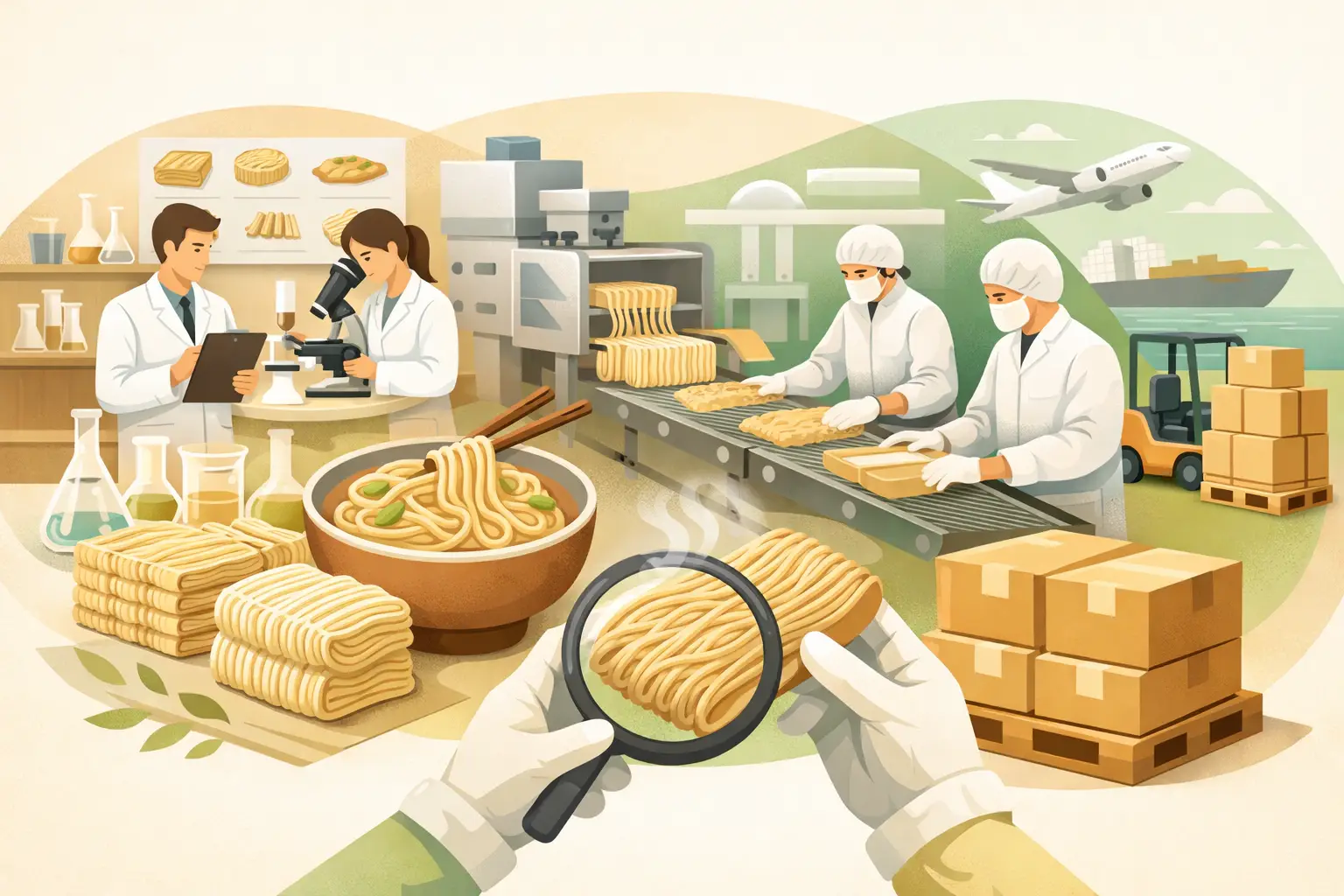
A noodle idea can look straightforward on a product brief, yet small decisions in flour selection, noodle thickness, drying method, and pack format can determine whether it is commercially workable. From concept to commercialization, the noodle development process must turn a market opportunity into a repeatable product that performs consistently across production, distribution, and customer use.
For brand owners, importers, distributors, and foodservice buyers, development is not simply about creating a noodle that tastes good in a sample session. It is about defining a product that can be manufactured at scale, meet agreed quality expectations, support the intended market position, and arrive in a format that makes sense for the sales channel.
From Concept to Commercialization: Noodle Development Process
The strongest projects begin with a clear commercial brief. A manufacturer can make better technical choices when the intended customer, product use, target market, and product position are defined early. A retail-ready private-label noodle, for example, has different requirements from a foodservice noodle portion or a child-friendly noodle concept.
The brief should establish the noodle style, whether the product is air-dried or fried, the preferred eating texture, cooking method, serving size, ingredient direction, pack format, and expected distribution channel. It should also clarify what cannot be compromised. For one brand, the priority may be a cleaner ingredient direction. For another, it may be a familiar Asian noodle texture, efficient portion control, or a pack format suited to export distribution.
This is also the point to consider the commercial trade-offs. More customization may help a product stand apart, but it can add complexity to sourcing, processing, packaging, and quality control. A practical development partner helps distinguish between changes that create meaningful market value and changes that add cost without improving the customer proposition.
Translate the market brief into a technical specification
Once the product direction is agreed, the concept needs to become a usable specification. This includes the noodle dimensions, ingredient profile, target appearance, moisture control parameters, cooking behavior, and packaging requirements. The specification becomes the reference point for development trials and later production checks.
Texture requires particular attention. Consumers may expect noodles to be springy, soft, firm, smooth, or quick-cooking depending on the product category and market. Those outcomes are influenced by the flour blend, water level, mixing, sheeting, cutting, steaming where applicable, frying or drying conditions, and the final noodle cake or bundle design.
A good specification is specific enough to guide manufacturing but realistic enough to produce consistently. It should not rely on vague descriptions such as “premium texture” without defining what that means in cooking and eating performance. For B2B buyers, measurable agreement reduces avoidable rework after samples have been approved.
Formulation and Process Development Work Together
Noodle formulation is not separate from the manufacturing process. An ingredient change can affect dough handling, sheet strength, drying behavior, color, cooking time, and finished texture. That is why product development should evaluate the recipe and process as one system rather than treating the formula as a fixed starting point.
For example, an air-dried noodle concept may be selected for its product positioning and cooking characteristics, while a fried noodle may be better suited to a different texture expectation or preparation style. Neither approach is automatically better. The right choice depends on the brand’s intended market, product claims strategy, cost structure, and consumer experience.
Customized development may involve flour choices, starches, vegetable ingredients, egg-based options, seasoning compatibility, or portion formats. Infant and toddler noodle concepts require especially careful consideration of noodle size, texture, ingredient suitability, and preparation experience. These projects benefit from an early discussion between the brand team and the manufacturer so that commercial goals remain aligned with practical production controls.
Prototype trials should test real-use performance
A prototype is more than a visual sample. It should be assessed under the conditions the customer will actually use. This can include cooking time, water absorption, texture after cooking, clumping tendency, soup compatibility, stir-fry performance, breakage during handling, and product appearance after preparation.
Testing should also consider variation. A noodle that performs well when prepared immediately may behave differently after holding for several minutes, which can matter for foodservice applications. Likewise, a compact retail portion may require different structural strength than a larger foodservice pack. The development team needs to identify these conditions before finalizing the product.
Feedback should be consolidated into clear decisions. It is common for stakeholders to request changes after tasting, but each change should be linked to a defined outcome: firmer bite, reduced cooking time, smaller portion, different noodle width, or improved handling. This keeps the project moving forward instead of creating repeated trial cycles based on subjective comments alone.
Build Quality and Food Safety Into the Product
Commercialization depends on controlled manufacturing, not just a successful sample. Ingredient approval, batch traceability, hygiene practices, process monitoring, foreign-material controls, and finished-product checks all support consistent production. Buyers should understand how their manufacturing partner manages these controls before committing to a launch plan.
Tehki Food operates with food safety and quality systems including ISO 22000, HACCP, GMP, MeSTI, and Halal certification. For customers developing private-label or export-oriented dry noodles, these systems provide a structured foundation for discussing specifications, documentation expectations, production controls, and customer requirements.
Quality decisions should be agreed before production begins. These may cover noodle shape, color range, breakage tolerance, net weight control, pack seal appearance, cooking instructions, and carton configuration. Not every quality parameter needs to be identical across noodle categories, but each one should be appropriate to the product and clearly documented.
Packaging Is Part of the Noodle Development Process
Packaging has a direct effect on product protection, presentation, handling, and distribution efficiency. It should be developed alongside the noodle, not after the product is finalized. The dimensions of the noodle cake, portion size, seasoning components where relevant, and carton arrangement all influence pack selection.
For retail products, the pack must communicate the brand clearly while supporting practical shelf handling. For foodservice and wholesale channels, outer-case strength, efficient storage, and ease of use may carry more weight. Export projects can require additional attention to transport conditions, labeling coordination, language needs, and destination-market documentation requested by the customer or importer.
A visually attractive pack is valuable, but it should not create unnecessary complexity on the packing line. Design features, film choice, sealing performance, coding space, and carton fit should all be reviewed with the manufacturer before artwork is treated as final. Early coordination prevents a common problem: packaging that looks right on screen but is difficult to run consistently in production.
Validate Scale-Up Before the Launch
A development sample is made to prove a concept. Commercial production must prove repeatability. Moving from trial conditions to a full manufacturing run requires confirmation that the noodle can maintain its agreed characteristics at scale.
During scale-up, teams should monitor dough consistency, process settings, noodle dimensions, drying or frying performance, finished moisture control, breakage, pack weights, and cooking results. The objective is not to replicate every trial condition exactly. It is to establish stable production parameters that deliver the agreed finished product repeatedly.
This stage is where a capable OEM or ODM noodle manufacturer adds substantial value. Manufacturing experience helps identify process risks early, such as a formula that is difficult to sheet consistently, a noodle structure that becomes fragile after drying, or a pack configuration that slows production. Addressing these issues before a broader rollout is more efficient than correcting them after inventory has been produced.
Prepare the commercial handover
Before launch, the product team should confirm the final specification, approved artwork, packaging components, quality criteria, cooking instructions, order planning approach, and responsibilities for changes. Internal alignment matters as much as technical readiness. Procurement, sales, marketing, operations, and the manufacturing partner should be working from the same approved version of the product.
The first commercial production should be treated as a learning point, not merely a finish line. Buyer feedback, distributor handling observations, foodservice preparation results, and production data can all inform future refinements. A well-managed product is designed to improve through controlled change rather than frequent, unstructured adjustments.
The most effective noodle launches start with a concept that is ambitious enough to earn attention and practical enough to manufacture consistently. When formulation, process design, quality systems, packaging, and scale-up are planned together, a noodle product is better positioned to support a brand long after its first production run.