
A noodle product can look simple on the shelf, but consistency at scale is never simple inside the plant. That is why noodle factory quality systems matter so much for brand owners, importers, distributors, and foodservice buyers. When a manufacturing partner can control raw materials, processing conditions, product specifications, and documentation with discipline, the result is not just a better noodle. It is a more dependable product program.
For B2B buyers, quality is rarely a single checkpoint at final packing. It starts much earlier, with how ingredients are approved, how product standards are defined, and how production risks are controlled before they become customer problems. In OEM and ODM manufacturing, that difference is especially important because one factory may be producing multiple noodle types, textures, formulations, and packaging formats across different customer requirements.
What noodle factory quality systems are designed to do
At a practical level, quality systems in a noodle factory are built to create repeatability. A buyer may need the same noodle width, bite, cooking performance, moisture level, and pack presentation across different batches and production runs. Without a structured system behind the process, those details can drift.
A strong quality system connects food safety, process control, product specification, traceability, and corrective action. These are related, but they are not identical. A factory can produce a noodle that is safe to eat while still failing the customer requests that could be due to quality issues, texture inconsistencies, or packaging defects. Serious manufacturers understand that quality means both compliance and consistency.
For private-label and export-focused buyers, documentation is part of the quality system too. If a specification changes, if a raw material is substituted, or if a non-conformance occurs, the factory should have a clear way to review, record, and manage that change. That level of control helps reduce surprises later in the supply chain.
The core layers of noodle factory quality systems
The best noodle factory quality systems are not built around one certificate alone. Certifications matter because they show that systems are audited and maintained, but day-to-day execution inside the factory matters just as much.
The first layer is supplier and raw material control. Flour, starches, oils, functional ingredients, and packaging materials all affect final product quality. If incoming materials are inconsistent, the finished noodle will be inconsistent too. Good factories define acceptance criteria, inspect incoming goods, and work with approved suppliers rather than buying purely on short-term cost.
The second layer is process control. In dry noodle manufacturing, small changes in mixing, dough resting, sheeting, forming, steaming, frying, or drying can affect texture, appearance, and stability. Air-dried noodles and fried noodles do not behave the same way in production, so control points should reflect the product format. The system must be detailed enough to protect consistency, but practical enough for production teams to follow every day.
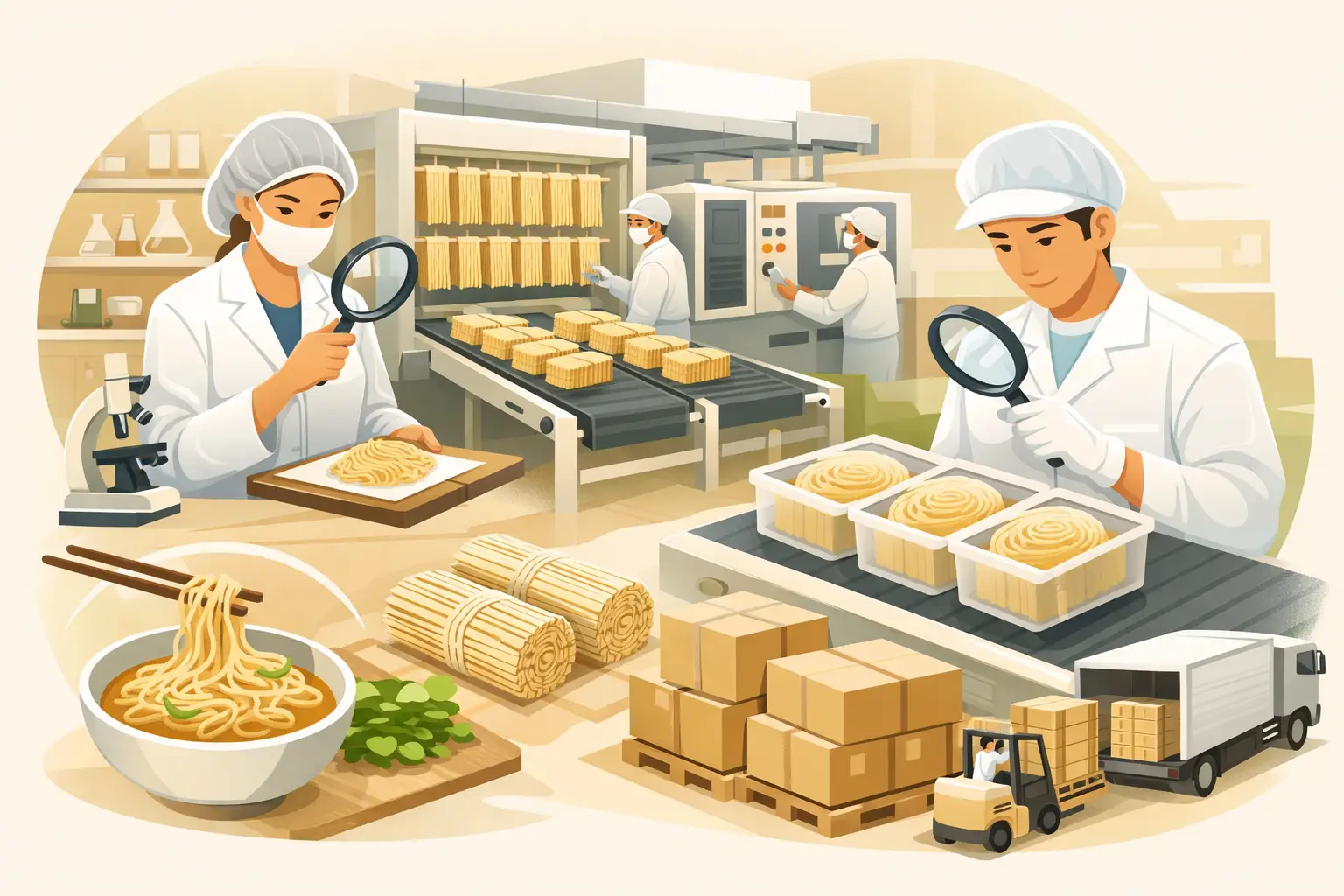
The third layer is finished product verification. This includes physical checks, sensory review, packaging inspection, labeling control, and relevant food safety verification. It is not enough to assume that a stable process guarantees perfect output. Finished product checks confirm whether the batch actually meets the agreed standard.
The fourth layer is traceability and response. If a customer raises a concern, the factory should be able to trace the batch, identify what happened, review records, and take corrective action. Fast response depends on disciplined records, not memory.
Why certifications matter, but are not the whole story
Buyers often start by looking for certifications such as ISO 22000, HACCP, GMP, MeSTI, and Halal. That is a sensible starting point because these standards show that a manufacturer has formal systems for food safety and operational control. They also help create confidence for market entry, retail acceptance, and export discussions.
Still, certifications do not automatically mean the same level of manufacturing discipline from one factory to another. The real question is how those systems are applied to noodle production itself. A capable manufacturer should be able to explain how standards are translated into actual controls for noodle texture, dough handling, drying conditions, contamination prevention, allergen management where relevant, packaging integrity, and batch consistency.
This is where experienced noodle manufacturers usually stand apart from general food processors. Noodles are highly sensitive to formulation and processing details. A factory with deep noodle experience is better positioned to connect quality systems with product behavior, especially when developing customized products for different markets.
Quality systems and customization must work together
Many B2B buyers do not want an off-the-shelf noodle. They may need a specific thickness, ingredient profile, cooking characteristic, or pack format that suits their brand or market segment. This creates a common tension inside manufacturing. The more customization involved, the more control the factory needs.
A weak system struggles when product variation increases. One formula change can affect dough handling. A packaging change can create different packing line requirements. A child-focused noodle product may need different ingredient and format considerations than a standard dry noodle range. Without disciplined product development and change control, customization can increase risk.
A good manufacturing partner handles customization through documented product specifications, trial procedures, approved samples, controlled formulation records, and clear production instructions. That keeps innovation commercially useful rather than operationally disruptive.
For buyers, this matters because the goal is not only to launch a differentiated product. The goal is to launch one that can be reproduced reliably after the first successful batch.
What buyers should look for in a quality-focused noodle manufacturer
A factory visit or supplier review should go beyond broad claims about quality. Buyers should look for evidence that the manufacturer can translate systems into consistent execution.
One useful sign is whether specifications are treated seriously. If a manufacturer can clearly define noodle dimensions, target texture, ingredient standards, pack format, and inspection criteria, it usually shows operational maturity. Another sign is whether production records are well controlled and accessible. If issues arise, the ability to review what happened on a specific batch is essential.
It is also worth paying attention to housekeeping, line organization, material flow, and segregation practices. These are basic operational signals, but they reveal whether standards are truly embedded. In many factories, quality problems begin with everyday discipline rather than major technical failures.
Communication is another major indicator. Strong manufacturers do not hide behind vague language when discussing deviations, technical limits, or product trade-offs. They can explain what is possible, what needs adjustment, and where a buyer may need to balance cost, performance, and specification demands.
Export readiness depends on system discipline
For businesses supplying multiple markets, noodle factory quality systems also support export readiness. Export programs usually require more than a good product sample. Buyers may need batch records, labeling control, traceability support, certification alignment, and confidence that repeat shipments will remain within specification.
This becomes especially important when a brand is building a long-term category presence. A single inconsistency can create downstream issues with distributors, retailers, or foodservice customers. The commercial cost of rework, complaints, rejected shipments, or damaged market confidence is often much higher than the cost of maintaining strict factory controls.
Manufacturers based in established export environments, including Malaysia, can add value when their systems are built for both local and international customer expectations. The benefit is not geography alone. It is the ability to support structured production, documented quality control, and practical communication across different business requirements.
Quality systems should support efficiency, not slow it down
Some buyers worry that heavy quality procedures will make manufacturing less responsive. In practice, the opposite is often true. A factory with clear standards, approved processes, and stable controls usually runs more efficiently because there is less confusion, less rework, and fewer avoidable interruptions.
That does not mean every process should be rigid. In real manufacturing, some flexibility is necessary, especially during product development or when adjusting for raw material variation. The point is to control those adjustments, not leave them informal.
At Tehki Food, this balance between control and practical execution is central to how dependable noodle manufacturing should work. Quality systems need to protect food safety and consistency, but they should also support commercial realities like customization, scalability, and export preparation.
For any business building a noodle brand or expanding its product range, the right manufacturing partner is not simply the one that can make noodles. It is the one that can make the same noodles well, again and again, while giving you the confidence to grow the product with fewer surprises.