
A noodle line that runs well on paper can still lose margin in small, repeated ways - inconsistent dough sheets, uneven drying, avoidable downtime, packaging variation, or manual checks that catch issues too late. That is why noodle manufacturing automation trends matter to B2B buyers as much as they matter to producers. Automation is no longer just about running faster. It is increasingly about producing more consistently, documenting more clearly, and scaling with fewer surprises.
For brand owners, importers, and foodservice buyers, this shift changes what a dependable manufacturing partner looks like. The right factory is not simply adding machines. It is using automation where it improves product repeatability, food safety control, and commercial reliability, while keeping enough process flexibility for different noodle types, formulations, and packaging formats.
What is driving noodle manufacturing automation trends?
The biggest driver is not technology for its own sake. It is operating pressure. Noodle manufacturers are managing tighter quality expectations, more documentation requirements, higher labor sensitivity, and a broader range of product requests than they did a decade ago. Private-label programs, export-oriented production, and specialized products such as air-dried noodles or child-friendly formats all put pressure on process control.
Manual production can still work in selected applications, especially where product character depends on hands-on handling. But in scaled dry noodle manufacturing, variation becomes expensive. A small inconsistency in mixing, resting, sheeting, steaming, frying, drying, or packing can affect texture, appearance, breakage rate, and final pack presentation. Automation helps reduce that variation when it is applied thoughtfully.
There is also a labor reality. Food factories across many markets are trying to reduce dependence on repetitive manual tasks that are difficult to staff consistently. Automation can ease this pressure, but it also changes the workforce mix. Instead of relying only on line labor, manufacturers need stronger technical capability in maintenance, process monitoring, and quality systems.
Automation is moving from speed to control
Older conversations about automation often focused on throughput. That still matters, especially for high-volume OEM and ODM production. But the more relevant shift is control at critical points.
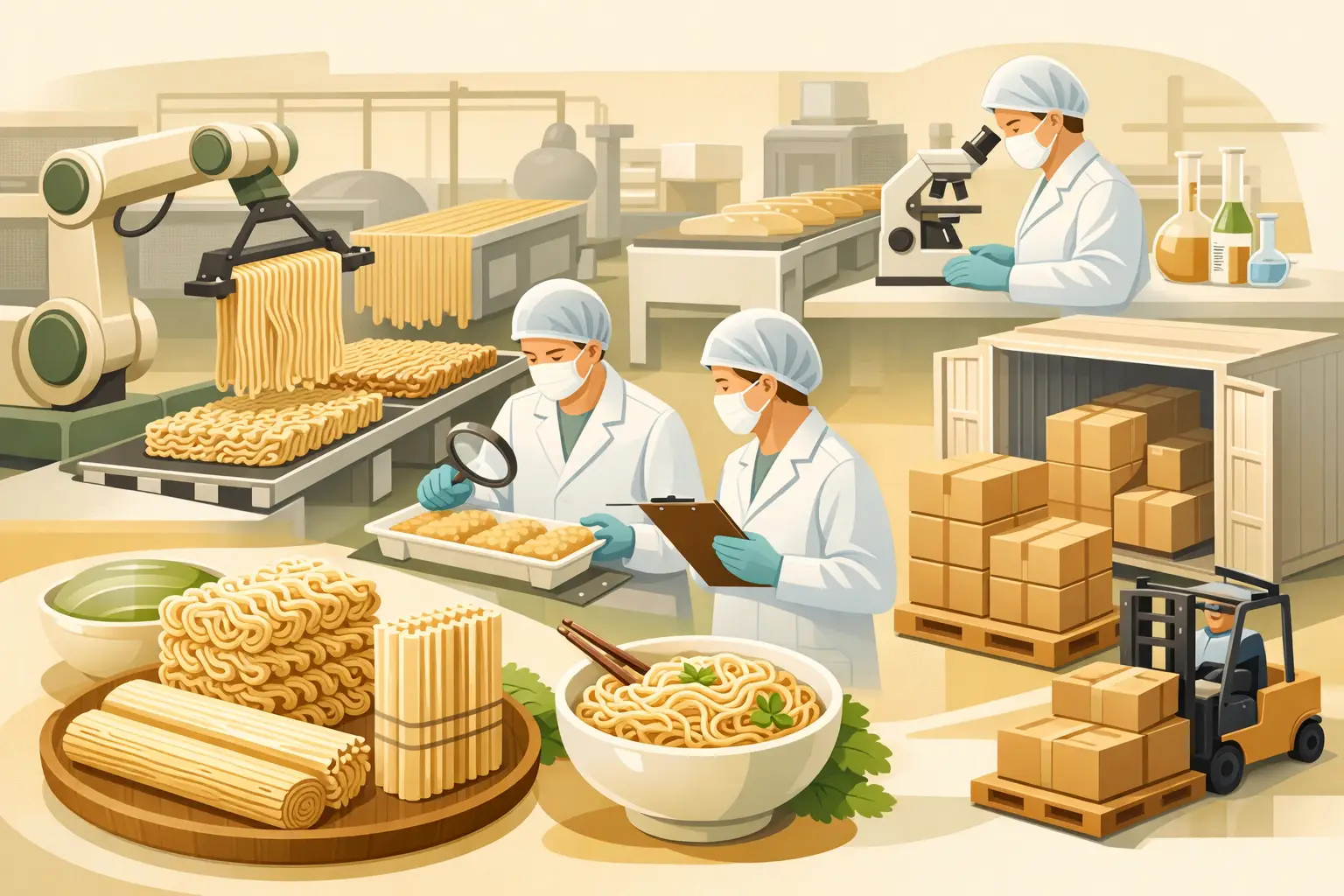
In noodle manufacturing, automated dosing and mixing systems can improve ingredient consistency batch to batch. Automated sheeting and cutting systems help maintain uniform dimensions. Controlled steaming, frying, or drying conditions support more stable moisture targets and product texture. Inline weight checks, metal detection, seal checks, and vision inspection add another layer of consistency before products leave the line.
For buyers, this matters because consistency is a commercial issue, not just a technical one. If one shipment cooks differently from the last, breaks more easily in transit, or presents unevenly on shelf, the problem reaches your brand, distributor relationship, or menu operation quickly.
The rise of data-led production
One of the most practical noodle manufacturing automation trends is the move toward better production data, not just more machines. Modern lines can capture operating conditions, production rates, deviations, downtime reasons, and quality check records in a much more structured way than paper-based systems alone.
That creates real value in three areas. First, traceability becomes easier to manage. Second, recurring production issues are easier to identify because the factory can compare runs with more precision. Third, product development becomes more disciplined. When a manufacturer adjusts formulation, thickness, drying profile, or pack format, the impact can be tracked against actual process data rather than assumption.
This is especially relevant for OEM and private-label projects. Buyers often need a manufacturer that can reproduce a target specification reliably over time, including when volumes grow. Data-supported production helps reduce the gap between sample success and commercial-scale consistency.
Automation in drying and thermal processing matters more than many buyers realize
For dry noodle products, thermal processing and drying control are often where quality outcomes are won or lost. This is true whether the product is air-dried, fried, or built around a more specific texture target.
Automation in this part of the line can improve temperature management, airflow balance, timing, and moisture consistency. Those may sound like technical details, but they shape final product performance. Even a good formulation can underperform if drying is uneven or thermal exposure is not tightly controlled.
The trade-off is that more automation does not automatically mean better noodles. A poorly calibrated system can scale defects just as efficiently as it scales output. That is why experienced process management still matters. The strongest manufacturers combine automated control with practical understanding of noodle behavior - dough response, flour variation, humidity effects, and the needs of specific formats.
Flexible automation is becoming more valuable than fixed automation
Not every manufacturer serves the same product mix. A factory focused on one standard SKU can justify highly fixed automation. But OEM and ODM noodle production usually requires more flexibility. Different widths, shapes, portion sizes, formulations, and packaging requirements demand equipment and process design that can adapt without losing control.
This is where investment decisions get more nuanced. Buyers should not assume that the most automated factory is automatically the best fit. The better question is whether the line is automated in ways that support your product category. Can it maintain consistency across multiple noodle styles? Can it handle customized pack counts or private-label requirements without creating excessive complexity? Can it support both quality control and product variation?
For many business buyers, flexible automation is more useful than maximum automation. It supports commercial responsiveness while still protecting core manufacturing standards.
Packaging automation is now part of brand protection
Packaging is often treated as the final step, but for B2B buyers it is part of the product promise. Automated packaging systems increasingly do more than fill and seal. They help manage weight accuracy, coding consistency, seal integrity, pack presentation, and inspection before case packing.
This matters even more for export-ready noodles, where handling conditions may be more demanding and documentation standards may be stricter. A product that is well made but poorly packed still creates avoidable risk.
Automation here also supports more professional private-label execution. When a manufacturer can maintain consistent coding, carton accuracy, and packaging checks across runs, it supports smoother distribution and stronger shelf readiness. That does not eliminate the need for final human oversight, but it reduces preventable variation.
Quality systems and automation increasingly work together
Automation is most valuable when it supports a disciplined quality culture. Sensors, inline checks, digital records, and controlled processing can strengthen implementation of food safety and quality systems, but they do not replace them.
For B2B customers, this is an important distinction. A well-automated facility without strong GMP discipline or documented controls is not necessarily lower risk. On the other hand, a manufacturer with recognized food safety systems, validated process controls, and practical automation at key stages is better positioned to manage consistency and compliance demands.
This is one reason experienced manufacturers continue to invest in both systems and equipment. Buyers are not only assessing product samples. They are assessing whether the factory can reproduce those results within a structured operating environment.
What buyers should ask when evaluating automation
When reviewing a noodle manufacturing partner, it helps to look beyond a simple claim of being automated. Ask where automation is used, what problems it is designed to solve, and how it supports your product type.
A useful discussion usually covers process control in mixing and forming, thermal or drying management, packaging accuracy, inspection points, traceability records, and changeover capability for customized products. It should also cover the human side - how the line is monitored, how deviations are handled, and how preventive maintenance is managed.
That last point is often overlooked. Automation improves consistency only when equipment is maintained well and operators understand the process. Otherwise, the line becomes harder to troubleshoot, not easier.
Why this matters for private-label and OEM noodle development
For companies building their own noodle range, automation can shorten the distance between concept and reliable repeat production. That is valuable when developing multiple SKUs, regional variants, or quality-sensitive formats.
In practice, the best manufacturing partners use automation to stabilize what should be stable, while keeping enough technical flexibility to adjust what should be customized. That could mean texture tuning, pack size changes, ingredient adjustments, or packaging adaptations for different channels. The point is not to remove craftsmanship from noodle manufacturing. It is to apply control where control improves business outcomes.
For a company like Tehki Food, that balance is central to modern OEM and ODM production. Buyers need product consistency, certification-backed discipline, and scalable systems, but they also need a manufacturer that understands the practical differences between one noodle concept and another.
Automation will continue to shape the industry, but the real trend is smarter manufacturing judgment. The factories that stand out will not be the ones with the most impressive equipment list. They will be the ones that use automation to protect quality, support customization, and give customers more confidence every time production scales.