
Parents rarely shop the baby aisle the same way they shop the rest of the store. They read ingredient panels more carefully, compare textures and formats, and expect products to feel safe, practical, and age-appropriate. That is exactly why OEM baby noodle production for private label food brands has become a serious category opportunity. For brand owners, distributors, and importers, baby and toddler noodles are not just a smaller version of standard noodles. They are a distinct product line that needs tighter formulation thinking, clearer positioning, and reliable manufacturing control.
This category sits at the intersection of convenience, child-friendly product design, and trust. For private label food brands, that creates room to build differentiated products without investing in their own factory setup. The commercial appeal is clear, but success depends on getting the product brief right and choosing a manufacturing partner that understands both noodle production and the practical demands of baby-focused formats.
Why OEM baby noodle production is gaining attention
Private label growth has changed how food brands enter new categories. Instead of building a production line from scratch, companies can test and scale products through OEM manufacturing with lower capital risk. In baby noodle products, that model is especially useful because the category often requires smaller portion formats, tailored textures, careful ingredient selection, and packaging designed for a parent-led purchase decision.
There is also a portfolio advantage. A brand already selling noodles, pantry staples, frozen foods, or family-oriented grocery products can extend into infant and toddler offerings under the same brand umbrella. For importers and distributors, baby noodles can fill a gap in an existing Asian food or children’s food range. For retailers, the category can support a house-brand strategy that responds to demand for practical, family-focused dry foods.
That said, this is not a category where a generic noodle product with new packaging will perform well. Buyers in this space need manufacturing support that can align product texture, noodle length, ingredients, and presentation with the expectations of child-focused products.
What private label food brands need from OEM baby noodle production
A workable OEM program starts with understanding what makes baby noodles different at the product level. Texture is one of the most important considerations. Noodles for infants and toddlers are often expected to cook into a softer, easier-to-manage bite than standard dry noodles. Portion size also matters because parents usually want manageable servings rather than large-format family packs.
The formulation brief must also be practical. Some brands want simpler ingredient decks. Others want air-dried rather than fried noodle formats to support a cleaner product position. Some need specific flour blends, vegetable-based variations, or noodle shapes and lengths designed for easier handling. None of these choices are purely marketing decisions. They affect processing, consistency, packaging, and production efficiency.
This is where experienced OEM manufacturers add value. A capable partner should be able to translate a commercial idea into a manufacturable product specification. That includes advising on noodle type, production method, texture targets, pack format, and customization options that are realistic at scale.
The real opportunities for private label food brands
The biggest opportunity is category expansion with less operational burden. A private label brand can enter the baby and toddler noodle segment without building specialized manufacturing infrastructure. That allows the team to focus on market positioning, distribution, and customer fit while relying on an established producer for process control and production consistency.
A second opportunity is regional adaptation. Baby food preferences are not identical across markets. Some markets respond better to familiar Asian noodle styles in child-friendly portions, while others prefer simplified product concepts with mild positioning and straightforward preparation. OEM production makes it easier to tailor the product for the target market rather than forcing one standard SKU into every region.
There is also room for product line architecture. Instead of launching one item, brands can build a small family of products with shared manufacturing logic. That might include different noodle cuts, ingredient variations, or stage-based portion concepts. For foodservice and hospitality buyers, the opportunity can look different. Child-friendly noodles can support kids’ menu development, institutional meal programs, or packaged meal components where consistency and ease of preparation matter.
The broader point is that OEM baby noodle production works best when it is treated as a brand-building category, not a one-off novelty item.
Product development decisions that shape the outcome
In this segment, small technical choices have visible commercial impact. Noodle thickness, strand length, and cooking behavior affect how the product is experienced. Packaging size influences not just convenience but retail fit and perceived value. Ingredient selection affects both consumer perception and manufacturing practicality.
There is always a trade-off between customization and operational simplicity. A highly specialized noodle format may help a brand stand out, but it can also add complexity to sourcing, production planning, and packaging execution. On the other hand, a more standardized format may be easier to scale but harder to differentiate on shelf.
That is why a disciplined development process matters. The strongest OEM projects usually begin with a clear target market, intended sales channel, and product role within the brand portfolio. Once those are defined, it becomes easier to decide which features are essential and which are optional.
Manufacturing reliability matters more in baby-focused categories
For business buyers, product concept is only half the decision. The other half is whether the manufacturer can produce consistently and support long-term growth. In a baby-oriented product line, inconsistency creates immediate risk for the brand. Texture drift, packaging issues, or specification gaps can quickly erode buyer confidence.
A dependable OEM partner should bring disciplined quality systems, documented process control, and food safety management that supports commercial credibility. Certifications such as ISO 22000, HACCP, GMP, MeSTI, and Halal are relevant because they indicate structured manufacturing practices and broader market readiness. For export-focused buyers, those systems are often part of supplier qualification from the start.
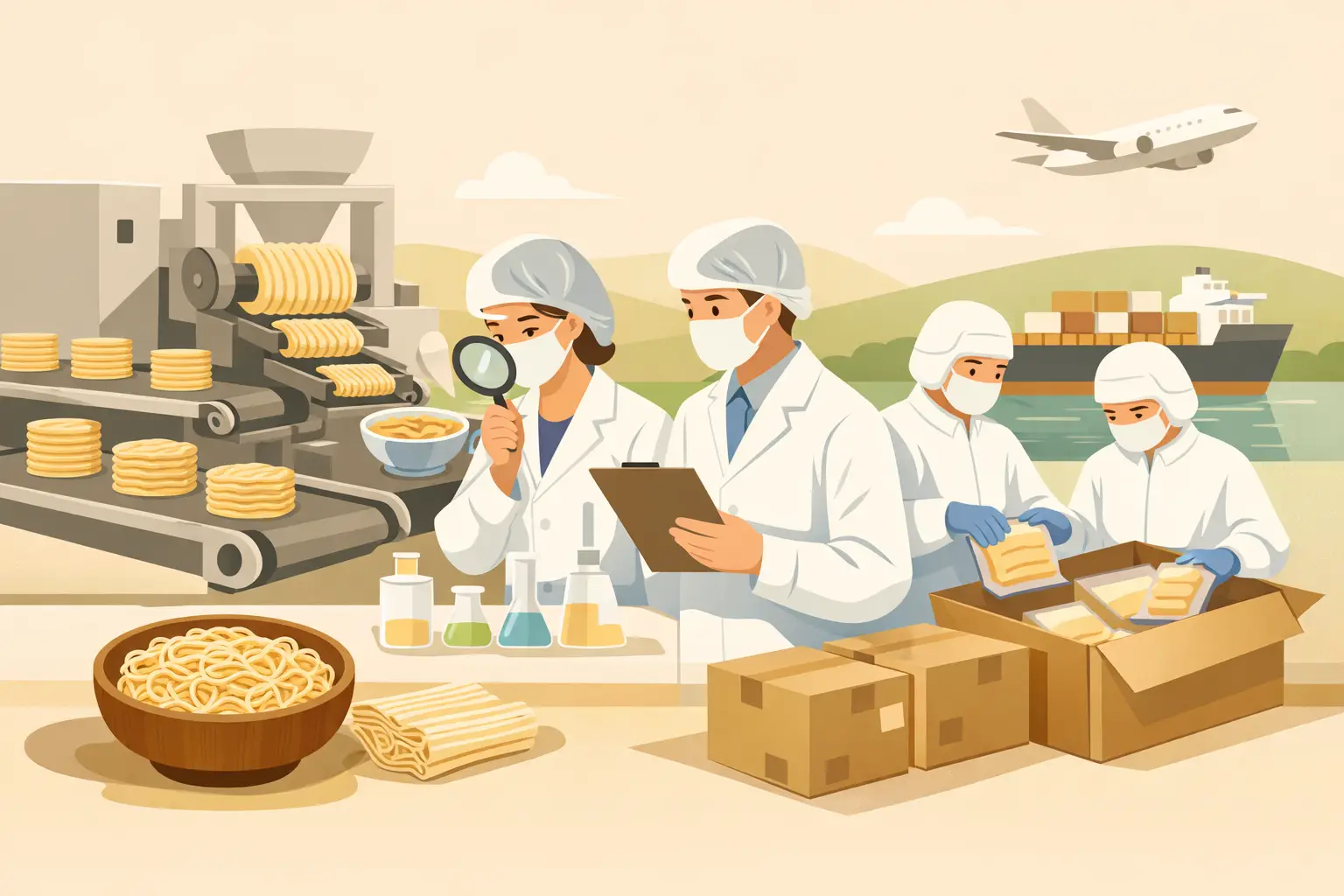
This is also where working with an experienced dry noodle manufacturer makes a practical difference. Dry noodle production is not only about mixing and cutting dough. It involves control over drying method, noodle integrity, texture outcome, and packaging compatibility. In baby noodle applications, those details become even more important because the final product must align with a narrower use case.
OEM baby noodle production and export readiness
Many private label buyers are sourcing not just for one domestic market, but for multi-country distribution. In that context, export readiness is not a side issue. It affects packaging planning, product documentation, consistency expectations, and the ability to maintain supply across repeat orders.
Malaysia has become a relevant sourcing base for this kind of manufacturing because it combines established food production capability with strong familiarity in Asian noodle formats. For buyers seeking export-oriented OEM support, that can be a practical advantage, especially when the manufacturer understands both customization and production discipline.
Still, export suitability depends on the product brief. A concept that works well in one country may need adaptation in pack language, noodle format, or positioning for another market. The benefit of OEM is flexibility, but that flexibility is only useful when the manufacturing partner can manage variation without losing consistency.
Choosing the right OEM partner for private label baby noodles
The right supplier conversation goes beyond asking whether baby noodles can be produced. A better question is whether the manufacturer can support the specific role the product needs to play in your business. That includes product design support, packaging compatibility, scalable production, quality assurance, and the discipline to hold specifications over time.
Private label buyers should also look at how the manufacturer approaches collaboration. A transactional supplier may simply quote against a basic brief. A stronger OEM partner will ask about target markets, product positioning, sales channels, and expected customization needs before recommending a production path. That reduces development friction and improves the odds of launching a product that is commercially workable.
For companies entering this category, Tehki Food’s model reflects what many B2B buyers now expect from a manufacturing partner: practical product development support, dry noodle expertise, flexible OEM and ODM capability, and quality systems that help brands move from concept to market with more confidence.
OEM baby noodle production is not attractive because it is trendy. It is attractive because it gives private label food brands a realistic way to build a focused, child-friendly product line with controlled manufacturing risk. The brands that do well in this space are usually the ones that treat product development, quality systems, and partner selection as one connected decision.