
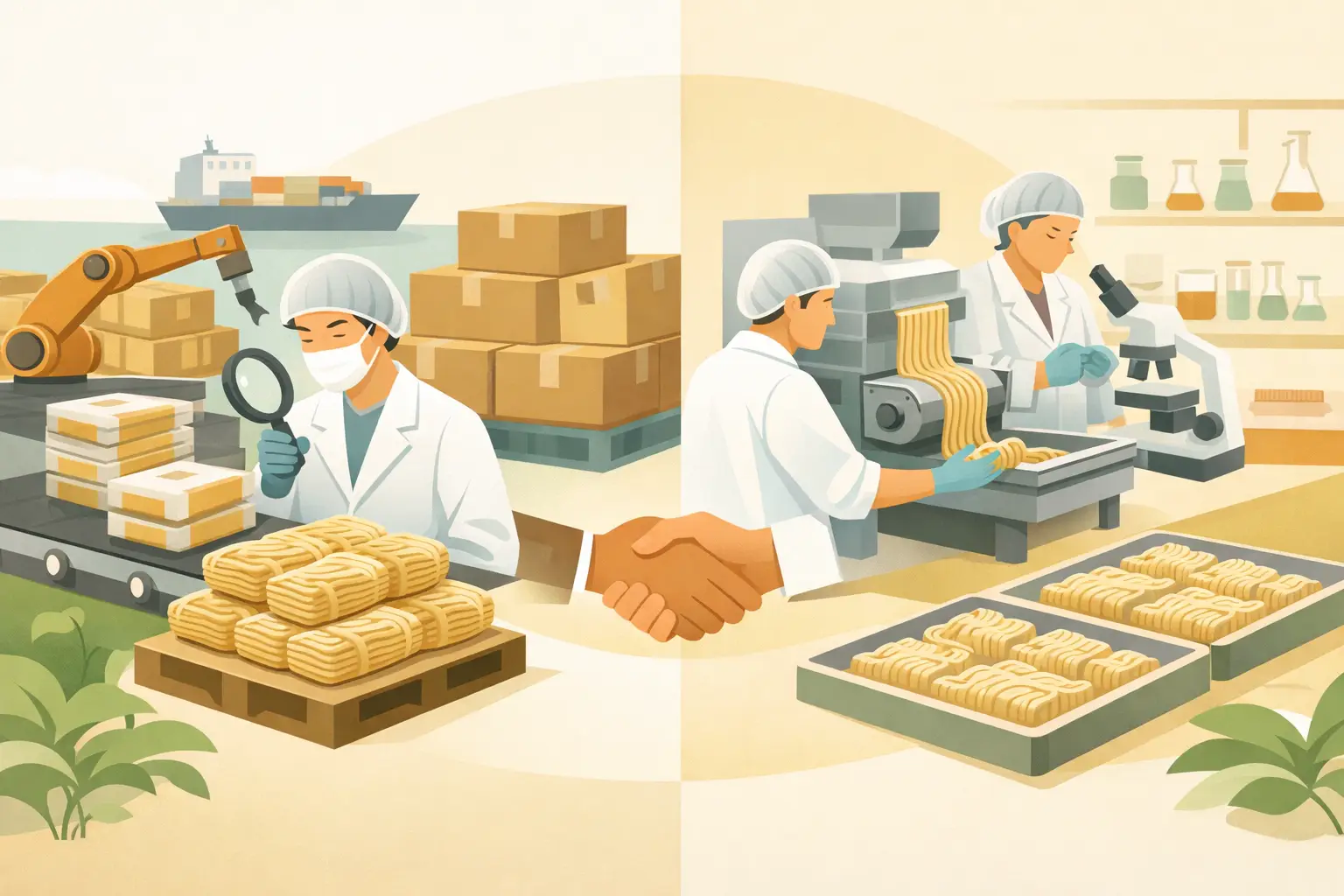
A new noodle range can look commercially promising long before the manufacturing decision is clear. The real question behind OEM vs. in-house noodle manufacturing: which model supports your business growth? is not simply who can make noodles at the lowest unit cost. It is whether your business can protect quality, respond to demand, meet buyer requirements, and invest capital where it will have the greatest commercial return.
For brand owners, importers, distributors, foodservice operators, and food companies, manufacturing strategy affects far more than production. It influences product development speed, working capital, food safety management, packaging flexibility, export preparation, and the capacity to build a dependable product portfolio.
The Decision Is About Capability, Not Just Cost
In-house manufacturing offers direct ownership of the production process. OEM manufacturing places production with a specialist partner that makes noodles to your agreed product and brand requirements. Both can support growth, but they solve different business problems.
The wrong comparison is often: “Can we produce noodles ourselves for less?” A more useful comparison is: “What capabilities must we own, and which capabilities should we access through a manufacturing partner?”
Noodle production requires more than equipment and ingredients. It depends on formulation knowledge, process control, drying or frying parameters, texture consistency, packaging performance, quality documentation, trained operators, maintenance, supplier management, and food safety systems. These requirements become more demanding as sales volumes increase or products enter multiple markets.
When In-House Noodle Manufacturing Makes Sense
In-house production can be a strong strategic choice for businesses with stable, high-volume demand and a clear need to control every production variable. A company may want to safeguard proprietary processes, integrate noodle production with an existing food facility, or create formats that require highly specialized handling.
Direct oversight can be valuable when product development is continuous and internal teams have strong technical manufacturing knowledge. It may also help businesses coordinate production closely with their own ingredient systems, warehouse operations, or foodservice supply network.
However, owning the factory also means owning the operational burden. Capital investment extends beyond noodle lines and packaging machines. Businesses must account for factory compliance, utilities, quality control systems, preventive maintenance, labor training, raw material testing, production scheduling, product traceability, and inventory risk.
Capacity utilization is another critical issue. A factory that runs below efficient volume can add significant cost to every pack produced. Demand fluctuations, seasonal purchasing, and retailer listing changes can turn fixed manufacturing costs into a commercial constraint. In-house manufacturing works best when the business has enough predictable volume to keep production assets productively employed.
The Hidden Demands of Control
Control is often described as the main advantage of in-house production, but control only creates value when a business has the systems to use it well. If recipe records are incomplete, operators are inconsistent, or quality checks vary between shifts, owning the line does not automatically deliver a more consistent noodle product.
The same applies to customization. A factory can modify noodle thickness, ingredients, portions, and packaging, but each change needs testing, documentation, production planning, and quality verification. Businesses should evaluate whether they have the internal resources to manage this work at the required level.
Why OEM Manufacturing Can Support Faster Growth
OEM noodle manufacturing gives a business access to established production capability without building it from the ground up. The brand or buyer remains focused on market research, product positioning, sales channels, customer relationships, and portfolio development, while the manufacturing partner manages the technical production environment.
This model is particularly practical when a business wants to introduce private-label noodles, test a new category, enter export markets, or expand its range without committing substantial capital to a dedicated factory. It can also help companies offer several noodle concepts, such as air-dried noodles, fried noodles, child-friendly formats, or customized dry Asian noodle products, without attempting to develop every production capability internally.
A capable OEM partner should do more than manufacture to a basic specification. It should help translate a commercial idea into a product that can be produced consistently. That includes practical discussion around noodle type, ingredient selection, texture, portion configuration, pack format, and production suitability.
For buyers, the benefit is not reduced involvement. It is better allocation of involvement. Your team can set the product brief, approve samples, define brand requirements, and monitor performance without having to manage daily plant operations.
Where OEM Requires Discipline
OEM manufacturing is not a hands-off arrangement. Results depend on clear specifications and a well-managed supplier relationship. A vague request for “premium noodles” or “healthy noodles” is not enough to guide repeatable production. Product briefs should identify the intended market, noodle format, ingredient priorities, target texture, pack size, labeling needs, and any applicable customer or export documentation requirements.
The buyer should also assess the manufacturer’s quality systems, production experience, traceability practices, communication process, and ability to maintain consistency as volumes grow. Food safety certification and documented manufacturing controls matter because they provide a structured basis for supplier confidence, particularly for businesses serving retailers, distributors, or international customers.
OEM vs. In-House Noodle Manufacturing: Key Growth Questions
The best model becomes clearer when decision-makers assess their business against a few practical questions:
- Is demand large and predictable enough to support dedicated production assets over time?
- Does the business have internal technical, quality, and operations teams with relevant noodle manufacturing experience?
- Is speed to market more valuable right now than ownership of production equipment?
- Will the product range require frequent changes in noodle type, ingredients, portioning, or packaging?
- Do target customers require established food safety systems, consistent documentation, or export-ready manufacturing support?
If the immediate need is to build a branded noodle range, validate demand, or serve varied customer requirements, OEM is often the more flexible starting point. If demand is mature, highly predictable, and strategically tied to proprietary production, in-house manufacturing may become more compelling over time.
The answer can also change as a business grows. Many successful food companies begin with OEM production to establish their product, build distribution, and learn what the market actually wants. Only after volumes, product specifications, and demand patterns become stable does it make sense to reassess factory ownership.
Product Complexity Changes the Calculation
Not all dry noodle products carry the same manufacturing demands. A standard noodle format with stable specifications may be easier to bring in-house than a portfolio involving several formulations, specialized ingredients, varied pack sizes, or distinct market requirements.
For example, air-dried noodles require careful process management to achieve the intended product quality and handling characteristics. Fried noodle formats involve different production considerations. Infant and toddler noodle concepts require particularly disciplined attention to formulation, ingredient controls, and product consistency. Each format can create additional requirements for product development, production validation, and quality assurance.
This is where an experienced OEM or ODM manufacturer can offer commercial value beyond factory capacity. A partner with established expertise can identify whether a concept is practical at production scale before the buyer commits heavily to packaging, sales activity, or market launch plans.
Build a Decision Around Your Next Stage of Growth
The strongest manufacturing choice is the one that supports the next three to five years of your business, not just the next production run. Consider where growth will come from: broader distribution, new markets, foodservice accounts, retail private label, additional formats, or a more differentiated product position.
If growth depends on agility, category testing, and reliable production support, OEM can preserve capital and reduce operational complexity. If growth depends on deep manufacturing integration and large, stable demand, in-house investment may provide strategic control. Neither model is automatically superior.
Tehki Food supports businesses that need scalable, export-ready dry Asian noodle solutions under their own brand, with practical options for noodle format, formulation, portioning, and packaging. The most productive conversations begin with a clear commercial objective, then work backward to the manufacturing model that can support it.
Before choosing a factory or a partner, define what your noodle business must achieve next. A manufacturing decision should give your team more room to grow, not create a new operational burden before the market is ready.