
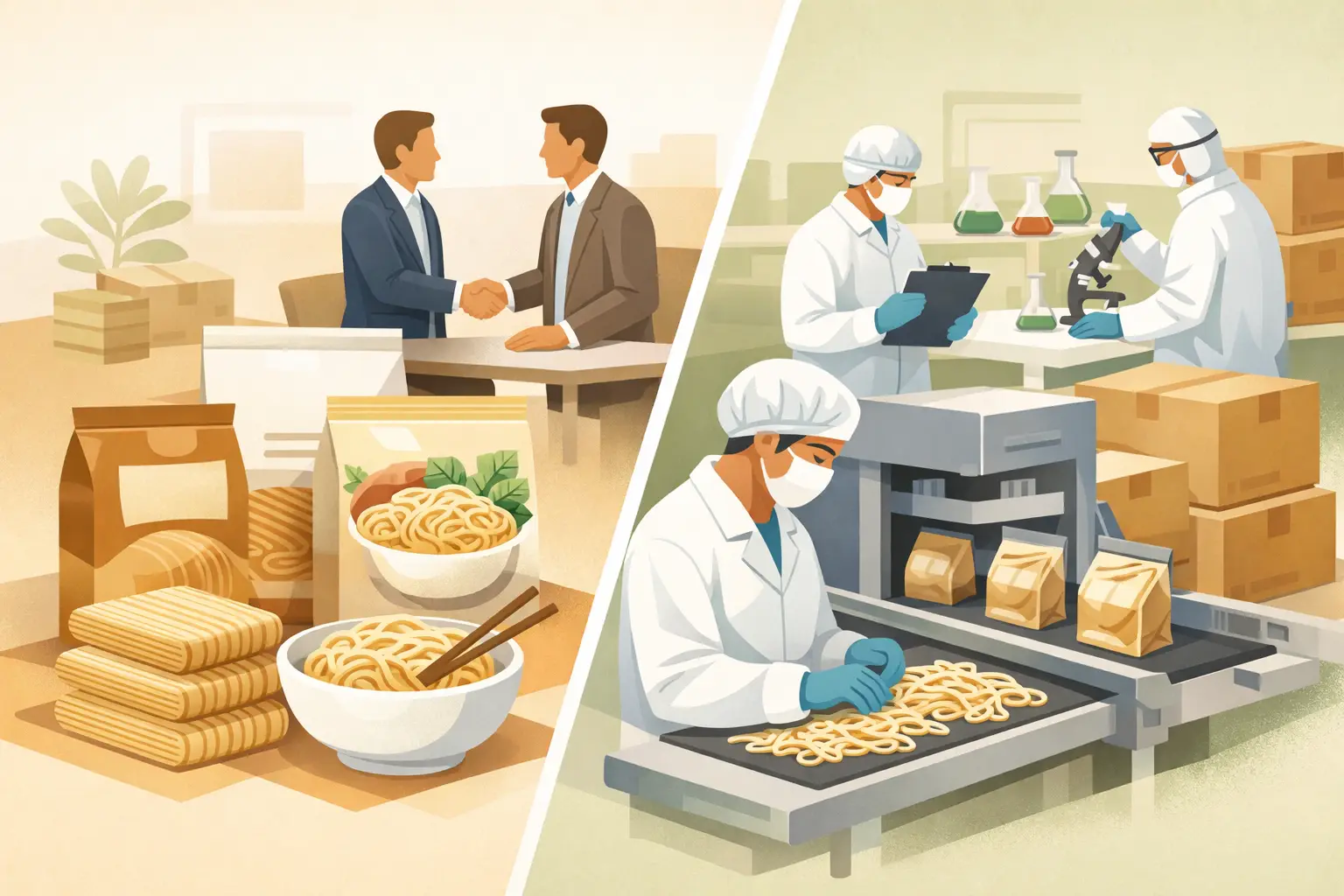
A buyer comparing private label versus contract manufacturing is usually not choosing between two factories. They are choosing how much control, differentiation, speed, and operational responsibility their business wants to carry. That decision affects product development, branding, margins, supply planning, and how easily a noodle line can grow across retail, distribution, or foodservice channels.
In the noodle category, the distinction matters even more because product quality is not only about ingredients. Texture, cooking performance, portion format, packaging suitability, labeling requirements, and manufacturing consistency all shape commercial success. What looks similar on paper can perform very differently once the product reaches importers, distributors, kitchens, or store shelves.
What private label versus contract manufacturing really means
Private label usually refers to a manufacturer producing an existing or semi-standard product that is sold under the buyer's brand. The manufacturer may already have established formulations, formats, and packaging options, and the customer selects from those available specifications with limited adjustments. This model is often attractive when speed to market matters and the buyer wants a simpler path to launching a house-brand noodle product.
Contract manufacturing is broader and often more customized. In this model, the manufacturer produces according to the buyer's formula, target specification, or development brief. The customer may require a specific noodle width, texture profile, ingredient approach, cooking time, pack size, or market-ready format. Contract manufacturing can also include collaborative development, where the buyer brings the commercial objective and the factory helps translate it into a manufacturable product.
In practice, the two models can overlap. Some manufacturers offer both. A project may begin as private label and later move into a more customized contract manufacturing arrangement once the product gains traction and the buyer wants stronger differentiation.
When private label makes more commercial sense
Private label works well when the priority is efficiency. If a distributor, retailer, or foodservice supplier wants to launch a noodle range without building a product from scratch, private label can reduce complexity. The core product has often already been tested within the factory's production environment, which can make quality consistency and scale-up more straightforward.
This approach is also useful when the product category is familiar and the market does not require extreme formulation uniqueness. For example, a buyer may need a dependable dry noodle under its own brand with practical choices in noodle type, pack format, and labeling presentation. In that case, a strong private-label program can provide enough flexibility without extending development time.
Private label can also support portfolio expansion. A company may already sell sauces, seasonings, frozen foods, or pantry staples and want to add noodles under the same brand. It may not need a highly original concept at first. It may need a reliable product, clean execution, and packaging aligned with its market position.
That said, private label has limits. If multiple customers are working from similar base products, differentiation tends to come more from branding, channel strategy, and packaging than from the noodle itself. For some buyers, that is acceptable. For others, it becomes a constraint.
When contract manufacturing is the better fit
Contract manufacturing becomes more valuable when product requirements are specific and commercially meaningful. A brand owner may want an air-dried noodle format instead of a fried one, a child-oriented noodle concept with a particular portion approach, or a house-brand range tailored to a distributor's regional market preferences. Those decisions usually require deeper technical alignment between buyer and manufacturer.
This model is especially relevant when the noodle product is part of the brand's positioning, not just an item in the catalog. If the business wants to compete on texture, ingredient direction, portion control, cooking behavior, or packaging format, a more customized manufacturing process is often necessary.
Contract manufacturing also suits businesses that already have a product concept but need a factory that can produce it consistently and at scale. In these cases, the manufacturer is not just filling orders. It is helping protect product integrity through process control, raw material management, quality systems, and production discipline.
For B2B buyers, this matters because a specification is only useful if it can be reproduced reliably. A noodle that performs well in one trial but varies across batches can create problems downstream for distributors, foodservice operators, and end customers. A capable contract manufacturer helps reduce that risk.
The real trade-off is control versus simplicity
Many sourcing decisions are framed as cost decisions, but the bigger issue is usually control. Private label typically offers more simplicity, while contract manufacturing offers more influence over the final product. Neither is automatically better.
If your team values speed, lower development burden, and a clearer starting point, private label may be the practical route. If your business needs product distinction or channel-specific functionality, contract manufacturing may justify the additional development effort.
The right answer depends on what your noodle line needs to achieve. A private-label product can be commercially strong if brand presentation, distribution reach, and quality consistency are in place. A custom-manufactured product can create stronger market separation, but only if the added complexity supports a real business objective.
How this affects cost, risk, and scalability
Private label is often perceived as the lower-risk option because the factory is typically working with known production parameters. Development work may be lighter, and the path to launch may be more direct. For companies testing a category or entering a new market, that can be a sensible way to control early-stage risk.
Contract manufacturing may involve more product development work, specification review, testing, and alignment. That does not automatically mean it is the more expensive choice over time. If the custom product creates stronger customer loyalty, better channel fit, or improved brand identity, the commercial return may outweigh the additional effort.
Scalability should also be evaluated carefully. A product that is simple to launch is not always the best one to scale across export markets or multiple channels. Packaging compliance, manufacturing repeatability, ingredient sourcing, and format suitability all matter once volumes increase. Buyers should ask not only whether a manufacturer can make the product, but whether the product can be scaled with consistency.
Private label versus contract manufacturing in noodles
In noodle manufacturing, small formulation or process changes can have visible effects. Drying method, flour characteristics, dough handling, noodle thickness, and packing format all influence the final product. That is why the private label versus contract manufacturing decision should be made with the product's commercial use in mind.
A retailer launching an entry-level house brand may prefer private label if the goal is a dependable, well-presented noodle product with efficient market entry. A food company creating a more distinctive line may need contract manufacturing support to align product attributes with brand expectations.
Importers and distributors should also think beyond the product sample. Export readiness, manufacturing documentation, food safety systems, and production consistency are part of the purchasing decision. A noodle product may look competitive at first glance, but commercial reliability depends on the factory's ability to reproduce quality over time.
This is where an experienced manufacturer adds value. Tehki Food, for example, operates in the space where OEM, ODM, and private-label noodle development often overlap. For many B2B customers, the most effective solution is not choosing a rigid model, but working with a manufacturing partner that can adapt the level of customization to the business case.
Questions buyers should ask before deciding
Before selecting either route, it helps to clarify a few business realities. Is this product meant to fill a gap quickly, or is it meant to stand apart in the market? Will the brand compete mainly on price, presentation, or product characteristics? Does the sales channel require standardization, or does it reward a more tailored noodle format?
It is also worth examining your internal resources. Some buyers have strong product development teams and clear technical briefs. Others need more guidance from the manufacturer. Neither position is a weakness, but it changes what kind of factory relationship will work best.
Finally, assess whether the manufacturer can support the level of quality assurance your market requires. Certifications, process control, and documented food safety systems matter because they support consistency, not just compliance paperwork. For exporters, distributors, and established brand owners, that reliability is often as important as the formulation itself.
A good manufacturing decision is rarely about choosing the more impressive model. It is about choosing the one that fits your brand's stage, your market expectations, and your operational reality. The best partners understand that sometimes the smartest product is the one that is simple and scalable, and sometimes it is the one built carefully enough to give your brand a reason to be chosen.