
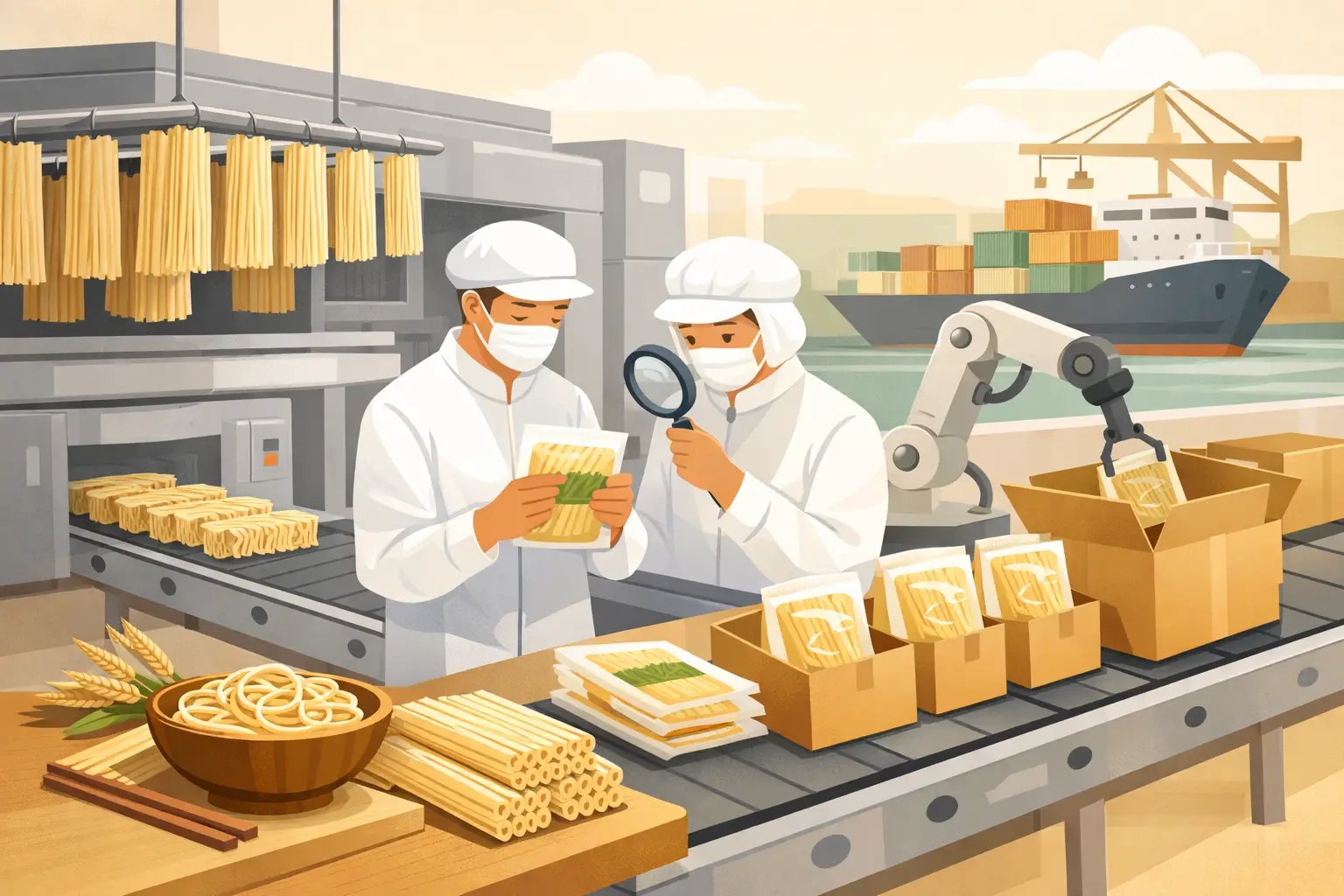
A delayed noodle launch rarely fails because of one big issue. More often, it slips because small gaps across formulation, production planning, packaging coordination, and quality control start to stack up. That is why reducing lead times through efficient noodle production systems matters to brand owners, importers, distributors, and foodservice buyers who need dependable supply without compromising product consistency.
For B2B buyers, shorter lead times are not just an operational preference. They affect inventory exposure, launch timing, promotional planning, and customer confidence. In private-label and OEM noodle manufacturing, speed only works when it is supported by process discipline. If a manufacturer moves quickly but cannot hold texture, specification, or packaging accuracy, the result is simply a faster route to rework.
What reducing lead times through efficient noodle production systems really means
Lead time reduction in noodle manufacturing is often misunderstood as pushing the factory harder. In practice, efficient systems reduce waiting, handoff errors, changeover losses, and approval delays. The goal is not rushed output. The goal is a production flow that is predictable enough to support commercial commitments.
That distinction matters. Dry noodle manufacturing involves several connected variables, including flour selection, dough handling, sheeting or extrusion control, drying method, portioning, packing format, quality checks, and documentation. A delay in any one area can affect the whole schedule. Efficient production systems therefore depend on coordination, not just machine speed.
For buyers, this has a direct commercial impact. A manufacturer with a stable process can respond more effectively to repeat orders, product extensions, and export planning. A manufacturer with weak process control may appear flexible at the inquiry stage but struggle once multiple SKUs, packaging variants, or market-specific requirements are introduced.
The biggest causes of avoidable delay
Many noodle projects slow down long before production begins. Product development is a common pressure point, especially when specifications are still shifting. If the target noodle texture, cooking behavior, portion size, ingredient profile, or packaging format is not clearly defined, approvals tend to stretch. Each revision adds time, and the delay carries into procurement and line scheduling.
Packaging alignment is another issue. In OEM and ODM work, the noodle itself may be ready, but the packaging, carton design, print approval, or labeling details may not be finalized. That creates a mismatch between manufacturing readiness and shipment readiness. Buyers often focus on noodle quality first, which is understandable, but packaging decisions have equal influence on scheduling.
Production complexity also matters. A factory handling too many uncontrolled variations may experience bottlenecks from frequent changeovers. Different noodle widths, block sizes, drying profiles, and pack formats all affect setup requirements. Customization is valuable, but it has to be supported by a system that can organize production efficiently. Otherwise, flexibility starts to create drag.
Then there is quality documentation. In export-oriented supply, certification records, batch traceability, specification sheets, and buyer-specific compliance paperwork need to move in parallel with production. If documentation is treated as an afterthought, a finished product can still sit and wait.
How efficient noodle production systems shorten turnaround
An efficient noodle production system starts with product standardization where it makes sense. This does not mean offering generic products only. It means building custom products on a controlled manufacturing base. For example, a manufacturer may support variation in noodle type, ingredients, and packaging while keeping core process parameters disciplined and repeatable.
That balance is important for OEM and private-label customers. Brands need differentiation, but they also need a process that can be scaled. Standardizing critical production steps such as dough mixing control, drying conditions, and weight consistency helps reduce avoidable variation. That leads to fewer interruptions, fewer corrective actions, and more stable planning.
A second factor is line planning. Efficient manufacturers do not schedule jobs in isolation. They group production in a way that reduces changeover strain and protects throughput. Similar formulations, similar pack formats, or similar noodle structures can often be sequenced more effectively than a random mix of orders. This improves factory flow without forcing customers into unsuitable product compromises.
Procurement discipline also plays a major role. Reliable raw material planning supports reliable production planning. If ingredient sourcing, packaging supply, and stock control are not aligned with forecast demand and active orders, the factory loses agility. In dry noodle manufacturing, even a strong production line cannot make up for weak material readiness.
Why product development decisions affect manufacturing speed
One of the fastest ways to improve lead time is to make better decisions earlier in development. Buyers sometimes request broad customization without identifying which elements truly matter in the market. That can create unnecessary complexity. A better approach is to separate must-have features from nice-to-have features.
For example, if brand positioning depends on an air-dried format, fried noodles format, child-friendly portioning, or a specific noodle bite, those should be prioritized and validated early. If secondary visual or packaging changes can be phased in later, the production path may become simpler. This is not about limiting creativity. It is about protecting launch efficiency.
The most effective manufacturing partnerships usually involve structured technical discussions upfront. That includes product intent, target user, market channel, pack architecture, and expected ordering pattern. When those factors are understood early, the manufacturer can recommend a more practical route to commercialization.
This is where an experienced OEM or ODM partner adds value beyond making noodles. The manufacturer can identify whether a requested customization affects drying efficiency, line compatibility, pack handling, or quality control frequency. Those details may seem operational, but they influence how quickly and consistently a product can move from concept to supply.
Reducing lead times through efficient noodle production systems in export markets
Export supply introduces a different level of discipline. Buyers are not only managing factory output but also freight timing, market launches, importer coordination, and regulatory documentation. In this environment, efficient noodle production systems need to support more than manufacturing speed. They need to support shipment readiness.
That means documentation, labeling accuracy, carton standardization, and traceability all need to be built into the process. A technically good noodle product can still create delay if export handling is poorly coordinated. The manufacturer must be able to manage production and pre-shipment requirements as one connected workflow.
This is especially relevant for businesses sourcing from Malaysia for regional or international distribution. A manufacturing partner with established food safety systems and experience in export-oriented dry noodle production can reduce friction across approval, production, and dispatch stages. Not every buyer needs the same level of customization, but nearly every buyer benefits from a system that is organized for repeatability.
What buyers should look for in a manufacturing partner
If lead time reliability matters, buyers should assess more than sample quality. They should look at whether the manufacturer has structured quality systems, practical customization capability, and production planning discipline. Certifications such as ISO 22000, HACCP, GMP, MeSTI, and Halal are relevant because they indicate a controlled operating environment, but buyers should also consider how those systems support day-to-day execution.
It is also worth asking how the manufacturer handles product changeovers, packaging coordination, and specification control. A partner that can explain its process clearly is usually better positioned to manage complexity without confusion. That matters when a product range expands, seasonal demand shifts, or a customer needs to adjust pack formats.
Tehki Food works in this space as a manufacturing partner for businesses that need dry Asian noodle products developed with commercial practicality in mind. That includes balancing customization with process control so products can be produced consistently and prepared for market with fewer avoidable delays.
There is always a trade-off to manage. High customization can support stronger brand differentiation, but it may also introduce more planning and validation steps. Standardization can improve efficiency, but it may not fit every market strategy. The right production system does not force one extreme or the other. It creates enough structure to keep supply dependable while allowing meaningful product variation.
For buyers building or expanding a noodle range, that is often the real advantage. Faster supply is useful, but predictable supply is what supports long-term growth. When production systems are efficient, lead times become easier to manage because fewer things are left to chance.
The most valuable manufacturing partner is usually not the one promising the fastest answer to every request. It is the one with a process strong enough to keep moving when specifications, packaging, and market demands become more complex.