

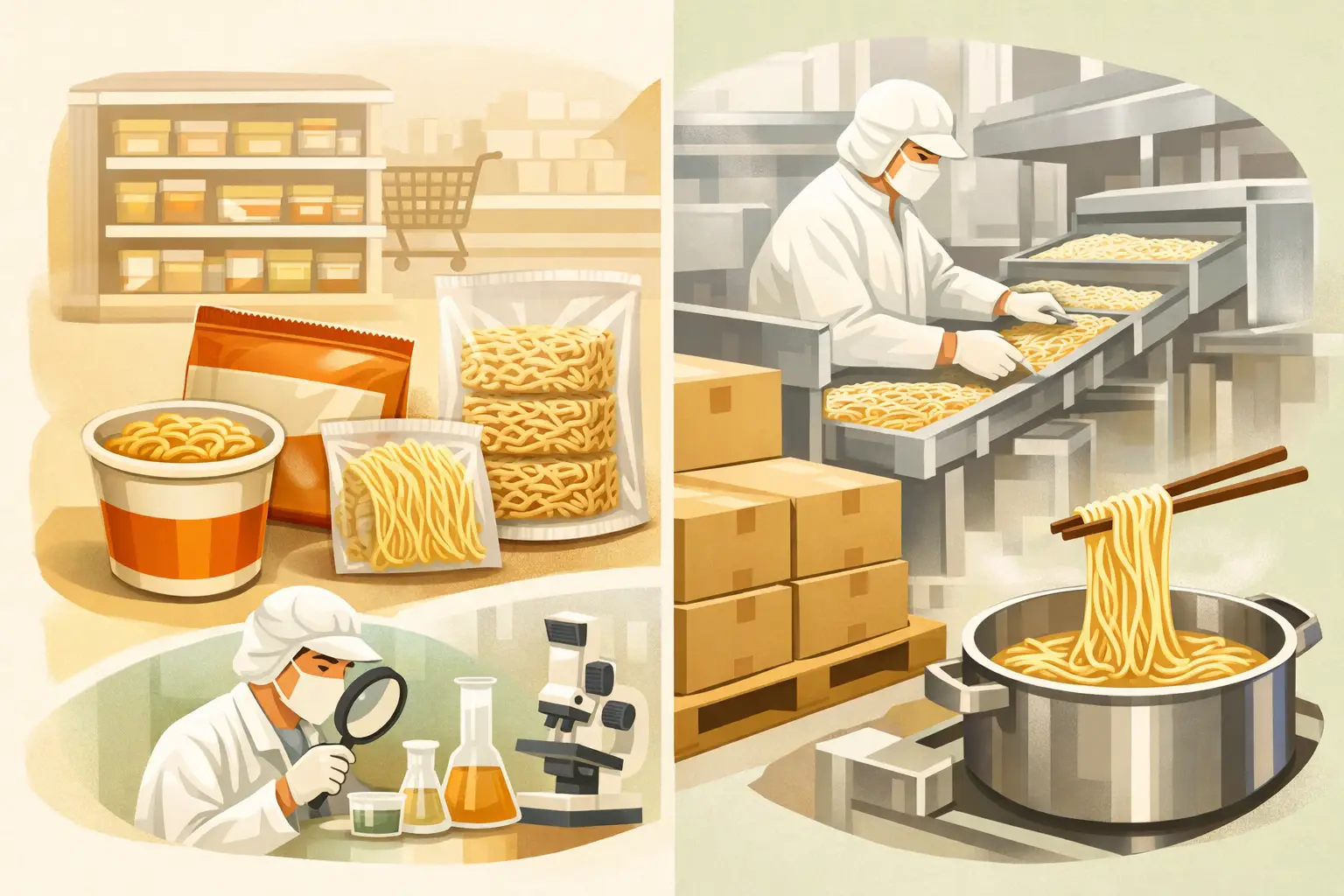
A noodle that performs well on a supermarket shelf can fail in a commercial kitchen, and a noodle built for back-of-house efficiency may not work as a retail product. That is the real issue behind retail noodles versus foodservice noodles. For B2B buyers, the difference is not just packaging. It affects product design, texture, cooking behavior, handling, margin structure, and how well the product fits the market.
For importers, brand owners, distributors, and foodservice operators, this distinction matters early in product development. Choosing the wrong format can create avoidable problems later, from inconsistent preparation to poor shelf presentation or unnecessary operational cost. The more clearly the end channel is defined, the easier it becomes to build a noodle product that performs as intended.
Why retail noodles versus foodservice noodles matters
Retail and foodservice channels ask different things from the same category. Retail products must win at the point of sale. They need the right pack size, clear positioning, stable product appearance, and a cooking experience that suits home users. Foodservice products need to work under kitchen pressure. They must be efficient to portion, reliable in batch preparation, and consistent across repeated service.
That difference shapes almost every specification. A retail noodle often needs consumer-friendly instructions, attractive packaging, and portioning that fits household use. A foodservice noodle is usually judged more by speed, tolerance during preparation, holding performance, and the ability to support menu consistency.
This is why product decisions should not start with the noodle alone. They should start with the channel, the user, and the operational setting.
Product design starts with end use
At a basic level, both retail and foodservice noodles can use similar ingredients and formats. The separation happens in how the product is engineered for use. Thickness, length, curl, drying method, cooking time, and texture retention may all be adjusted depending on where the noodle will be sold and how it will be prepared.
A retail buyer may want a product that cooks predictably in a home kitchen with minimal skill required. That usually means the noodle needs to be forgiving. If the consumer cooks it a little longer than intended, the texture should still remain acceptable. If the cooking steps are too technical, repeat purchase may suffer.
A foodservice buyer often needs something more specific. In a restaurant, central kitchen, catering operation, or institutional setting, the noodle may be cooked in larger volumes, rinsed, stir-fried, reheated, or held for service. In that environment, a noodle with stronger structure and better handling tolerance may be more useful than one designed purely for home convenience.
Packaging and portioning are not the same job
One of the clearest differences in retail noodles versus foodservice noodles is packaging logic. Retail packaging sells, informs, and protects the product through distribution and shelf display. Foodservice packaging is more operational. It is built to move efficiently through storage, preparation, and inventory handling.
For retail, pack format is often tied to household behavior. Smaller portions, family packs, multipacks, or branded private-label designs may all be relevant depending on the target market. The pack has to communicate product type, preparation method, and brand value clearly. Even if the noodle quality is strong, poor pack alignment can weaken the product's retail performance.
In foodservice, the user is not browsing a shelf. The kitchen team is looking for ease of use, space efficiency, and practical portion control. Case configuration, inner packing, breakage resistance, and handling convenience become more important. A foodservice pack may need to support repeat opening, batch usage, and straightforward stock management rather than visual shelf appeal.
Texture expectations are channel-specific
Texture is one of the most underestimated differences between these two segments. Retail consumers often judge the noodle as a finished meal component at home. Their expectations may center on chewiness, softness, familiarity, or ease of preparation depending on the cuisine and market.
Foodservice operators judge texture more aggressively because the noodle has to survive process variation. It may be boiled ahead, mixed with sauce, exposed to steam, or served in broth for longer periods. In these cases, texture is not only about eating quality. It is about operational stability.
That creates trade-offs. A noodle designed for a tender and easy home-cook experience may not hold as well in high-volume service. A noodle built for stronger resilience in foodservice may require different consumer messaging or cooking guidance if sold through retail. Neither approach is better by default. It depends on where the product needs to perform.
Cost is broader than unit price
Buyers sometimes compare retail and foodservice noodles only by price per pack or carton. That is too narrow. The real commercial comparison includes waste, labor, preparation time, consistency, and the fit between product and channel.
In retail, cost efficiency often connects to margin structure, shelf strategy, and packaging value. If the product is over-engineered for the consumer channel, it may carry unnecessary cost. If it is underdeveloped, returns, weak repeat sales, or brand inconsistency may become the bigger issue.
In foodservice, labor and operational efficiency can outweigh a small difference in raw product cost. A noodle that portions faster, breaks less, cooks more consistently, or holds texture better may reduce kitchen friction. That has commercial value even if the purchase price is not the lowest option.
For distributors and importers serving both channels, this is where separate SKUs often make sense. Trying to force one specification into every sales channel may simplify sourcing, but it can create performance gaps that limit long-term growth.
Retail noodles versus foodservice noodles in private-label development
Private-label and OEM/ODM projects need particular care here because the same brand family may sell into multiple channels. A company may want a retail line for supermarkets and a foodservice line for restaurants or institutional buyers. The brand can remain consistent, but the product specification should still reflect channel needs.
This may involve changing portion size, noodle thickness, cooking tolerance, or carton configuration while keeping the product identity aligned. For example, the retail version may emphasize household convenience and clearer preparation guidance, while the foodservice version may prioritize kitchen handling and batch consistency.
A capable manufacturing partner should be able to guide these distinctions early. That includes discussing target market, serving application, product positioning, and practical production requirements before finalizing the specification. Tehki Food works with this kind of channel-specific thinking because commercial success depends on more than producing a noodle that looks acceptable on paper.
What B2B buyers should evaluate before sourcing
When comparing noodle options for retail or foodservice, buyers should look beyond the sample itself. The right questions usually relate to use conditions. How will the noodle be cooked? Who is preparing it? What level of consistency is required? Is the product intended for premium retail positioning, value retail, quick-service operations, catering, or distribution into mixed channels?
It is also worth checking how much customization is realistically needed. Some projects need only packaging adaptation. Others require deeper formulation or format changes. Air-dried options, fried noodles, child-friendly concepts, or specific Asian noodle styles may all call for different technical decisions depending on whether the end use is home cooking or professional preparation.
Food safety systems and manufacturing consistency also matter more in B2B supply than many buyers first assume. A good product concept can still struggle if the manufacturer cannot support repeatable quality, documentation needs, export requirements, or scalable production. For importers and brand owners, channel fit and manufacturing reliability should be evaluated together, not separately.
The better question is not which is better
Retail noodles and foodservice noodles are not competing versions of the same product. They are tools built for different commercial settings. One is designed to sell and perform in the consumer market. The other is designed to support preparation efficiency and menu consistency in professional use.
That is why the better sourcing question is not which noodle is better. It is which noodle is better for the channel, the user, and the business model behind it. When that question is answered clearly, product development becomes more focused, and the final result is usually stronger in market.
The most effective noodle programs are built with that discipline from the start. When the specification reflects the real demands of retail or foodservice, businesses put themselves in a much better position to launch with confidence and grow with fewer corrections later.