
A restaurant group can create a strong noodle dish in one flagship kitchen. Repeating that same bowl across multiple outlets, service periods, and markets is a different challenge entirely. That is where scaling up: how commercial noodle production powers modern restaurants becomes a practical business question, not just a manufacturing topic.
For foodservice operators, distributors, and brand owners, noodles are not simply an ingredient. They affect portion control, cooking performance, labor efficiency, menu consistency, and customer expectations. When a concept grows from a few locations to a broader network, the noodle supply behind the menu has to support that growth with stable quality and reliable output.
Why scaling changes the noodle decision
In an independent kitchen, chefs can adjust cooking time, dough handling, and portioning by feel. That flexibility often disappears once a restaurant expands. Standardized operations depend on inputs that behave predictably, especially in high-volume service where staff turnover, peak-hour pressure, and multi-site coordination are part of daily reality.
Noodles that vary in thickness, hydration response, breakage rate, or texture can create operational problems quickly. A small inconsistency at production level can become a large inconsistency at the table. That matters for chain restaurants, central kitchens, meal kit operators, and foodservice brands that need the same product result every time.
Commercial noodle production helps solve that problem by moving noodle quality from individual kitchen technique into a controlled manufacturing process. The goal is not to remove character from the product. The goal is to make sure the product performs the same way at scale.
Scaling up: how commercial noodle production powers modern restaurants
Modern restaurants need more from noodles than basic supply. They need a product format that fits their menu, prep flow, brand position, and target cost structure. Commercial production makes that possible because it allows specifications to be built into the product itself.
That can include noodle width, shape, texture, ingredient profile, cooking tolerance, nesting format, portion size, and packaging configuration. For a foodservice buyer, those details are not minor. They influence back-of-house efficiency, waste control, menu development, and how easily a concept can grow.
A ramen shop, for example, may require a firmer bite and stable texture in broth. A casual Asian restaurant may prioritize versatility across stir-fry and soup applications. A distributor supplying multiple markets may need export-ready dry noodles with dependable packing standards and documentation support. These are different commercial needs, and they require manufacturing capability rather than generic product sourcing.
Consistency is what protects the menu
Restaurants are judged one bowl at a time. A guest may not know the noodle specification, but they will notice if the texture feels wrong or if one visit differs from the next. When that happens across multiple branches, brand perception starts to weaken.
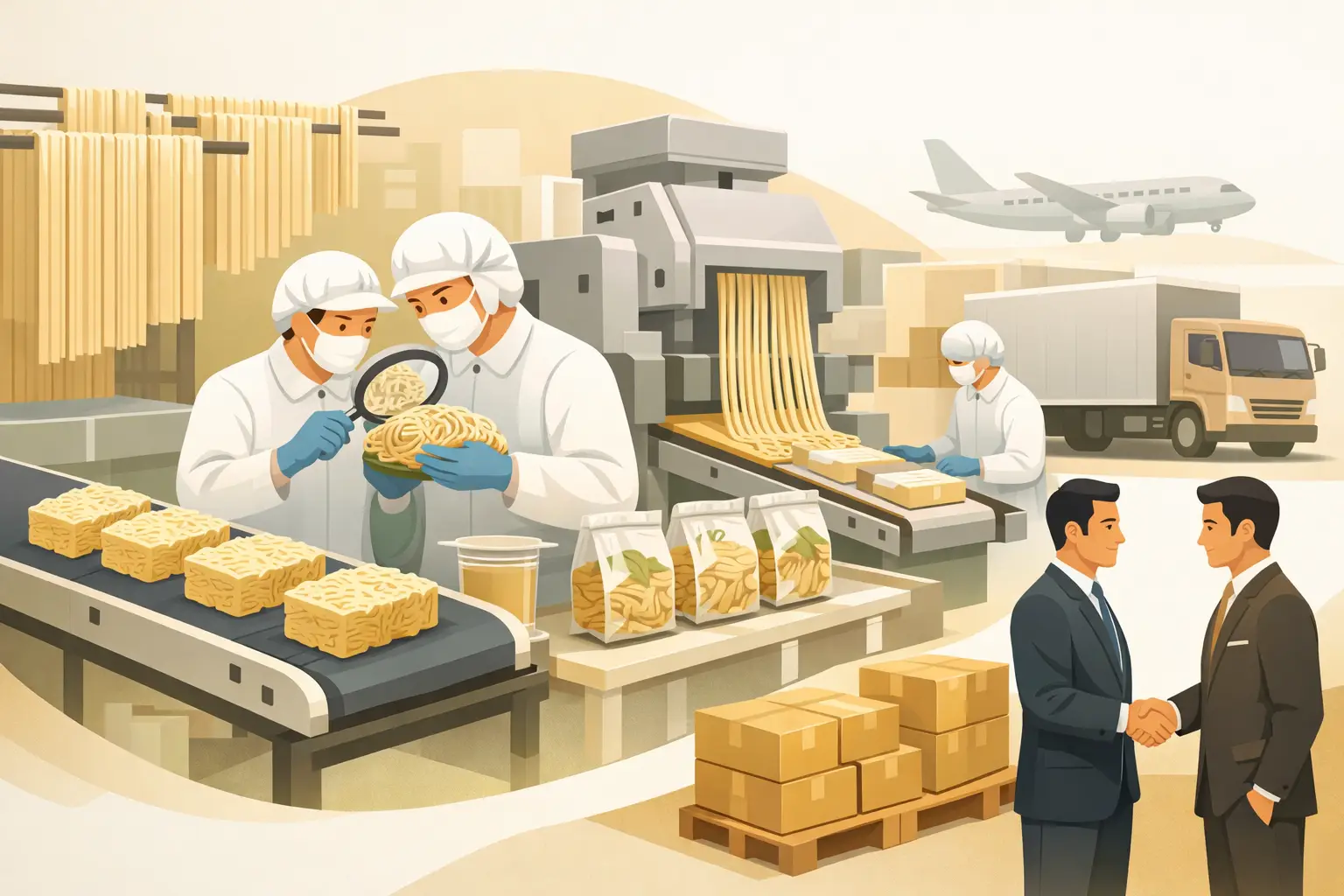
Commercial noodle production supports consistency by controlling variables that are difficult to manage in-house at scale. Raw material selection, dough mixing, sheet formation, cutting precision, drying conditions, and final quality checks all play a role in keeping product performance stable.
This is especially important for dry noodle formats used in foodservice systems. Dry noodles can offer practical storage and distribution benefits, but only if they are manufactured properly. Poorly controlled production can lead to uneven cooking, excess breakage, or inconsistent mouthfeel. Reliable production reduces those risks and gives operators more confidence during service.
For restaurant groups, consistency also affects training. If the noodle behaves as expected, kitchens can standardize prep instructions more easily. That lowers the margin for error without forcing every location to depend on highly specialized labor.
Manufacturing scale also supports menu flexibility
There is a common assumption that scale reduces customization. In practice, capable OEM and ODM production can do the opposite. Once a manufacturer understands the commercial application, the noodle can be developed to support a specific concept rather than forcing the concept to adapt to a generic product.
That may mean developing air-dried noodles for buyers seeking a less oily product profile, adjusting portion sizes for controlled servings, or refining texture for child-friendly noodle concepts. It can also mean aligning packaging for private-label retail, foodservice bulk supply, or mixed-channel distribution.
The trade-off is that customization requires technical alignment. A product that performs well in one menu application may not be ideal for another. A noodle designed for fast cooking may handle broth differently than one designed for longer hold time. This is why product development should start with operational use, not only appearance or price.
For business buyers, the value of a manufacturing partner is not just production volume. It is the ability to translate commercial needs into product specifications that make sense in the real world.
Food safety and certification matter more as restaurants grow
As restaurant operations expand, supplier expectations become stricter. Procurement teams, importers, and chain operators need more than a good sample. They need confidence in process control, documentation, and manufacturing discipline.
This is where certified systems matter. Standards such as ISO 22000, HACCP, GMP, MeSTI, and Halal are relevant because they signal a structured approach to food safety and quality management. For B2B buyers, that reduces sourcing risk and supports smoother onboarding into retail, foodservice, and export channels.
The importance of certification increases further when a product is crossing borders or entering organized distribution. Product quality has to be matched by process credibility. Restaurants and brand owners do not only buy noodles. They buy confidence that the product can be manufactured consistently under controlled conditions.
Why dry noodles remain commercially attractive
Modern restaurants work under constant pressure to balance quality, storage practicality, labor efficiency, and supply continuity. Dry noodles remain attractive because they can fit well into these requirements when the manufacturing quality is right.
They are easier to handle across multiple locations than fresh formats in many cases, and they can support broader distribution models for foodservice groups and export-oriented brands. They also offer room for variation in style, texture, and formulation, which is valuable for private-label development and menu differentiation.
That said, dry noodles are not automatically the right answer for every concept. Some restaurants will prefer fresh or frozen formats based on cuisine style or service expectations. The right choice depends on menu design, kitchen system, logistics, and target market. Commercial manufacturers add value when they help buyers evaluate those trade-offs clearly instead of pushing a one-size-fits-all solution.
The role of commercial partners in restaurant expansion
As brands scale, supply decisions become more strategic. Restaurants need manufacturers that can support product stability, customization, and long-term planning, not just fill purchase orders. A dependable partner can help align noodle development with market positioning, packaging needs, and operational realities.
For example, a foodservice brand entering new territories may need export-ready dry noodles with consistent product documentation and suitable pack formats. A private-label buyer may want house-brand noodles tailored to a specific segment. A distributor may need a portfolio that serves both mainstream and niche demand. These are growth questions, and manufacturing has a direct role in answering them.
This is where an experienced producer such as Tehki Food becomes relevant. A manufacturer with OEM and ODM capability, practical customization options, and established quality systems can support business customers more effectively than a basic contract supplier.
Commercial noodle production is now part of brand strategy
Noodles used to be treated as a back-end procurement item. For many modern restaurants, they are now part of the brand experience and operating model. Texture, consistency, clean-label direction, child-friendly development, and format flexibility all influence how a menu performs in the market.
That means commercial noodle production should be part of early planning, especially for businesses preparing to scale. Waiting until demand increases can limit options and create avoidable pressure on operations. Bringing manufacturing considerations in earlier usually leads to better product fit and fewer compromises later.
The strongest restaurant systems are built on repeatable details. Noodles are one of those details. When production is designed for consistency, safety, and practical customization, restaurants gain more than supply. They gain a product foundation that can support growth with fewer surprises.
A smart noodle program does not start with volume alone. It starts with the question every growing food business should ask: can this product still perform when the brand gets bigger?