

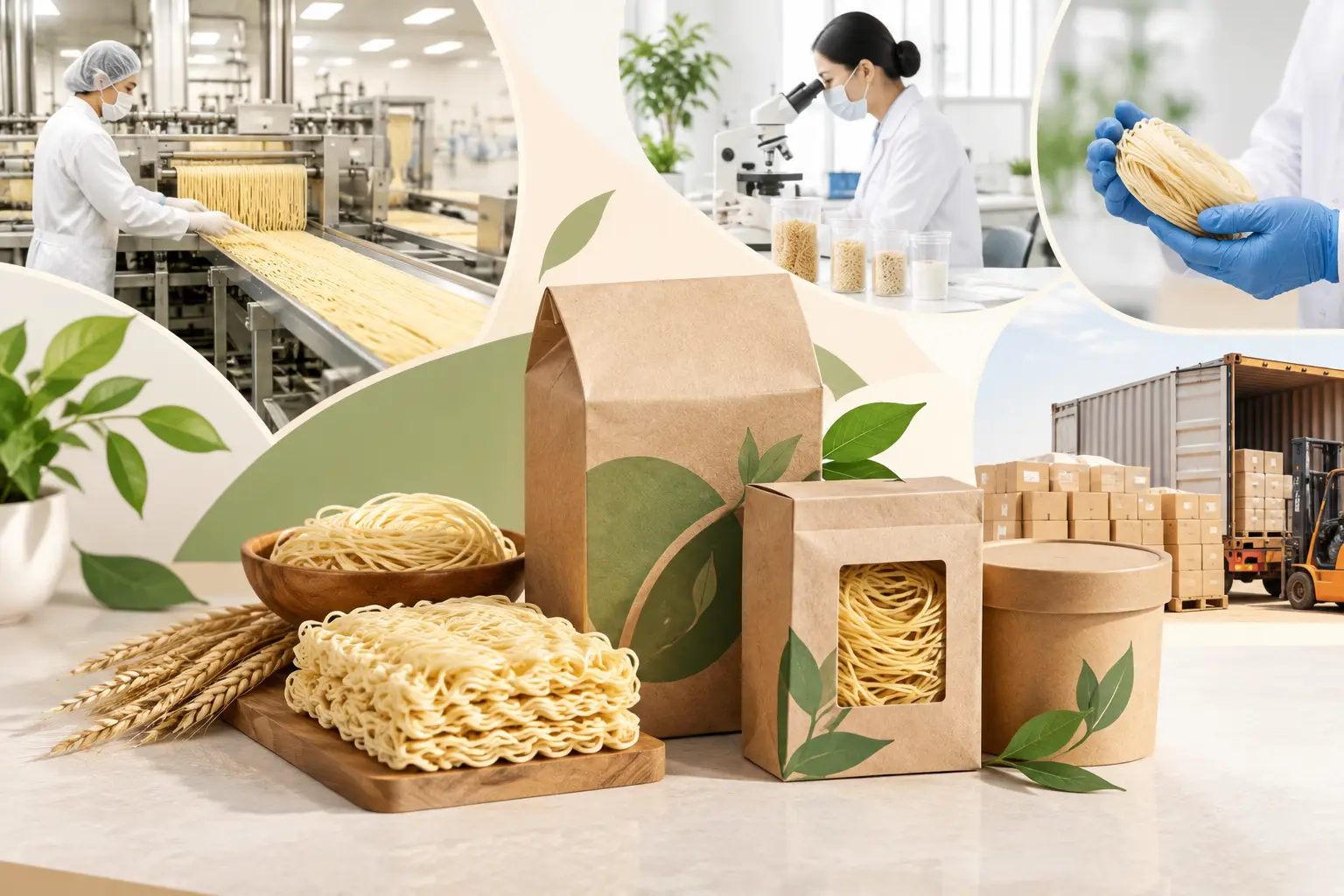
A noodle pack has to do more than look responsible on a retail shelf. It must protect dry noodles from moisture and damage, run reliably on packing equipment, communicate product information clearly, and arrive in marketable condition after distribution. That is why sustainable noodle packaging trends are becoming a product-development issue, not simply a marketing decision, for brand owners and food businesses.
For private-label and OEM noodle programs, the practical question is not which material appears most sustainable in isolation. The question is which packaging system can reduce unnecessary material or improve end-of-use options while preserving product quality, food safety controls, production efficiency, and export suitability.
Sustainable Noodle Packaging Trends Shaping Product Development
The strongest trend is toward packaging decisions based on the full product journey. Buyers are looking beyond a broad claim such as “eco-friendly” and asking more specific questions: How much material is used? Can the pack be recycled where it will be sold? Does the material require special collection? Will it maintain the required barrier performance for dry noodles? Can it be supplied consistently at commercial scale?
This more disciplined approach is especially relevant for noodles. Dry Asian noodles may be relatively lightweight, but their shape can be vulnerable to breakage, and their quality depends on protection from moisture. A package that uses less material but creates excessive product loss, handling damage, or quality complaints may not deliver the intended environmental or commercial benefit.
Material reduction is often the first practical step
Lightweighting remains one of the most accessible packaging strategies. This may involve reducing film gauge, simplifying pack structures, optimizing headspace, or reviewing whether outer packaging is necessary for a particular sales channel. The objective is to use only the material needed to protect the product through warehousing, transport, and retail handling.
For noodle brands, this work requires testing rather than assumptions. A thinner film can affect sealing performance, puncture resistance, print quality, and the appearance of the finished pack. Changes should be assessed alongside pack size, noodle format, carton configuration, and expected distribution conditions.
Right-sizing is equally important. A portion-controlled noodle product, a family-size retail bag, and a foodservice pack have different functional needs. Reducing unused space can improve pallet efficiency and reduce secondary packaging demand, but a very tightly packed format may increase breakage. The best result is usually a balanced specification, not the smallest possible pack.
Mono-material structures are gaining attention
Many conventional flexible packs combine different materials to achieve sealing, strength, and barrier performance. These structures can perform well, but mixed-material formats may be harder to manage in recycling systems. This has increased interest in mono-material or more easily separated structures.
For dry noodle packaging, mono-material options can be promising where the required protection level can be achieved without a complex laminate. However, material compatibility must be evaluated carefully. A pack may perform differently during filling, sealing, carton packing, and distribution than an existing structure. Brand teams should also consider whether recycling collection and processing infrastructure exists in the intended market. A technically recyclable material does not automatically mean it will be recycled in practice.
Paper-based formats are expanding, with clear limits
Paper-forward packaging is often attractive because it gives a natural shelf appearance and can support brand positioning around reduced plastic use. It may work particularly well for outer sleeves, cartons, retail boxes, or certain secondary packaging applications.
Yet paper is not a universal replacement for flexible film. Uncoated paper alone may not offer sufficient protection against moisture, grease, or rough handling. Coatings and liners can improve performance, but they may also affect how the pack is handled after use. For this reason, paper-based noodle packaging should be selected for its real functional fit, not only its visual appeal.
A useful approach is to separate primary and secondary packaging decisions. A paper-based carton may provide branding and structure, while a suitable inner pack protects the noodles. Whether this is the right format depends on the target channel, product value position, shipping distance, and local waste-management context.
Compostable materials require market-specific planning
Compostable packaging receives significant attention, especially from brands seeking alternatives to conventional plastic. Its suitability depends heavily on the intended disposal route. Some compostable materials need controlled processing conditions that may not be available to the end user or in the destination market.
For B2B buyers, the key consideration is whether the product claim, disposal instructions, and packaging performance align with the reality of the market. If collection systems are limited, a compostable pack may not achieve the outcome a brand expects. Material stability, seal integrity, print requirements, and storage conditions also need close review before commercialization.
Packaging Must Still Protect Noodle Quality
Sustainability goals do not remove the core responsibilities of food packaging. Dry noodles need protection against moisture exposure, contamination risks, and physical damage. Packaging also has to support traceability information, clear labeling, and dependable seal quality.
This is particularly important for air-dried noodles, fried noodles, and child-focused noodle formats, where product positioning and pack presentation may differ. Smaller portions can support convenience and portion management, but they may require more packaging per kilogram of product. Larger packs may use less packaging relative to product weight, but they may not suit every retail or foodservice application. There is no single best format across all noodle categories.
Manufacturers and brand owners should assess sustainable packaging alongside the product itself. Noodle length, nest shape, moisture sensitivity, seasoning inclusion, bundle count, and expected handling all affect the most suitable packaging solution. A packaging change that works for one dry noodle type may not be appropriate for another.
Better Packaging Starts With Better Specifications
A clear brief helps prevent sustainability goals from becoming vague or difficult to execute. Before selecting a material, brand teams should define the sales market, pack format, target channel, transportation route, product protection needs, and intended end-of-use message.
It is also useful to establish priorities early. Some businesses may prioritize lower material use. Others may need a format aligned with a retailer’s packaging policy, a premium shelf presentation, or a specific recycling stream. Export-focused brands may place greater emphasis on pack durability and stable supply availability. These priorities can conflict, so decisions should be made transparently rather than expecting one packaging choice to solve every requirement.
Testing should cover more than visual samples. Commercial evaluation may include machine runnability, seal consistency, drop resistance, compression performance in cartons, print legibility, and checks after representative storage and transport conditions. When packaging changes are introduced without this level of review, the risk is transferred downstream to distributors, retailers, and customers.
The Role of Secondary and Transit Packaging
Primary packs receive most of the attention, but outer cartons, dividers, pallet patterns, and stretch-wrap use also shape the packaging footprint. Improved carton sizing can reduce empty space and support more efficient container loading. Stronger carton design may lower the risk of crushed retail packs during handling. In some cases, reducing product damage is as meaningful as reducing a small amount of primary packaging material.
For international distribution, transit packaging deserves particular attention. A noodle product may pass through multiple warehouses, climate conditions, and handling points before reaching its destination. Packaging specifications should reflect the actual route, not only the conditions at the factory.
Communicate Claims With Precision
Packaging sustainability claims should be specific, supportable, and easy for business partners to understand. Broad phrases can create confusion if they do not explain what has changed. A more useful message identifies the practical feature, such as reduced material weight, a paper-based outer carton, or a pack designed around a particular recycling pathway.
Brand owners should also avoid presenting a packaging material as universally better without considering infrastructure and product protection. Transparent communication builds more confidence with retailers, importers, and procurement teams than overstated environmental language.
Build Packaging Into the OEM Process Early
Packaging is most effective when it is considered early in noodle development, alongside formulation, noodle format, portion size, and market positioning. Late-stage packaging changes can affect artwork, packing line settings, carton design, product handling, and launch planning.
As a Malaysian OEM and ODM dry noodle manufacturer, Tehki Food can support business buyers in aligning noodle specifications and packaging requirements from the development stage. This is especially valuable for private-label programs that need a consistent, export-ready product presentation without losing sight of practical manufacturing requirements.
The most useful sustainable packaging choice is the one that fits the noodle, the market, and the supply chain. Start with a clear product brief, test the trade-offs under realistic conditions, and select a format that supports both responsible material use and dependable product delivery.