

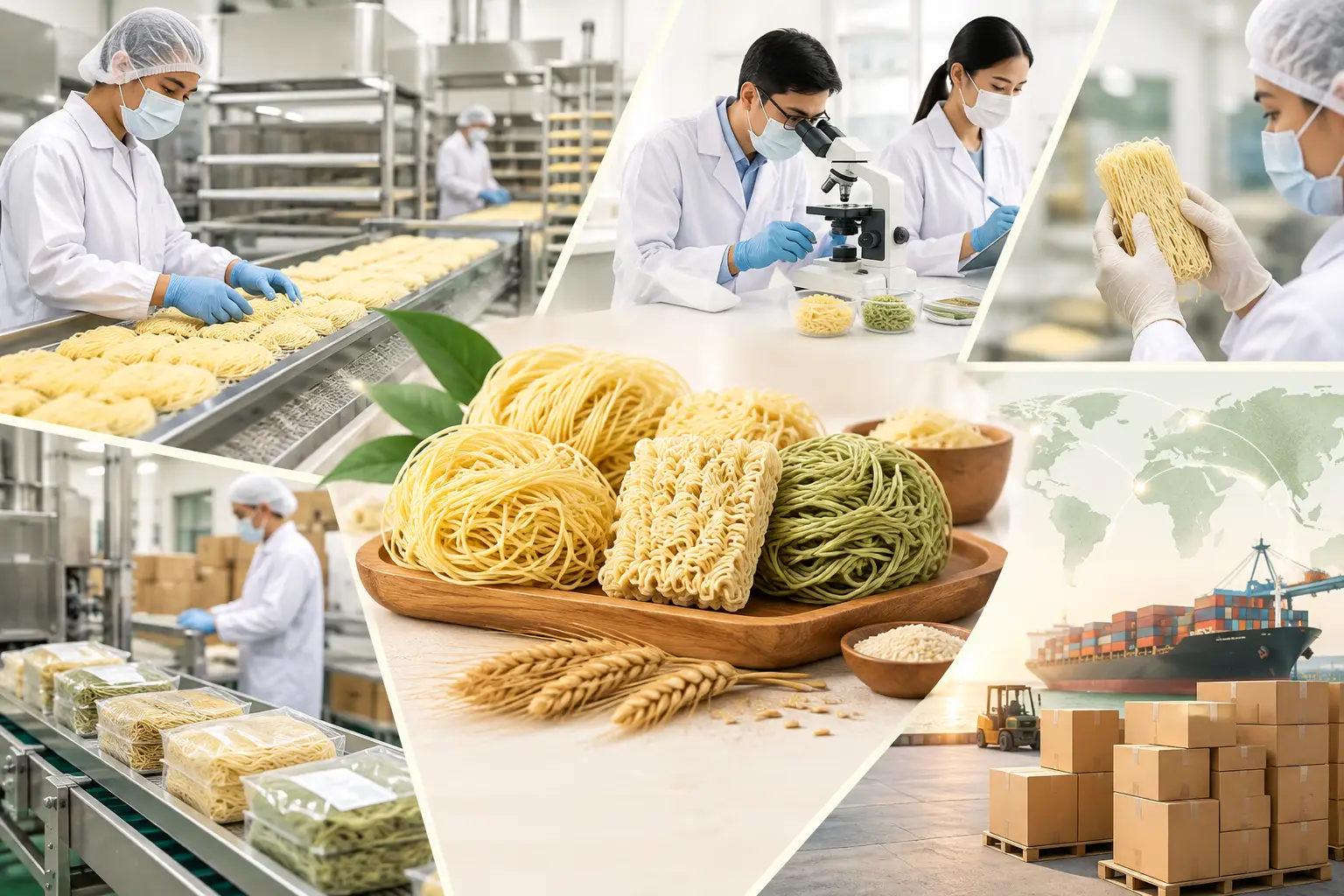
A traditional noodle export supplier bringing authentic Malaysian noodles worldwide does more than fill containers. For brand owners, importers, and foodservice buyers, the real requirement is a noodle program that preserves the expected eating experience while remaining consistent across production runs, packaging formats, and export markets.
Malaysian noodle products have broad commercial appeal because they reflect diverse Asian noodle traditions and work across retail, foodservice, and private-label ranges. Yet authenticity alone is not enough for a successful international launch. Buyers need dependable specifications, documented quality systems, practical customization, and a manufacturing partner that understands how a product must perform after it leaves the factory.
What Buyers Need From a Traditional Noodle Export Supplier
A dry noodle may appear straightforward, but each product decision affects its market fit. Flour selection, noodle thickness, drying method, oil content, portioning, and pack design can change the final texture, cooking behavior, price position, and consumer perception. A supplier must be able to manage these variables without losing control of production consistency.
For importers and distributors, this means receiving the same product characteristics from order to order. For brand owners, it means developing a product that matches a defined category position, whether that is a familiar traditional noodle, a lighter air-dried format, a child-friendly offering, or a customized house-brand line. For foodservice operators, it means noodles that can hold up under real kitchen conditions rather than only in a test sample.
The strongest manufacturing relationships begin with clear commercial and technical alignment. Before development moves forward, the buyer and manufacturer should agree on the intended customer, cooking method, target texture, ingredients, serving size, packaging requirements, and destination-market needs. This early work prevents a common sourcing problem: a noodle that tastes acceptable in isolation but does not fit the final menu, shelf, or brand strategy.
Authentic Malaysian Noodles Need Controlled Manufacturing
Traditional noodle know-how is valuable because texture is central to the product. Some noodle styles are expected to have a firm bite, while others should be softer, springier, or better suited to absorbing soup and sauce. Those differences come from more than a recipe. They depend on disciplined mixing, sheeting, cutting, steaming or frying where applicable, drying, and packing.
Modern manufacturing makes that traditional product knowledge repeatable at scale. Controlled processes help reduce variation in noodle dimensions, moisture management, color, and finished-product integrity. This is particularly important in export programs, where products may move through multiple handling points before reaching the customer.
Dry noodle formats also give businesses flexibility in portfolio planning. Air-dried noodles may support product concepts centered on a less oily preparation format, while fried noodles can serve categories where a particular taste, texture, or preparation style is expected. The right choice depends on the brand position and buyer's market. Neither format is automatically better. The commercial question is which format best meets the intended eating experience, target price range, and channel requirements.
Product Development Should Start With the End Use
A retail noodle pack, a foodservice bulk format, and an infant or toddler noodle product should not be approached as minor variations of the same item. Each has different expectations for portioning, noodle structure, ingredient selection, preparation instructions, and packaging presentation.
For example, a distributor supplying Asian grocery stores may prioritize recognizable noodle styles and efficient replenishment. A retailer developing a private label may need packaging that clearly differentiates the range and supports its own quality standards. A food company may require an ingredient profile or noodle cut designed for use in a larger meal solution. Product development is most effective when these decisions are considered together rather than handed off in stages.
Export Readiness Is Built Into the Product
Export readiness is not simply the ability to ship overseas. It is the ability to manufacture, document, pack, and coordinate a product in a way that supports reliable cross-border trade.
Food safety systems are a central part of that readiness. Certifications such as ISO 22000, HACCP, GMP, MeSTI, and Halal give B2B buyers greater confidence that manufacturing controls are part of the operating system, not an afterthought. Buyers should still review the requirements that apply to their own markets and customers, but recognized quality programs provide a practical foundation for supplier assessment.
Packaging is equally important. It must protect the noodles through handling while presenting the product appropriately for its sales channel. A private-label retail range may need individual packs, multipacks, or a distinctive visual identity. A wholesale or foodservice buyer may prioritize pack configuration and operational convenience. Packaging choices influence freight efficiency, shelf presentation, and the way customers understand the product, so they should be evaluated early in the project.
Clear specifications also matter. A capable supplier can work from agreed requirements for noodle type, ingredients, net weight, pack format, labels, and quality expectations. This creates a shared reference point for procurement teams, product developers, and quality personnel. It also makes future range extensions easier because the process is already established.
Customization Without Losing Commercial Control
Customization is valuable when it solves a real market need. It may involve noodle shape, thickness, texture, ingredients, portion size, packaging, or a complete private-label concept. However, more options do not always create a better product. Every custom decision should have a clear purpose tied to customer preference, menu use, category differentiation, or brand positioning.
The practical balance is to customize what customers will notice and what supports the business case, while using proven manufacturing methods for the rest. A brand might choose a distinct noodle cut and branded packaging while retaining an established dry-noodle production format. Another buyer might need a more tailored formulation because its target channel or product application requires it. The right level of development depends on volume planning, launch objectives, and the degree of differentiation needed.
Tehki Food supports this process as an OEM and ODM manufacturing partner, combining traditional Asian noodle expertise with scalable dry-noodle production. Its range includes air-dried noodles, fried noodles, infant and toddler noodle concepts, and tailored house-brand products. The focus is not only on making noodles to a brief, but on helping B2B customers make choices that remain practical for production and export.
Questions That Improve Supplier Selection
When evaluating a traditional noodle export supplier for Malaysian noodles, buyers should look beyond a product catalog. A productive discussion should cover the supplier's experience with the relevant noodle format, quality certifications, customization boundaries, packaging capabilities, and approach to product development.
It is also useful to ask how the supplier manages consistency when a product moves from sample approval to regular production. This is where manufacturing discipline matters most. A sample can demonstrate potential; controlled production demonstrates whether the supplier can support a brand over time.
Buyers should also be transparent about their route to market. A product intended for premium retail, value retail, Asian specialty stores, institutional foodservice, or meal-kit applications may require different decisions. The more clearly the manufacturer understands the commercial context, the better it can recommend a suitable noodle format and development path.
Building a Noodle Range That Can Travel
Authentic Malaysian noodles can create a meaningful opportunity for businesses expanding Asian food portfolios, but successful export programs are built on operational detail. The noodle must meet the intended texture and format. The factory must maintain consistent controls. The packaging must fit the channel. The development process must leave room for brand distinction without creating unnecessary complexity.
For buyers, the most useful next step is to define the product's end use before requesting a quotation or sample. A concise brief covering noodle style, target customer, desired preparation, pack format, and destination market gives a manufacturing partner the information needed to turn a traditional noodle concept into a dependable export-ready product.