
A procurement team may begin with a simple search: “what is private label noodles?” The commercial answer is straightforward. Private label noodles are noodle products manufactured by one company and sold under another company’s brand. The brand owner controls the market position, packaging, and customer relationship, while the manufacturing partner produces the noodles to an agreed specification.
For food brands, importers, distributors, and foodservice buyers, private labeling is not simply a packaging exercise. It is a way to build a differentiated noodle range without investing in a factory, production equipment, food safety systems, or an internal technical team. The value depends on how well the product specification, manufacturing capability, quality controls, and target market requirements fit together.
What Are Private Label Noodles?
Private label noodles are dry noodle products made for a customer’s own brand. The customer may select an existing noodle format from a manufacturer’s established range, customize certain product elements, or develop a more distinctive product through an OEM or ODM program.
The finished product carries the customer’s branding rather than the manufacturer’s consumer-facing name. It may be sold through retail stores, e-commerce channels, wholesale networks, foodservice supply chains, or export markets. Formats can include air-dried noodles, fried noodles, traditional Asian noodle styles, portioned noodle blocks, and child-friendly noodle concepts.
The arrangement gives the brand owner a practical division of responsibilities. The brand owner typically defines the commercial brief: intended customer, product positioning, sales channel, packaging direction, price architecture, and target market. The manufacturer translates that brief into a product that can be made consistently at scale.
That distinction matters. A noodle product can look attractive on a package yet fail commercially if its texture varies between batches, its cooking performance does not suit the intended use, or its packaging is impractical for distribution. Private label manufacturing should address the product system, not just the brand design.
Private Label, OEM, and ODM: The Practical Difference
These terms are often used together, but they describe different levels of customer involvement.
Private label refers to the commercial model: noodles are sold under the buyer’s brand. OEM, or original equipment manufacturing, generally means the buyer provides a defined product concept or specification and the manufacturer produces it. For example, a brand may request a specified noodle shape, pack format, ingredient direction, and cooking profile for its own retail range.
ODM, or original design manufacturing, involves more development support from the manufacturer. The manufacturer may help shape the noodle concept, recommend a suitable format, refine the formula, and guide the product toward manufacturability. This can be useful for a buyer entering a new category or adapting an existing line for a different market.
In practice, many projects sit between these categories. A customer may start with an established air-dried noodle platform, then customize portion size, packaging, noodle thickness, or ingredient preferences. That is often more efficient than building an entirely new product from the ground up, especially when speed, consistency, and manageable development risk matter.
Why Businesses Choose a Private Label Noodle Program
Private label noodles allow businesses to create a product range aligned with their own channel and customer strategy. A retailer may need an accessible everyday noodle line. A distributor may want products suited to a regional export market. A foodservice supplier may need noodles that perform reliably in a kitchen setting. Each use case calls for different decisions.
The main advantage is focus. Rather than operating a manufacturing facility, the brand owner can concentrate on category planning, distribution, sales, packaging, and customer demand. The manufacturing partner handles raw material control, process management, production planning, and product consistency.
Private labeling also creates room for product differentiation. That may come from a recognizable Asian noodle style, an air-dried format, a clean-label direction, a child-oriented concept, a convenient portion format, or packaging designed for a specific retail channel. Differentiation does not always require an unusual formula. Sometimes a well-executed, dependable product is the stronger commercial choice.
There are trade-offs. Greater customization can require more development work and more careful planning. Using an established manufacturing platform may limit certain design choices, but it can reduce technical uncertainty. The right path depends on the buyer’s brand objectives, forecast confidence, available resources, and need for distinction.
What Can Be Customized in Private Label Noodles?
A capable manufacturer can help buyers make decisions across both the noodle itself and the finished retail or foodservice product. Customization should begin with the intended eating experience and business application, not with visual packaging alone.
Noodle characteristics may include type, thickness, width, length, shape, color, texture, and cooking behavior. The manufacturing approach also matters. Air-dried noodles and fried noodles have different product characteristics and may suit different market positions. A buyer should be clear about whether the product is intended for quick preparation, soup applications, stir-fry use, meal kits, or another format.
Ingredient direction is another consideration. Some brands want a simple, familiar ingredient approach, while others are developing products for specific consumer preferences or age groups. Child-friendly and infant or toddler noodle concepts require especially careful attention to product design, ingredients, texture, and responsible positioning. Product claims should always be reviewed carefully and supported appropriately.
Packaging can be customized through pack size, portion count, bag format, carton configuration, labeling content, and brand presentation. These decisions affect shelf appearance, transport efficiency, handling, and the suitability of the product for retail, wholesale, or foodservice channels. A strong private label project considers all of these factors early, before artwork and production are finalized.
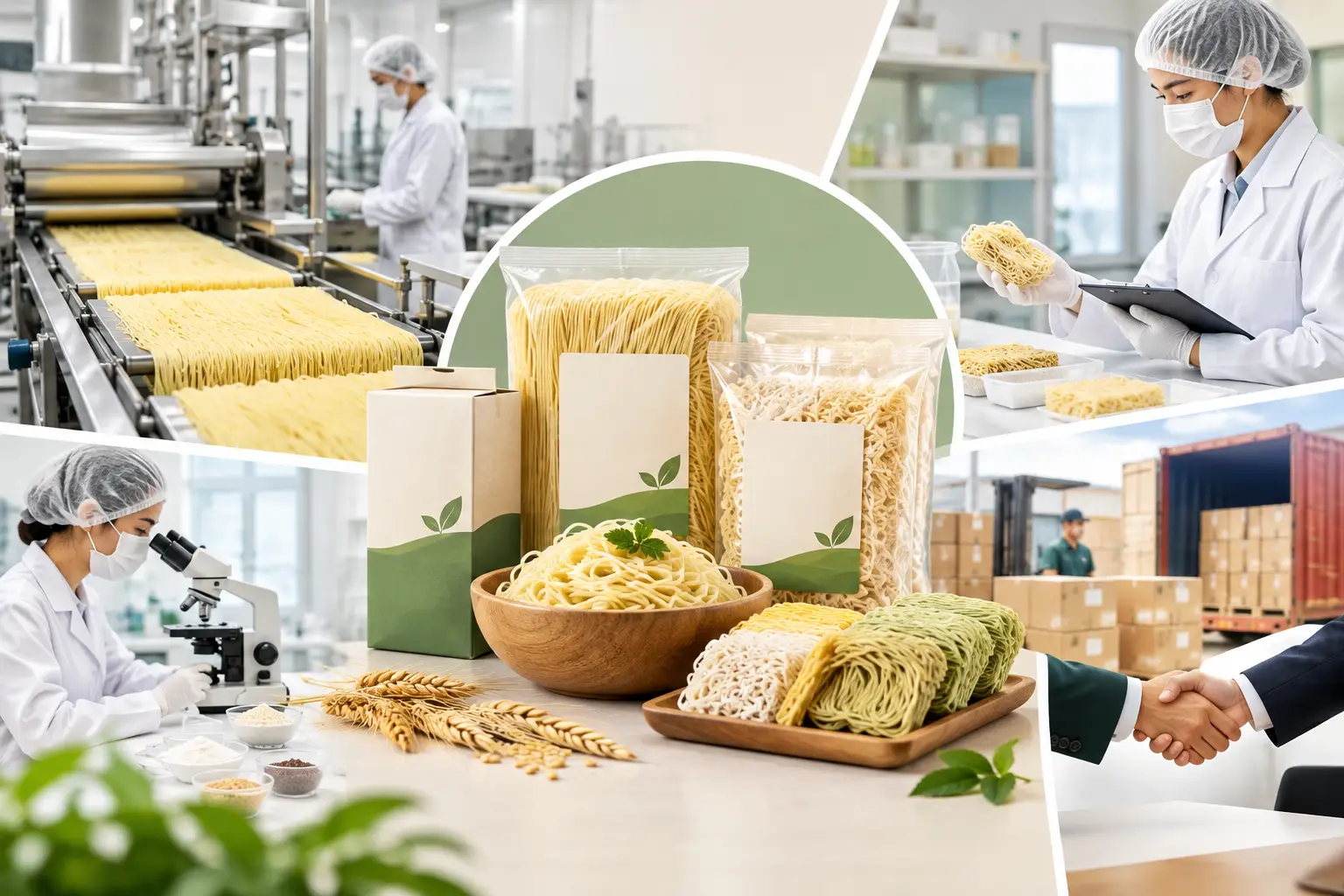
How the Manufacturing Process Typically Works
A private label noodle project usually starts with a clear product brief. The buyer should identify the target market, preferred noodle style, intended use, packaging format, and level of customization required. If the product will be exported, market-specific labeling and documentation expectations should be discussed from the start.
The manufacturer then reviews whether the concept is technically and commercially feasible. This includes the suitability of ingredients, noodle format, processing method, packaging, and quality requirements. Early conversations are valuable because a good manufacturer can identify where a concept needs refinement before resources are committed to artwork or launch planning.
Product development may involve samples, evaluation, and adjustments to the agreed specification. The goal is not merely to create a sample that tastes acceptable. It is to establish a product that can be reproduced consistently under normal manufacturing conditions.
Once the specification is confirmed, production moves into controlled manufacturing. Reliable partners use documented processes, traceable raw material management, hygiene practices, and quality checks to support batch-to-batch consistency. Packaging and finished-product handling must also be managed carefully because the product needs to arrive in market in suitable condition.
What to Assess Before Choosing a Noodle Manufacturer
The best private label partner is not necessarily the one offering the broadest list of options. It is the one that can reliably make the product you need and communicate clearly throughout development and production.
Start with product capability. Ask whether the manufacturer has experience with the noodle type, drying method, packaging format, and customization level you require. A manufacturer experienced in dry Asian noodles will understand that texture, cooking performance, moisture control, and handling are closely connected.
Then assess quality systems. Food safety certifications and documented manufacturing controls provide a more reliable foundation than informal assurances. For buyers serving markets where Halal compliance is relevant, certified capability can also be an important sourcing consideration. Export-oriented buyers should also confirm that the manufacturer is familiar with the practical documentation and packaging discipline needed for cross-border supply.
Communication is equally important. Product development often involves choices that affect cost, consistency, appearance, and timing. A dependable manufacturing partner explains these trade-offs directly instead of promising every option without technical review.
Tehki Food, a Malaysia-based OEM and ODM dry noodle manufacturer, supports private label programs with established food safety systems, Halal certification, and experience across air-dried, fried, and customized Asian noodle formats. For a buyer, the useful question is not whether a manufacturer can make noodles. It is whether that manufacturer can help turn a market brief into a stable, scalable product.
Build the Brief Before Building the Brand
Private label noodles work best when the brand concept and manufacturing plan are developed together. Before approaching a manufacturer, define who will buy the product, where it will be sold, how it will be prepared, and what will make it credible in that channel. Bring those answers into the first product discussion.
A clear brief gives the manufacturer the information needed to recommend the right noodle format, level of customization, and quality approach. That is how a private label noodle idea becomes a product that is practical to produce, dependable to supply, and ready to support long-term brand growth.