
A noodle product can look straightforward on paper, but sourcing it at commercial scale is rarely simple. If you are evaluating what to look for in noodle supplier selection, the real question is not just who can make noodles. It is who can make the right noodles consistently, safely, and in a format that supports your market, brand, and operations.
For importers, brand owners, distributors, and foodservice buyers, the wrong manufacturing partner creates problems that show up fast - inconsistent texture, packaging issues, uneven quality, poor communication, or products that are difficult to scale. The right supplier helps reduce those risks while giving you room to build a stronger product line.
What to look for in a noodle supplier first
The first filter should be manufacturing credibility. A supplier may offer an attractive product sample, but sample quality alone does not tell you how well that product performs across repeated production runs. In B2B sourcing, consistency matters as much as the initial product impression.
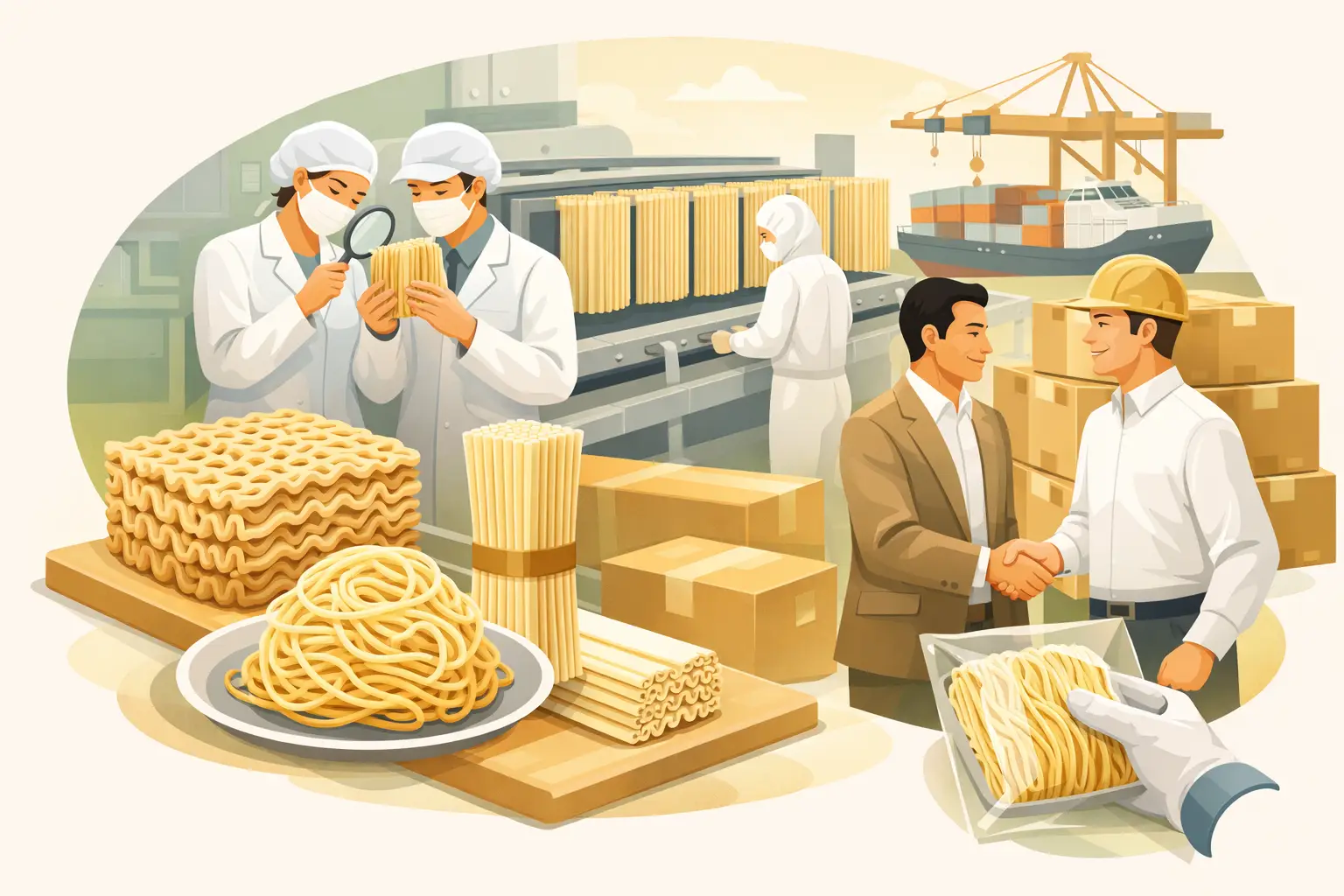
A capable noodle supplier should be able to explain its production process clearly, from raw material handling to drying, frying if applicable, packing, and quality checks. You want evidence that quality is built into the process, not inspected in at the end. That usually means structured production controls, documented procedures, and a practical understanding of how noodle texture, moisture, ingredient balance, and pack format affect commercial performance.
Food safety certification is part of this first review, not a secondary detail. Certifications such as ISO 22000, HACCP, GMP, MeSTI, and Halal can help indicate that the manufacturer operates within recognized quality and food safety systems. For buyers serving multiple markets or formal retail channels, this becomes even more important because your supplier's standards directly affect your own brand credibility.
Product consistency matters more than a good first sample
One common sourcing mistake is choosing a supplier based mainly on a promising sample run. Samples are useful, but they do not always reflect normal production conditions. A better question is whether the supplier can keep the same noodle quality over time when volumes increase, ingredients fluctuate, or pack formats change.
Consistency covers several practical points. Noodle thickness, color, cooking behavior, bite, and breakage rate should remain stable within reasonable tolerances. Packaging should also be dependable, especially if your product is going into retail, export distribution, or foodservice channels where presentation and handling matter.
This is where manufacturing experience shows. Suppliers that understand dry Asian noodle production in depth are generally better at managing texture targets, formulation adjustments, and product stability across batches. That matters whether you are buying standard noodles or developing a private-label range with specific product requirements.
A strong noodle supplier should support customization
Not every buyer needs a fully custom product, but many do need more than an off-the-shelf format. If your business is building a brand, targeting a niche category, or adapting to a market requirement, flexibility becomes a major factor.
A good supplier should be able to discuss customization in practical terms. That may include noodle type, size, shape, texture, ingredient profile, portion format, and packaging presentation. For some buyers, the priority is creating a house-brand noodle product with clear differentiation. For others, it may be adapting an existing format to better fit foodservice operations or importer requirements.
The key is whether the supplier can balance customization with production discipline. Too little flexibility limits your commercial options. Too much without proper process control can affect consistency. The best manufacturing partners understand where customization adds value and where standardization protects quality and efficiency.
Technical understanding is a commercial advantage
When buyers compare suppliers, price often gets attention early. That is understandable, but technical capability usually has a bigger impact over time. A manufacturer with strong technical knowledge can help prevent product mismatch, improve manufacturability, and reduce costly trial-and-error.
For example, an air-dried noodle and a fried noodle may serve different market positions, cost structures, and eating preferences. Infant and toddler noodle concepts require extra care in formulation, size, and product suitability. Export-oriented products may need more attention to packing format, labeling coordination, and specification control. These are not just product details. They affect commercial success.
A supplier that asks the right questions is usually a better partner. They should want to understand your target market, channel, consumer position, desired texture, preparation method, and brand direction. If the discussion stays at a basic catalog level, you may not get the support needed for long-term product development.
What to look for in noodle supplier communication and support
Communication is often underestimated during supplier selection. In practice, it shapes timelines, product decisions, and issue resolution. Even a technically capable manufacturer can become difficult to work with if communication is slow, unclear, or too reactive.
Strong suppliers communicate in a way that supports business decisions. That means clear answers on product specifications, manufacturing capability, documentation, testing, and packaging options. It also means being realistic. A dependable partner should explain trade-offs when needed, such as when a certain texture target may affect breakage, or when a packaging preference may need operational adjustment.
This kind of communication builds trust because it helps buyers make informed decisions rather than optimistic assumptions. For B2B customers launching or expanding a noodle line, that practical honesty is valuable.
Export readiness is not optional for many buyers
If you serve international markets, export readiness should be part of supplier evaluation from the start. Some manufacturers can produce acceptable noodles but are less prepared for the documentation, packing discipline, and quality consistency expected in cross-border trade.
Export-ready supply usually involves more than product quality. It also depends on organized documentation, traceability, labeling coordination, packaging reliability, and familiarity with working with overseas buyers. A supplier based in Malaysia, for example, may offer practical advantages for businesses looking for Asian noodle manufacturing with regional sourcing knowledge and export experience.
This is especially relevant for importers, distributors, and private-label brand owners who need stable support rather than one-time supply. Export capability should be viewed as part of operational readiness, not just logistics.
The best supplier is a manufacturing partner, not just a vendor
A transactional supplier fills orders. A manufacturing partner helps you build a product range that can grow. That difference matters when you are planning a private-label launch, extending into new categories, or refining a product after market feedback.
Partnership is visible in how the supplier handles development. Do they understand how to translate a concept into a manufacturable noodle product? Can they advise on suitable formats for retail, distribution, or foodservice use? Are they able to support both standard products and tailored solutions without losing control of quality?
For many B2B buyers, this is the deciding factor. A dependable OEM or ODM noodle manufacturer should not only make the product. They should help reduce uncertainty around product development, quality expectations, and scaling.
Tehki Food operates in this space with a manufacturing-first approach, supporting business buyers who need dry Asian noodle products that are practical to scale, customize, and position for local or export markets.
How to assess a supplier before committing
A useful evaluation process combines documentation review, product testing, and direct discussion. Ask for certifications, product specifications, and an explanation of manufacturing controls. Review samples, but also ask how consistency is managed from batch to batch. If you need customization, discuss what can be adjusted and how those changes are validated.
It also helps to assess how well the supplier understands your business model. A foodservice operator may need different support than a retail brand owner. An importer may prioritize documentation and stable specifications, while a distributor may focus on product range and market fit. The right supplier does not give the same answer to every buyer. They adapt their support to the commercial context.
That is often the clearest sign you are dealing with an experienced manufacturer. They understand that noodle sourcing is not only about making a product. It is about supporting a business case.
Choosing a noodle supplier is really choosing how much risk, flexibility, and support you want built into your supply chain. The better partner is usually the one that combines reliable systems with practical product understanding - and makes your next launch or expansion feel more manageable, not more uncertain.