
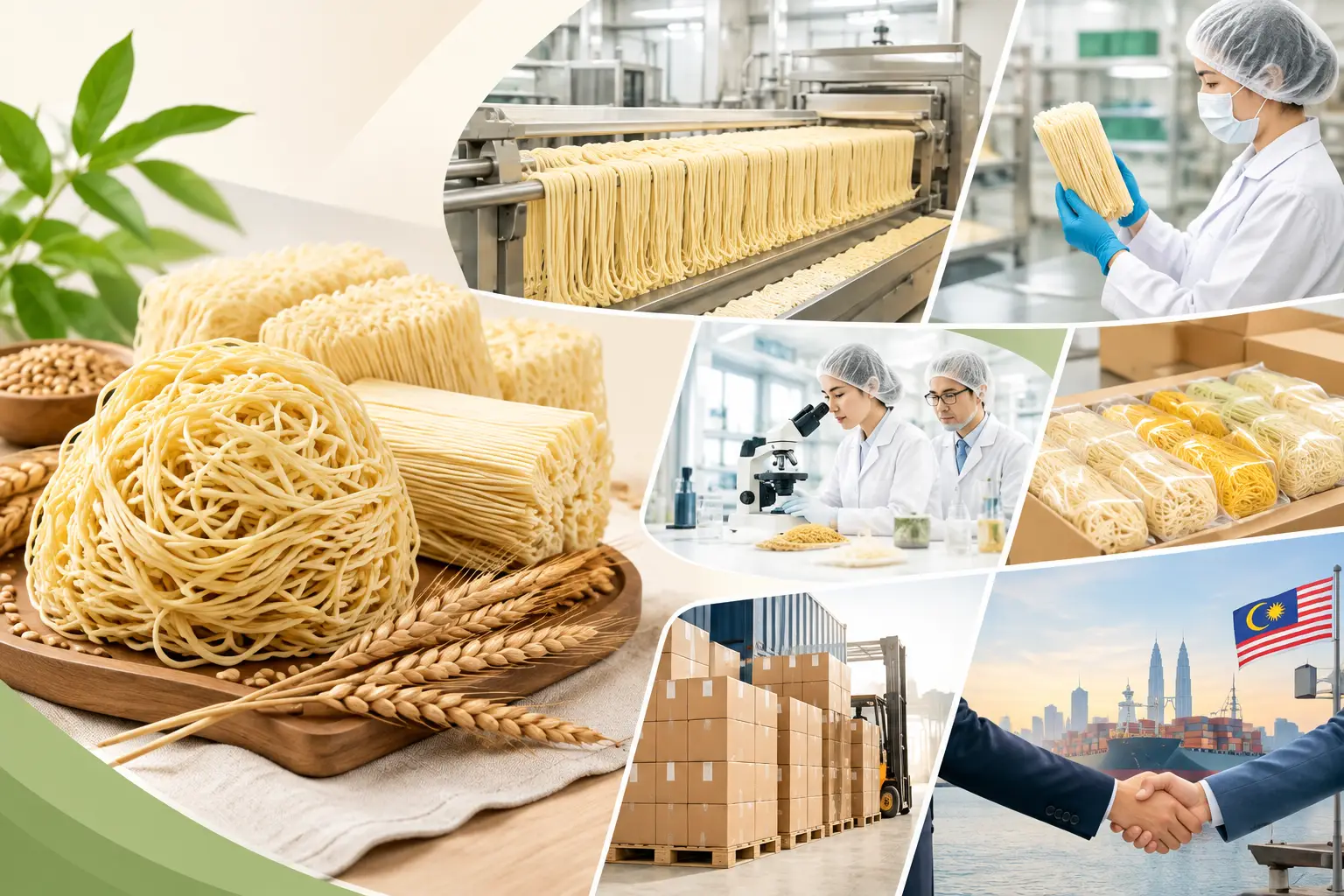
A noodle launch can look straightforward on a product brief, then become difficult when texture changes between batches, packaging does not suit the distribution channel, or a supplier cannot support the documentation your market requires. That is why choosing a Malaysian dry noodle manufacturer for your food business is not simply a sourcing decision. It is a decision about product consistency, development capability, and the reliability of your supply chain.
For brand owners, importers, distributors, and foodservice buyers, Malaysia offers a practical base for dry Asian noodle production. The right manufacturing partner can combine familiarity with regional noodle traditions and disciplined modern production systems, while helping you shape a product that fits your customer, price position, and route to market.
Why choose a Malaysian dry noodle manufacturer for your food business?
Malaysia sits within a region where Asian noodles are not treated as a generic commodity. Different formats have distinct expectations for bite, thickness, cooking behavior, flavor compatibility, and presentation. A manufacturer with hands-on experience in dry noodle production can translate those expectations into repeatable specifications rather than relying on a one-size-fits-all product.
This matters when your business needs more than a standard noodle block. You may be building a retail private-label range, supplying portion-controlled noodles for foodservice, developing a child-friendly product, or adding an air-dried option to a better-positioned portfolio. Each application calls for decisions about noodle style, ingredients, drying or frying method, portion size, and pack format.
A Malaysian manufacturer can be especially relevant when the product needs to retain an Asian noodle identity while meeting the commercial requirements of international distribution. The advantage is not geography alone. It is the combination of regional product knowledge, export-oriented manufacturing experience, and the ability to work from a clear customer brief.
Product development should start with the market, not the machine
The most useful manufacturing relationship begins with the end use. A retail brand may need a product that stands out through clean-label positioning, a specific noodle texture, or a convenient serving format. A distributor may need a dependable core range that can work across multiple customer accounts. A foodservice operator may prioritize portion consistency, preparation performance, and compatibility with a menu concept.
Those needs affect the product from the start. Noodle width, thickness, shape, flour selection, drying process, seasoning compatibility, and packaging are connected choices. Changing one can affect another. For example, a thinner noodle may cook differently from a wider flat noodle, while an air-dried format may require a different approach to texture and preparation than a fried noodle.
An OEM or ODM manufacturer should be able to discuss these trade-offs early. OEM production is appropriate when you have a defined product specification and need reliable execution under your brand. ODM is more useful when you have a market direction but need development input on the noodle format, formulation, or packaging concept. Both models can support private-label growth, but they require clear alignment on what is fixed and where development flexibility is needed.
Tehki Food supports this process with dry Asian noodle formats including air-dried noodles, fried noodles, infant and toddler noodle concepts, and customized house-brand products. The practical value is the ability to develop around a commercial brief rather than forcing every customer into the same stock format.
Consistency protects your brand after launch
For a buyer, a noodle product is only as strong as its repeatability. A promising sample is not enough if the finished product varies in appearance, texture, portion weight, or cooking performance at commercial scale. Consumers may not know who manufactured the noodles, but they will associate every experience with the brand on the package.
This is where a structured manufacturing system matters. Reliable suppliers use defined raw-material controls, production procedures, in-process checks, and finished-product standards to manage variation. They also understand that quality is broader than visual appearance. It includes handling characteristics, pack integrity, traceability, and the ability to reproduce the agreed product specification over time.
When evaluating a Malaysian dry noodle manufacturer, ask how specifications are documented and managed. Request clarity on the agreed noodle dimensions, ingredients, pack configuration, labeling responsibilities, and quality checkpoints. The goal is not to create unnecessary paperwork. It is to prevent assumptions from becoming costly issues after a product reaches distribution.
Food safety credentials support buyer confidence
Food safety systems are a central part of supplier selection, particularly for businesses serving multiple markets or supplying organized retail and institutional customers. Certifications do not replace buyer due diligence, but they provide evidence that the manufacturer operates within recognized quality and food safety frameworks.
Look for relevant systems such as ISO 22000, HACCP, GMP, and MeSTI, along with Halal certification where it is required for your target customers or market. These credentials should be considered alongside practical questions about facility controls, traceability procedures, allergen management, document support, and communication during product development.
The right partner will be prepared to discuss its quality approach in business terms. That means explaining how the production environment supports the product you are sourcing, not simply listing certificates. For an importer or brand owner, that transparency can make internal approval and supplier onboarding more efficient.
Air-dried and fried noodles serve different business strategies
Dry noodles are not a single category, and the production method should match your portfolio plan. Fried noodles are widely recognized in convenient noodle formats and may suit product concepts where familiar preparation and sensory expectations are central. Air-dried noodles can be relevant for brands seeking a less oil-focused format or a cleaner product positioning, depending on the complete formulation and claims strategy.
Neither option is automatically better. The right choice depends on your target customer, desired eating experience, intended price tier, and distribution channel. A premium retail concept may benefit from an air-dried format and carefully selected ingredients. A high-volume foodservice or value-focused line may have different priorities. The important point is to assess the total product proposition rather than choosing a process based on a trend alone.
A capable manufacturer can help compare formats realistically, including how each choice affects noodle texture, packaging options, preparation instructions, and overall positioning. That discussion should be grounded in your market plan, not broad consumer claims.
Customization creates room for a defensible private label
Private-label noodles compete most effectively when they have a clear reason to exist. That reason may be an authentic regional noodle style, a distinctive texture, a family-oriented format, a child-friendly concept, convenient portions, or packaging designed for a specific retail or foodservice channel.
Customization does not always require an entirely new product. Small, deliberate changes can create a more relevant offer: a different noodle cut, adjusted portioning, selected ingredients, or a package format that suits your brand architecture. The manufacturer’s role is to help identify which changes are practical to produce consistently and which may create unnecessary complexity.
For child-focused noodle concepts, the discussion should be especially careful. Product shape, portion size, ingredient selection, and preparation instructions should be developed responsibly for the intended market. Claims and labeling must be reviewed against the requirements of the markets where the product will be sold.
Export readiness reduces friction across markets
An export-ready noodle product requires more than a product that travels well. It requires a manufacturer that understands the operational side of international B2B supply: clear specifications, appropriate packaging, traceable production, responsive documentation, and communication that supports buyers across different markets.
Malaysia can be a practical manufacturing location for companies serving regional and international demand, but suitability still depends on your destination market and channel. Import requirements, labeling rules, language needs, case configuration, and retailer standards vary. A good manufacturing partner will work with your team to define responsibilities early rather than treating export requirements as an afterthought.
This is particularly valuable for businesses managing several markets. A standardized base product with market-specific packaging may be more manageable than maintaining completely separate product lines. In other cases, a localized noodle style or pack size may be necessary. The best approach depends on the scale of the opportunity and the level of differentiation each market needs.
Choose a partner that can grow with the brief
The lowest quoted unit cost is not always the lowest business cost. If a manufacturer cannot maintain quality, communicate clearly, support customization, or handle changing requirements, the hidden cost can appear in rework, delayed launches, customer complaints, and lost confidence in your brand.
A stronger selection process considers manufacturing capability alongside commercial fit. Review the supplier’s experience with your noodle category, food safety systems, private-label process, packaging capability, and willingness to work through technical details. Pay attention to how they respond to questions. Clear, practical answers during development are often a useful sign of how the relationship will function after launch.
For food businesses building a dry noodle line, the most productive next step is to turn the idea into a focused brief: who the product serves, how it will be sold, which noodle characteristics matter, and what documentation your market expects. That clarity gives a capable Malaysian manufacturing partner the foundation to create a product that is not only appealing at launch, but manageable to grow.